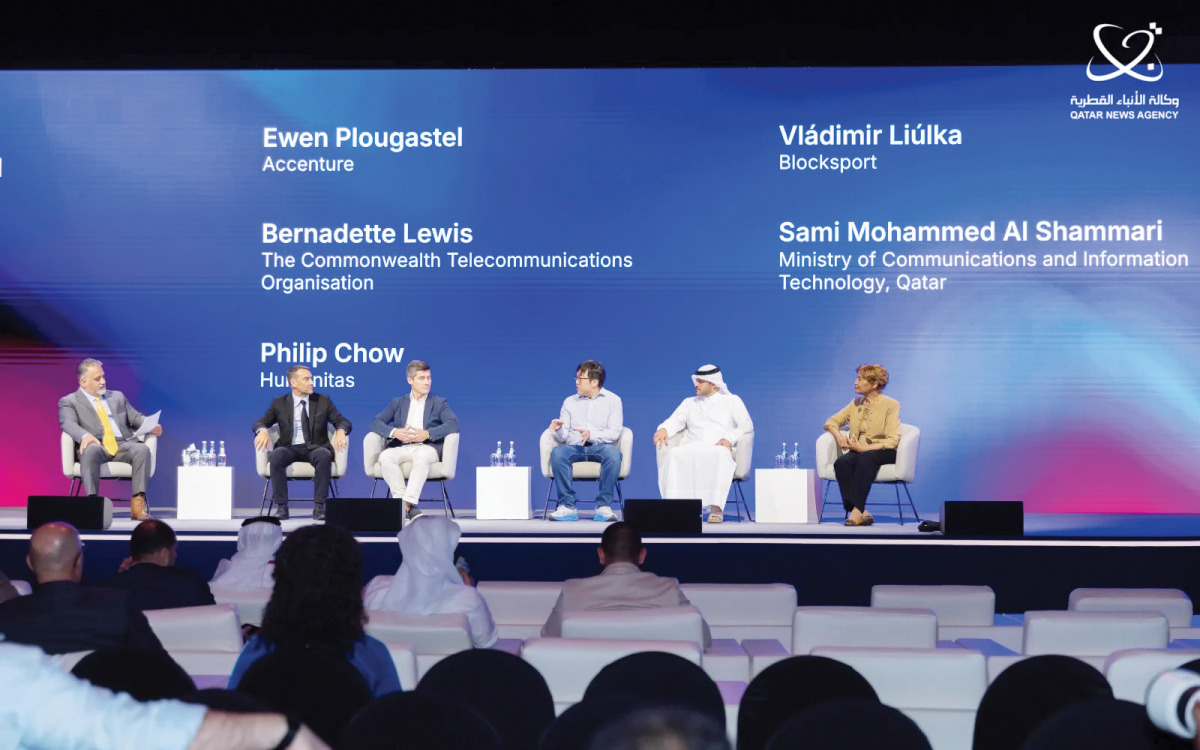
MCIT Assistant Undersecretary for Infrastructure and Operations Affairs Sami Mohammed Al Shammari with other industry leaders during the panel session at MWC26 Doha.
Doha, Qatar: International experts in telecommunications technology and artificial intelligence have emphasized that building integrated AI ecosystems requires moving beyond a reliance on isolated solutions developed independently by individual entities, and instead shifting toward the development of shared capabilities that can be utilised and leveraged across government institutions.
This took place during a panel discussion at the MWC26 Doha conference, which focused on the future of interactive AI.
The session was attended by international AI experts, leaders from the telecommunications and technology sectors, representatives from major global corporations, as well as investors and innovators from the region and beyond, including Head of ‘Quotient’ (Oliver Wyman’s global AI division) Jad Haddad and Regional General Manager of Google Cloud in Qatar Ghassan Kosta.
During the session, Assistant Undersecretary for Infrastructure and Operations Affairs at the Ministry of Communications and Information Technology (MCIT) Sami Mohammed Al Shammari emphasised that the use of AI in national planning marks a new phase in the development of government operations, shifting from traditional analytical models to intelligent tools that facilitate faster and higher-quality decision-making.
He indicated that the success of this digital transformation depends on the presence of an appropriate regulatory and technical environment, effective partnerships between institutions, and investment in infrastructure and human capabilities, all of which ensure that innovation in AI is translated into sustainable economic and institutional value.
For her part, Director of Digital Innovation at MCIT Eman Ahmed Al Kuwari affirmed that the State of Qatar is moving toward an advanced stage in the deployment of AI technologies.
This transition involves shifting from the use of smart applications, which currently serve as tools for assistance and information provision, to the development of systems capable of executing tasks, interacting with users, and delivering services, thereby enhancing the efficiency of government operations and elevating the experience of citizens and residents alike