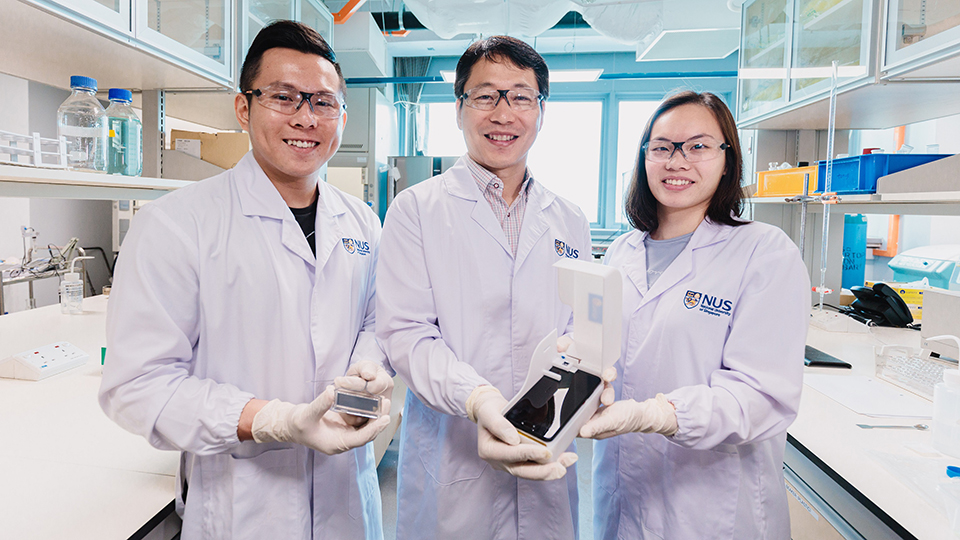
The NUS research team behind the novel algae detection device is led by Assistant Professor Bae Sung Woo (centre) who is holding the smartphone platform. With him are two team members: Mr Thio Si Kuan (left) who is holding the microfluidic chip, and Miss
Singapore - A team of engineers from the National University of Singapore (NUS) has developed an easy-to-use, portable system that makes use of a smartphone to detect the presence of toxin-producing algae in water within 15 minutes.
This invention can generate test results on-site, and findings can be reported in real-time using the smartphone's wireless communications capabilities.
This technological breakthrough could play a big role in preventing the spread of harmful microorganisms in aquatic environments, which could threaten global public health and cause environmental problems.
It costs less than S$300, far cheaper than conventional methods which can range from $3,000 to $100,000.
Shortening the interval between collecting water samples and analysis will enable preventive action to be taken earlier to nip potential algae blooms in the bud, said Assistant Professor Bae Sung-woo, who is from the NUS engineering faculty's Civil and Environmental Engineering department.
"By the time you get the results of the analysis a week later, the fact is the water in the sea is no longer the water you collected. It might be too late," said Prof Bae during a media demonstration of the new portable system at NUS.
"Our device can be used to detect algae in water bodies any time and anywhere, and before the algae are visible to the naked eye. It will be particularly useful in helping fish farmers to take early action."
Prof Bae said the smartphone system has an accuracy rate of 90 per cent, comparable to a standard cell-counting technique using an instrument called a hemocytometer