Doha: Huge demand pressure, increased production costs and power mix substitution are expected to drive gas prices up, the ‘Global Gas Outlook’ presented by Doha-headquartered Gas Exporting Countries Forum (GECF) noted in Vienna on Friday. Rapidly growing regions in Southeast Asia and India will remain the engines for energy demand. GECF’s global gas outlook projects the global gas trade to grow by 38.6 percent by 2040.
Natural gas consumption will benefit from a policy push towards clean sources of energy, especially with the implementation of new or reinforced emission standards. Natural gas will be supported as a flexible option to support renewables.
In his presentation of ‘2018 Global Gas Outlook’ at the GECF Conference in Vienna, Dmitry Sokolov, Head of Energy Economics and Forecasting Department Gas Exporting Countries Forum (GECF), said natural gas in the global energy mix is expected to increase from the 22 percent now to 26 percent by 2040. Global natural gas demand is to increase by 46 percent, from 3,709 bcm in 2017 to 5,427 bcm in 2040. The power generation (2.2 percent p.a.) and industrial sectors (1.2 percent p.a.) will be the biggest contributors to incremental demand.
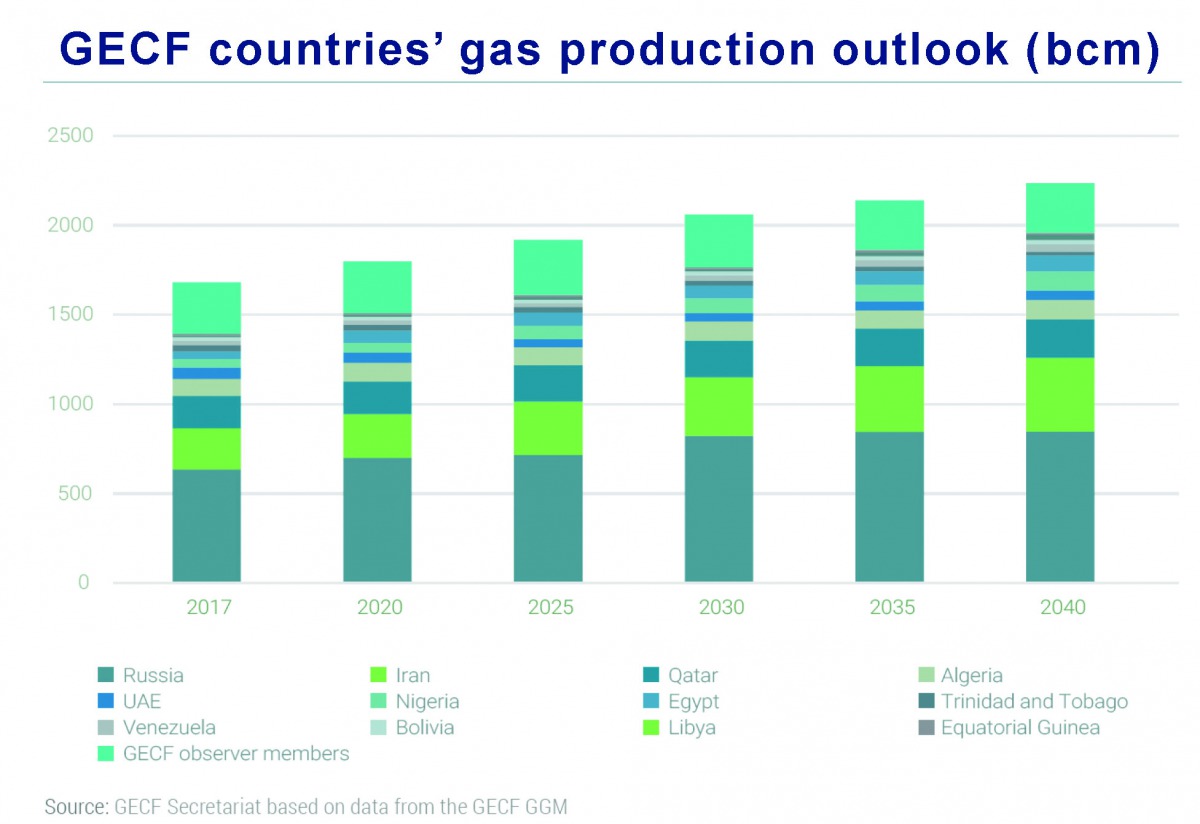
Overall growth in production of 1.7 percent per annum is expected in the period to 2040. The US, Russia, China and Iran are the largest contributors to this expansion. GECF Countries are expected to increase their production by one third, reaching approximately 2,250 bcm by 2040.
The global gas trade is expected to have grown by 38.6 percent by 2040, at 1.4 percent per annum, and reached 1616 bcm, sourcing 29.8 percent of global gas demand in 2040. To meet growing demand for natural gas and avoid energy crises by 2040, there is a need to invest $7.9 trillion in additional natural gas production capacity and gas trade infrastructure.
The GECF document noted natural gas will be the fastest growing fossil fuel and will displace other sources of energy in a range of sectors. The advantages of gas over coal and oil will continue to drive fuel -switching in the power sector.
Overall growth in electricity demand (forecasted to be 2.2 percent p.a.) will also provide a natural boost for gas as a fuel input. To capture gas demand in developing Asian countries, it is important to ensure the sufficient development of import and distribution infrastructure in Asia. If physical and institutional market infrastructure does not adequately mature, coal and renewables will take the market share otherwise allocated to natural gas.
“GECF countries should advocate for policy measures that promote gas through cooperation and appropriate dialogue between producers and consumers. They should also support investments in gas infrastructure and develop downstream operations in consuming markets to a larger extent. Policies that support the environmental advantages of natural gas and that advance gas -based technologies could be critical for long -term prospects,” Sokolov said in his presentation.
EU policy support to key gas infrastructure projects will continue, but economic and geopolitical uncertainties may affect the timing of their implementation. China will face several challenges in meeting its announced target for natural gas (8- 10 percent share of gas by 2020 and 15 percent by 2030), including a need to scale up domestic production, build extended infrastructure and storage facilities to manage seasonality and implement pricing and market reforms.
The document said policy measures in India will increase availability and accessibility to natural gas, especially in sectors where gas is in competition with oil, such as transport and industry.
Gas will continue to observe difficulties in the power sector due to competition from coal and renewables. Policy developments in many Asian countries show increased interest in promoting natural gas, especially in the power generation sector. This interest is mainly driven by the willingness of governments to reduce pollution and carbon emissions, as well as to substitute gas for oil in the power, industry and transportation sectors.