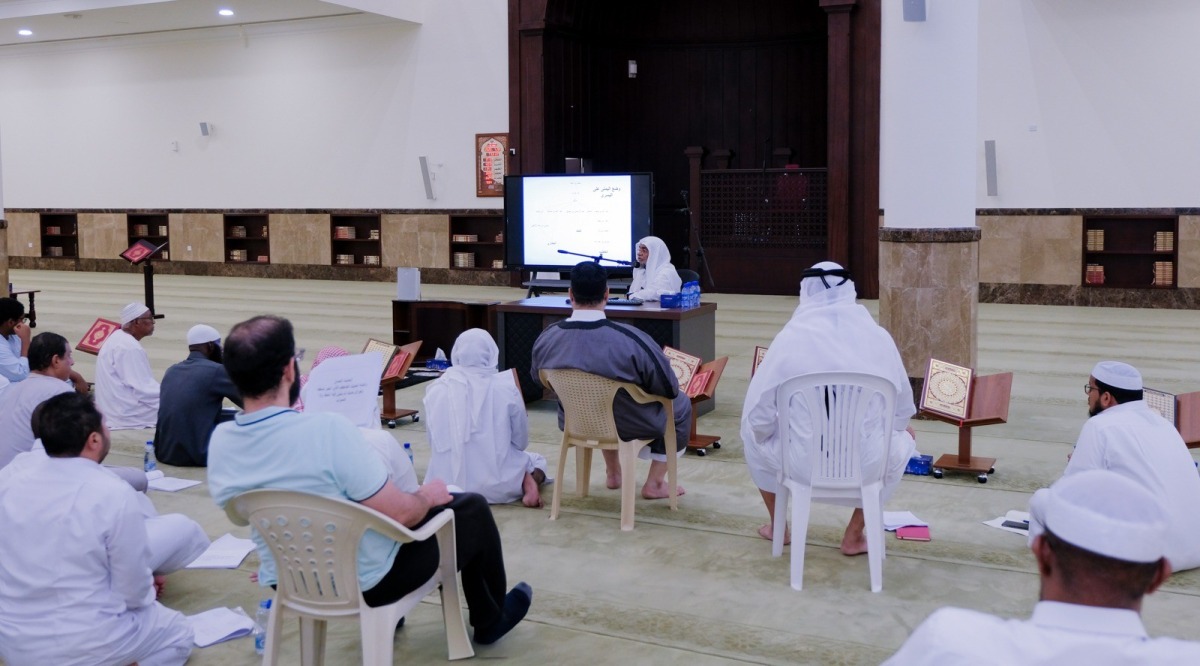
Participants during the programme.
Doha, Qatar: The Dawah and Religious Guidance Department at the Ministry of Endowments (Awqaf) and Islamic Affairs has concluded the sixth edition of the ‘Tafaqquh’programme on Hadith terminology and Quranic sciences, organised by the Dawah and Islamic Sciences Institute at Maryam bint Khalifa Al Attiyah Mosque in the Fereej Bin Omran area.
The programme drew strong participation from men and women seeking to acquire Islamic knowledge from reliable sources, as part of the institute’s series of academic and foundational programmes.
The course witnessed significant participation from members of the community, reflecting the Dawah and Religious Guidance Department’s commitment to providing specialised educational programmes that promote sound Islamic knowledge and religious awareness based on moderation and balance, while facilitating access to Islamic sciences through a group of scholars and specialists from the ministry.
The programme featured two main academic tracks.
Dr. Hamza Al-Mulaibari conducted a course on Hadith terminology titled “An Introduction to Hadith Terminology”, covering key concepts and basic principles related to the discipline. He introduced participants to the fundamentals of dealing with the Prophetic Sunnah and methods of verifying narrations and hadiths.
Dr. Masoud Jarallah Al-Marri presented a course on Quranic sciences titled ‘Topics in Quranic Sciences’, addressing a range of academic issues related to the sciences of the Holy Quran, as well as key terminology and topics that students of knowledge need to understand the Quran and comprehend its sciences and objectives.
The lectures were held daily from after Maghrib prayers until after Isha prayers, providing participants with an opportunity to benefit directly from specialists, ask questions and discuss the academic topics presented.
The ‘Tafaqquh’ programme is among the foundational academic programmes offered by the Dawah and Islamic Sciences Institute for men and women seeking to acquire Islamic knowledge. It aims to establish a systematic academic foundation for beginner students and introduce them to the keys and basic principles of Islamic sciences through a rigorous methodology based on reliable Islamic sources.
The programme also seeks to revive the mosque’s academic role as a centre of knowledge, guidance and religious outreach, strengthen its role in disseminating Islamic knowledge among members of society, and provide specialised educational content that contributes to establishing sound beliefs and a moderate understanding of Islam, with a positive impact on individual behaviour and social stability.
It also aims to make use of the ministry’s academic and religious outreach expertise by drawing on the knowledge and experience of its specialists to serve the community through courses and academic sessions that combine sound Islamic foundations with accessible presentations suitable for different segments of society.
Ibrahim Mohammed Al-Darwish, Head of the Dawah and Islamic Sciences Institute, said the “Tafaqquh” programme is one of the institute’s distinctive programmes that contributes to educating and preparing members of the public in Islamic academic fields by introducing them to the basic principles and foundations of Islamic sciences. This, he said, helps participants develop a correct understanding of religious matters based on evidence and knowledge.
The programme also contributes to strengthening sound religious awareness, promoting values of moderation and balance, and supporting efforts to safeguard the intellectual security of society by equipping individuals to address misguided ideas and misconceptions and providing them with the Islamic knowledge needed to engage consciously with contemporary intellectual and religious issues.