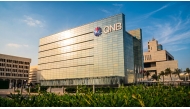
File picture of Bank Street used for representation.
The country’s first bank merger will support economic growth and the development of the financial and private sectors. On April 21 Barwa Bank and the International Bank of Qatar (IBQ) signalled the finalisation of negotiations and clearance of regulatory requirements necessary to consolidate operations.
The merged entity, which will operate as Barwa Bank, will have total assets of more than QR80bn ($22bn) and a shareholder equity base of over QR12bn ($3.3bn), Oxford Business Group (OBG) noted in its “Qatar 2019-Report”.
The merger will create the third-largest Islamic and sixth-largest overall bank in Qatar, with the consolidated lender having a 5 percent share of the market, according to ratings agency Moody’s. The new bank, which will also be the ninth-largest sharia-compliant lender in the GCC, is expected to benefit from lower funding costs and improved profitability.
Qatar’s banking sector is undergoing broader changes, as well, including a shift towards digital banking, which will likely see a reduction in branches and physical presence in the coming years. This will impact all aspects of the industry, from retail and private banking, to investment and international banking, according to Raghavan Seetharaman, CEO of Doha Bank, and could prompt further consolidation in the sector.
“Consolidation is a game-changer in the market,” Seetharaman told OBG. “Globalisation and new cost structures, as well as digitalisation and consumerism, are pushing banks to redefine the business model in order to address pressures and sustain growth.”
While M&A and the subsequent integration of infrastructure will create new opportunities and entities with increased capital, it is important to ensure shareholders remain satisfied and margins stay healthy, he added.
These changes will be imperative in creating a well-capitalised and resilient sector, especially in the aftermath of the blockade imposed by Qatar’s regional neighbours.
Ratings agency Standard and Poor’s (S&P) forecast a deterioration in asset quality and an increase in credit losses due to fallout of the blockade but anticipates the impact on the sector will be manageable.
“The Qatari banks’ strong capital generation and funding profiles, backed by public sector deposits, should further support the banking system,” S&P said in its May 11 assessment of the Qatari economy, projecting weaker asset metrics would recover in 2020.
S&P noted investments related to infrastructure development would help cushion the economy. It would seem to follow that this applies in particular to larger banks, such as the one created through the merger, which could have greater capacity for project finance.
Mergers are being utilised throughout the Gulf to shrink operational and funding costs, improve profitability and reinforce asset bases and risk-management capacity amid tighter market conditions and slower economic growth.
Across the region, banking sector consolidation is also strengthening efforts to reduce vulnerability to unpredictable oil prices and shift from economies dependent on hydrocarbons to knowledge-based markets driven by private sector development.
The Barwa Bank-IBQ merger is in line with Qatar’s blueprint for social and economic development, Vision 2030, released in 2008 after a sharp fall in oil prices. Vision 2030 aims to enhance financial and economic stability with low inflation rates, sound financial policy, and a secure and efficient financial system.