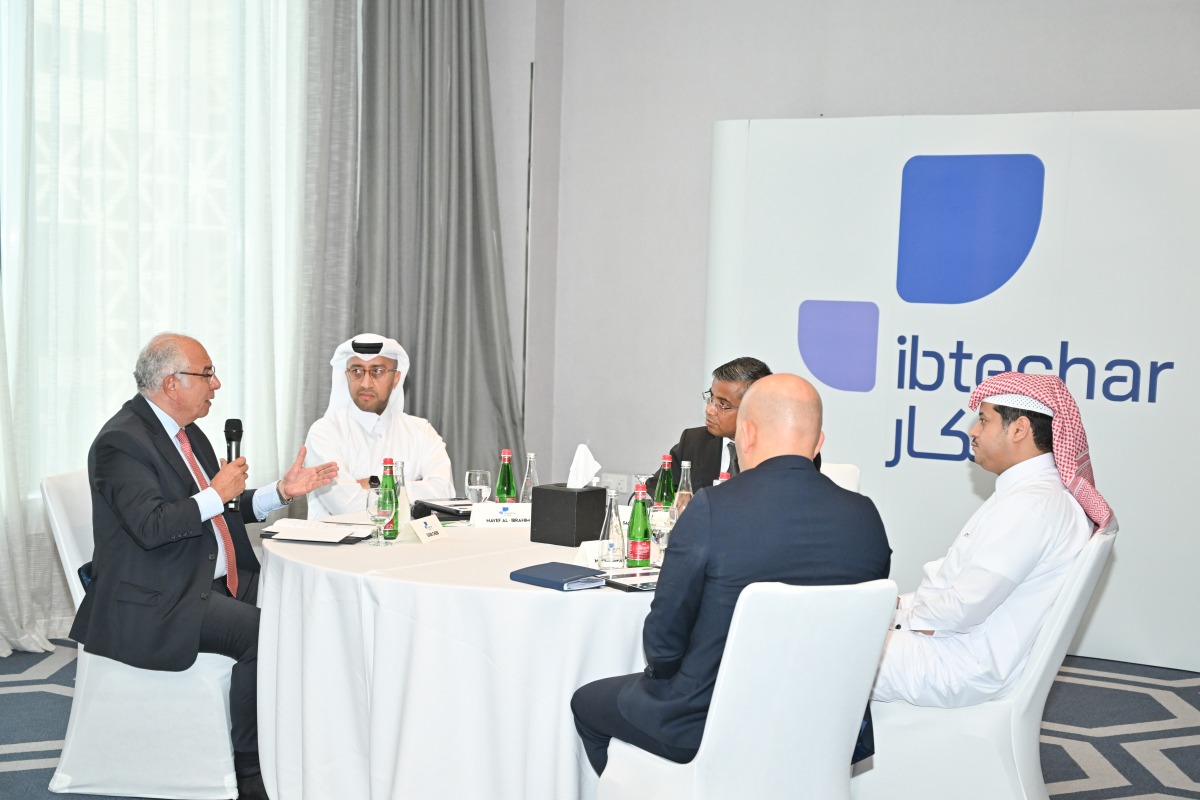
Abdullah Al Khater, Vice-President of Barzan Holdings; Mourad AlMaalaoui, Chief Technology Officer of Rheinmetall Barzan Advanced Technologies QSTP-LLC (RBAT); Soubhi Chebib, General Manager of GBM Qatar, and Nayef Mohamed Al Ibrahim, a Qatari entrepreneur and the CEO and founding partner of Ibtechar during the roundtable discussion held at W Doha Hotel and Residences, yesterday.
Doha: Ibtechar, leading innovation management and consultancy firm, held a roundtable discussion on Localizing Emerging Technologies. The panelists included Abdullah Al Khater, Vice-President of Barzan Holdings; Mourad AlMaalaoui, Chief Technology Officer of Rheinmetall Barzan Advanced Technologies QSTP-LLC (RBAT); Soubhi Chebib, General Manager of GBM Qatar, and Nayef Mohamed Al Ibrahim, a Qatari entrepreneur and the CEO and founding partner of Ibtechar.
Many important points were covered during the discussion including, leveraging technology to build a knowledge-based economy in Qatar; the challenges face the development of emerging technologies; private sector’s role in localizing and deploying new technologies; and aspects of a thriving innovation/technology ecosystem.
With its keenness to develop indigenous research and development (R&D) capabilities in Qatar, Barzan Holdings has R&D as an integral part of its operations, under the supervision of a specialized team. Through its joint ventures with specialist defense and security companies around the world, the company helps Qatar to develop its own indigenous R&D capabilities to build a secure future for the country.
Abdullah Al Khater commented, “At the forefront of Barzan Holdings’ operations is its commitment to revolutionizing the State’s defense and security sectors by leveraging the best emerging technologies available globally and localizing them within the Qatar context. These technologies are key to a thriving technological ecosystem and capacity-building, which are required to create a sustainable knowledge-based economy”.
“The deployment of emerging technologies brings with it an unprecedented level of opportunities and challenges,” he added. “Barzan Holdings’ close work with the private sector both within Qatar and internationally ensures that the technology localization process is smooth and stable, creating lasting value and strengthening Qatar’s sovereignty and long-term development. One of these collaborations is with Ibtechar. We work closely with them to develop sustainable solutions for drone tracking systems, helping us to ensure the safety and security of critical infrastructure and leveraging emerging technologies to benefit the country and community,” he added.
In his remarks, Nayef Mohamed Al Ibrahim said, “Technology has changed practically every industry in the world, and any country needs to have its own tech service providers/developers. It is only with localization that technology can be customized to be compatible with the existing infrastructure and become more targeted, efficient, and secure.
Under the Fourth Industrial Revolution (4IR), he explained, the rise of emerging technologies is reshaping the global labor market, entirely shutting down some job opportunities, while creating new ones which we aim to build in the locally as part of our strategy to contribute to the knowledge-based economy.
“This is a transitional moment in the history of humanity,” said Al Ibrahim. “From previous industrial revolutions, we know that they create divides between the haves and have nots, between what to include and what to exclude, and between those who have access to new opportunities and those who do not,” he added.
As an example of the challenges of localized technologies, he gave an overview of Ibtechar’s project to develop a customized solution for drone tracking systems, locally produced by the company’s own dedicated team of researchers and engineers with extensive knowledge and expertise in applied research and counter-drone systems.
“The new product has multiple features that make the tracking system able to identify any operating drone by displaying the drone itself, its serial number, the commercial frequency used, and motion details (speed, altitude, azimuth, path, etc.) This is part of our mission of contributing to a knowledge-based economy, under Qatar National Vision 2030,” he noted.
Another concept introduced by Al Ibrahim is the “regulations lab”, a field breakthrough that empowers change in the legislation and application of emerging technologies. With this revolutionary approach, regulators, private-sector companies, innovators, business leaders, and other stakeholders work together to co-create legislation that keeps pace with rapidly changing innovation.