Data science, with the help of cutting-edge technologies such as artificial intelligence (AI), is set to revolutionise healthcare and medical industry all over the world, including Qatar, said an industry expert associated with IBM, the global tech giant.
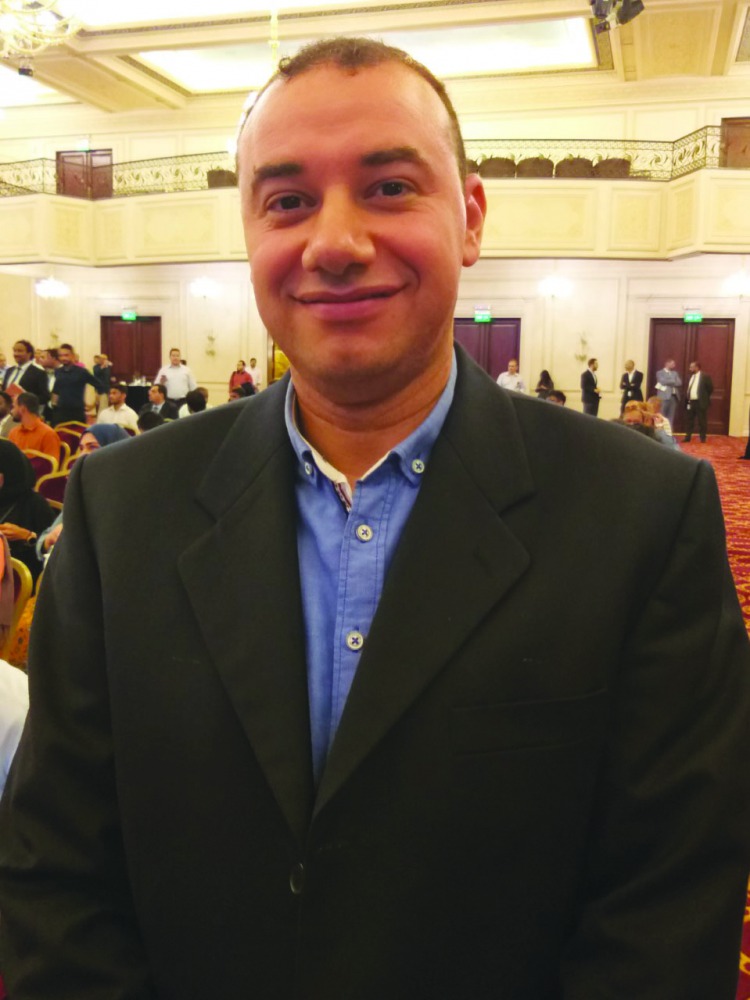
Diaa Eldin Ali (pictured), a Doha-based senior consultant working with IBM Qatar, speaking exclusively with The Peninsula, noted that data science has very bright future and great potential to reduce gaps in healthcare and medicine in terms of achieving more accurate diagnosis and medication for ailment and several critical diseases.
“Data science can be of great beneficial to the humanity, especially in the healthcare industry, where it can be used for more accurate diagnosis by better understanding how brain works. Data science and machine learning can give us tools that we could never imagined before like how it can save lives that we were not able to do without it”, Ali told this newspaper on the sidelines of an event here recently.
There is a big gap in the field of medicine today to understand the root causes of many problems. For instance, if a patient comes to a clinic with abdominal pain, the patient is usually referred to a doctor who specialises in internal medicine. But the abdominal pain can be a symptom, what if the root cause of his pain is something else, he posed.
Providing another example of a simple problem like allergy, he said that doctors usually deal only with symptoms. “Data science can solve this problem by analysing patients history from all societies using techniques to extract needful information about how the interactions between different symptoms can give us the root causes of the problem which we discover later.
This can help doctors to better diagnose and avoid misleading treatment and unnecessary medications.” Ali said that every stakeholder from government and private healthcare industry, research institutions, medical colleges, and the medical society such as doctors, researchers, nurses, and the representatives from the pharmaceutical industry are investing in data science to improve the industry and fill the gaps.
He also said that the development and applications of data science in the healthcare industry is still in the starting phase, which has big room and great potential to revolutionise the process of auto-diagnosis and fill, or shorten, gaps in the field of medicine which are not clearly identified.
The automatic medical diagnosis solution provides a broad spectrum of opportunities for startups that can develop similar technologies to contribute in Qatar’s efforts to achieve a knowledge-based society. This can also help in understanding medical imaging. Entrepreneurs can innovate technology how to auto-diagnose medical images quickly, and how to correlate images.
Commenting on Qatar’s adoptability to new technology and its aspirations, he said: “Qatar is one of the most advanced countries in the Arab World as it has been getting very-very high ranks in almost all factors that are considered benchmarks. Be its quality of life, technology, adoptability, infrastructure for high speed internet. These are foundations for high tech and knowledge-based society. In addition, Qatar is giving adequate focus on education which will enable the country to achieve its goal. Qatar is among the leading countries in terms of adoptability to new technology and has great future.”