DOHA: A slew of Qatar-listed companies’ decision to raise the cap of foreign ownership limits (FOL) could attract an estimated QR7bn in passive funds into these listed companies. The FOL increases and fund-flows should support the QSE index through mid-2018, according to QNB Financial Services (QNBFS)
QNBFS “Qatar Mid-Year Equity Strategy 2018” has noted that between January 1 and March 11 of this year, the QSE Index dropped marginally by 3 percent. However, from that point on, the picture changed materially as buying ahead of ex-dividend dates was further bolstered by positive news regarding potential/implemented foreign ownership limit (FOL) increases to 49 percent for select QSE-listed equities.
Driven by telecoms and real estate, QSE benchmark index rose 1.16 percent, yesterday.
QNB Group (QNBK) was the first to announce that it will propose an increase to the FOL to 49 percent at the company’s AGM, on March 12. In the following days, eight other companies announced plans to increase FOLs. They include Industries Qatar (IQ), QIB, Qatar Electricity and Water (QEWS), Barwa Real Estate (BRES), MPHC, QFLS, GISS, and International Islamic.
This led to a material rally in the Qatar All-Share Index driving it higher by 12 percent through May 1, while the aforementioned nine names increased by 16 percent over the same period.
“We estimate that this will result in material inflows as part of the MSCI and FTSE rebalancing, which could drive QR7bn ($2bn) in passive funds into these QSE-listed names,” QNBFS analysts said.
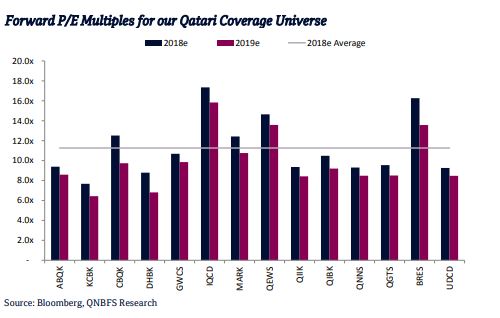
In longer-term QNBFS remains optimistic on the Qatari equity market as fundamentals remain attractive. Within its coverage universe, QNBFS forecasts a normalized 4.4 percent increase in aggregate earnings in 2018 followed by a more robust 2019 with 14.6 percent.
Despite the issues related to the blockade, QNBFS highlights that it continues to expect Qatari equities to post ROE metrics for 2018 and 2019 that are in line with peers (11.4/12.2 percent vs. regional peer averages at 11.8/12.2 percent).
Similarly, Qatari equities are expected to register dividend yields in line with peer average over the next 2 years at 4.6/4.9 percent vs. 4.7/5.0 percent. However, it cautioned that factors like deceleration of global economic growth prospects, regional geo-political issues, significant deterioration in oil prices, increase in volatility, exit of hot money from emerging/frontier markets, etc can negatively impact its forecasts.
From its Qatari coverage universe, QNBFS favours Qatar Electricity and Water (QEWS), GWC and QGTS (Nakilat). QEWS is a solid long-term play with a defensive business model. The State of Qatar, through various entities, owns 60 percent of the company.
GWCS has withstood the blockade well with freight forwarding bouncing back nicely and some after an initial hit. The company’s logistics business has also picked up steam driven by contract logistics and increasing occupancy in Bu Sulba.
QNBFS continues to favour Nakilat, the Number One owner/operator of LNG vessels globally, as a long-term play geared to Qatari LNG’s dominance & anticipated growth in the LNG market. QNBFS believes the stock is attractive at current levels. QGTS is a vital part of Qatar’s LNG value chain and enjoys stable revenue/cash flow from long-term and fixed-rate time LNG charter contracts with Qatargas and its affiliates.
The availability-based take or pay contracts shields Nakilat from end demand volatility and delays in charterers’ projects. 11 ships are on spot-to-medium-term charters; LPG is a spot business. The company has high leverage but debt is mostly secured by watertight charter agreements; QNBFS do not foresee any challenges in debt servicing/repayments.