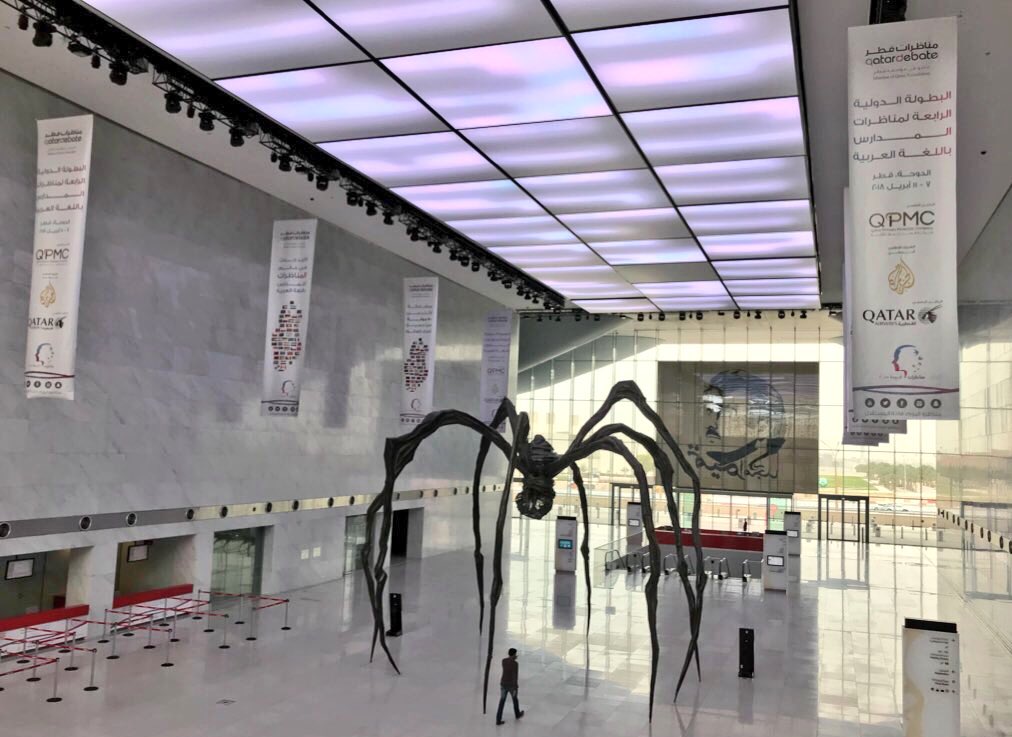
DOHA: Under the patronage of H E Sheikha Hind bint Hamad Al Thani, Vice-Chairperson and CEO of Qatar Foundation for Education, Science and Community Development (QF), the 4th International Schools Arabic Debating Championship, organised by the QatarDebate Centre at Qatar National Convention Centre (QNCC) will kick off today.
Fifty countries including 15 Arabic-speaking and 35 non-Arabic speaking will participate in the championship. They include Argentina, Spain, Australia, Albania, Germany, Indonesia, Ukraine, USA, Italy, Pakistan, Panama, Brazil, Bosnia and Herzegovina, Poland, Thailand, Turkey, Czech Republic, Tanzania, Tunisia, Algeria, South Africa, Russia, Syria, Sudan, Sweden, Singapore, Serbia, Montenegro, Somalia, Iraq, Oman, Palestine, Qatar, Kyrgyzstan, Kazakhstan, Canada, Kosovo, Kuwait, Colombia, Lebanon, Libya, The Maldives, Malaysia, Morocco, United Kingdom, Mauritius, Austria, Nepal and India.
As many as eight countries will be participating in the championship for the first time. They include Russia, Kosovo, Spain, Thailand, Serbia, Albania, Poland and Kyrgyzstan. The championship aims to strengthen educational and cultural relations among the participating countries and open up opportunities to strengthen relationship and urges sharing experiences among Arabic-speaking and non-Arabic speaking youth.
It also aims to raise the open discussion standards, secure freedom of expression in the Arab world and the world as a whole and respect the difference of opinion. For the first time in the history of the championship, a trial round will be held to involve all participating teams. A trial round involving all the teams participating in the championship without recording any scores will take place on the first day.
Mohammed Salman, Debate Coach, has pointed out that the trial round is aimed to allow the teams get in the mood for the championship before the actual rounds begin since some of the debaters are not aware of the atmosphere of the championship and its rounds and therefore they will not be able to control their feelings. “The trial round was found to be necessary for the participants to encourage and prepare them psychologically.
The trial round steps will be similar to the actual rounds in terms of the random selection of competing teams, identifying the house, the opposition and the adjudication panel and their comments, while the only difference is no scores are recorded,” explained Salman.
Salman added that QatarDebate Centre used to organise workshops for participants in the previous editions of the championship prior to the championship, but this year we decided to hold the trial round right before the first round.
Salman said a final round will take place after five rounds of the best two teams of non-Arabic speakers, so that the best of the two will be qualified for the final round after merging them with teams of different levels so they can gain experience and practice debates with the strongest and the weakest team. As for the Power Matching scheme, Salman said, “The debating teams will be randomly matched in the first round and then the Power Matching scheme will be applied to ensure a high level of competition and make sure the best teams to be qualified for the round 16 and the final rounds that depend after five rounds on the number of winning debates and the knockout scheme.