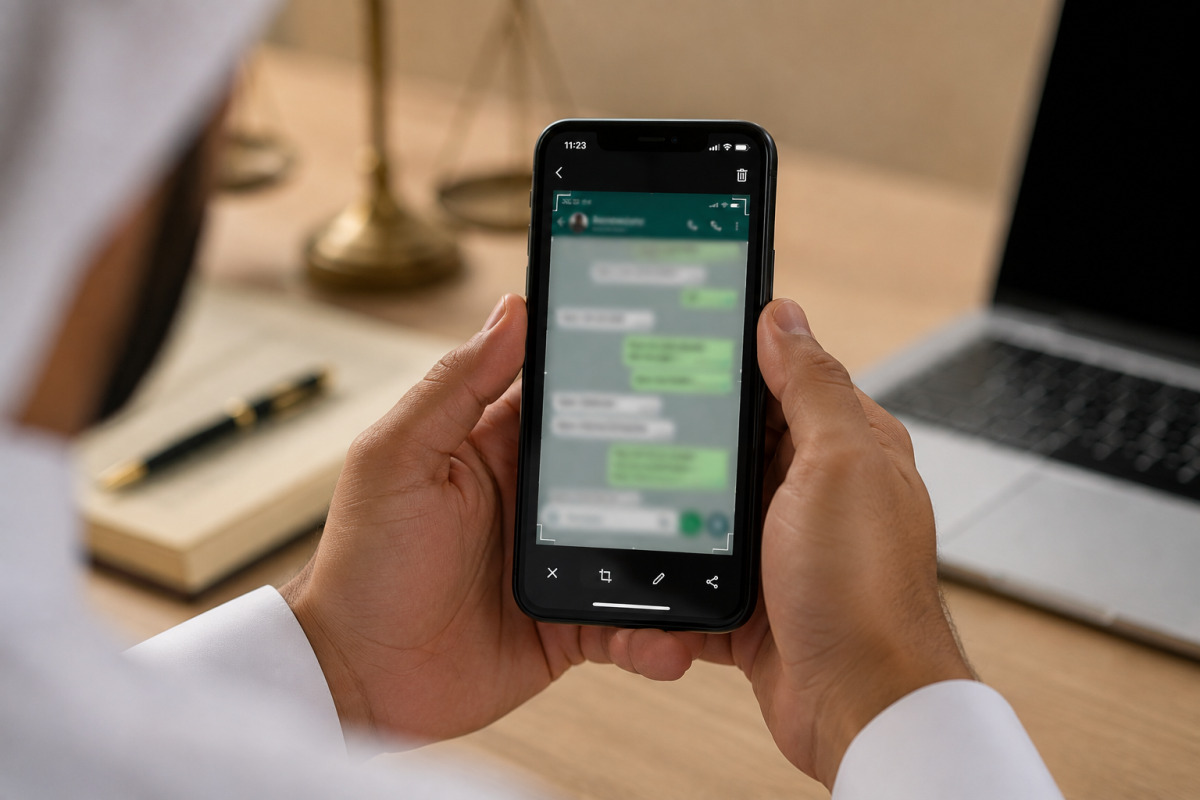
Doha, Qatar: Electronic messages such as WhatsApp conversations, text messages and emails can serve as valid evidence before Qatari courts, provided they meet specific legal requirements, Qatari lawyer Mansour Al-Dosari said in an interview with Al Rayyan TV.
Al-Dosari said digital communications have become an integral part of daily personal and commercial transactions, making electronic evidence increasingly significant in legal disputes.
"Previously, proof was largely limited to written documents, paper contracts, witness testimony and other traditional forms of evidence. Today, a case may begin and end based on a short electronic conversation, text message or email," he said.
He explained that Qatar's legislative framework has evolved alongside technological developments to safeguard rights and legal positions.
He pointed to laws governing electronic commerce and cybercrime, which recognise electronic evidence as admissible in court when it satisfies the legal requirements.
According to Al-Dosari, the admissibility of electronic evidence depends on the court's assessment of its authenticity and relevance rather than the platform on which it was exchanged.
Among the key conditions, he said, is the ability to identify both the sender and recipient, while the conversation should be presented in its complete sequence, or at least in a complete section that accurately reflects the relevant facts of the dispute.
"The conversation must also be directly related to the legal dispute," he said, advising people against editing, deleting or altering electronic messages before presenting them in court.
Al-Dosari cautioned that screenshots alone are not automatically considered conclusive evidence.
"A screenshot is easy to capture and manipulate. It can only acquire evidentiary value if its authenticity can be verified and it complies with the legal requirements," he said.
He noted that screenshots become stronger evidence when they clearly display identifying information, such as the phone number of the other party, preserve the chronological order of the conversation and show no signs of alteration.
The lawyer added that the evidentiary value of electronic messages may also be strengthened if the opposing party acknowledges the authenticity of the conversation or if investigators are able to examine the original device or the original electronic records.
Addressing common mistakes, Al-Dosari said many people submit incomplete screenshots that fail to present the full context of the exchange.
"The court needs to see the complete sequence of the conversation so that the legal facts are presented from beginning to end," he said. "Only then can the court properly assess the evidence and reach a legal conclusion."
He also stressed that the legal value of electronic evidence does not depend on whether it originates from WhatsApp, SMS or email.
"The strength of the evidence is determined by whether it meets the legal standards established by the law, not by the application used," he said, adding that electronic evidence, like other forms of evidence, ultimately remains subject to the court's discretionary assessment.