Doha, Qatar: The global economy endured large negative shocks during 2025, which were reflected by significant turbulence in financial markets and numerous iterations of economic growth forecasts. By mid-year, a dim outlook was grounded on the fears of broader and deeper trade wars after the new US administration embarked on a comprehensive increase of tariff rates for imports from all countries. This represented a major threat to global supply chains and a potential blow to growth in both advanced economies and emerging markets, QNB said in its economic commentary.
Expectations later began to recover gradually, as US policy shifted towards a more pragmatic stance, and an increasing number of signed trade deals helped moderate uncertainty, as well as discard the most extreme negative scenarios for global trade.
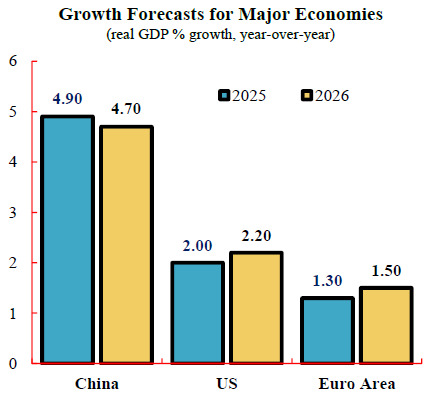
The improvement in the global outlook by the final part of the year helped set a less pessimistic tone for 2026. Going forward, we believe conditions point to a relatively stable macroeconomic environment of more balanced and synchronised global growth. Our view is slightly more positive than consensus, as we see the global economy expanding 3.2% in 2026. This rate of growth implies a minor acceleration in activity, although still below long-term growth trends.
In this article, we discuss the key factors that determine the outlook for the three major economies: the US, China, and the Euro Area, which together account for close to 60% of the world economy.
US economic growth is expected to remain resilient, backed by robust household consumption and investment flows. Consumption is benefiting from robust household balance sheets, showing the strongest financial position in decades, as well as from still-low unemployment rates. The AI-boom is fuelling investment flows and expectations of increasing productivity on the back of the adoption of new technologies.
Moreover, the Federal Reserve is still in the middle of a significant change of its monetary stance from restrictive to neutral. After lowering policy rates by 175 basis points (b.p.) since mid-2024 to 3.75%, Fed Funds rates are likely to be further reduced to 3.5% by end-2026.
This change in policy rates will further support investment and consumption growth, as credit becomes cheaper, new business become more attractive and the opportunity cost of spending decreases. As a result, we expect US growth to accelerate slightly to around 2.2% in 2026.
Although the Chinese economy is set for a slight deceleration, robust export performance, domestic demand and productivity growth will add up to growth of close to the 5% target that is expected to be confirmed by the government. Despite significant trade policy uncertainty and higher tariffs set by the US during 2025, China’s trade surplus topped USD 1 trillion (Tn) for the first time last year.
Chinese exports to the US dropped by almost 30% year-over-year by the end of 2025, but firms successfully re-oriented their shipments towards alternative markets, showing the remarkable versatility of its industrial sector. Furthermore, the Chinese economy continues its transition from exporting simple consumption goods to advanced-technology manufacturing, and high value-added products, a process that is re-positioning China at the high end of global supply chains and contributing to higher productivity growth.
Moreover, domestic consumption will remain supported by fiscal policy as well as further gradual monetary easing, adding to the positive factors that contribute to a moderately positive outlook for 2026.
For the Euro Area, we expect a slight reacceleration of the economy, backed by fiscal spending and less restrictive monetary policy. Spending under the NextGenerationEU (NGEU) programme contributed with 0.5 percentage points of total growth during 2025 and could do so again during 2026 if kept on track.
Furthermore, leading indicators of economic activity point to an improving trend in services, entering the expansionary range in the last 4 months of 2025. Since the services sector accounts for close to 70% of the Euro Area economy, this is an encouraging signal for the region, which we expect to grow by an above-consensus 1.5% in 2026.
All in all, after a highly turbulent 2025, we expect a slight improvement of global growth this year, as the major economies remain stable.