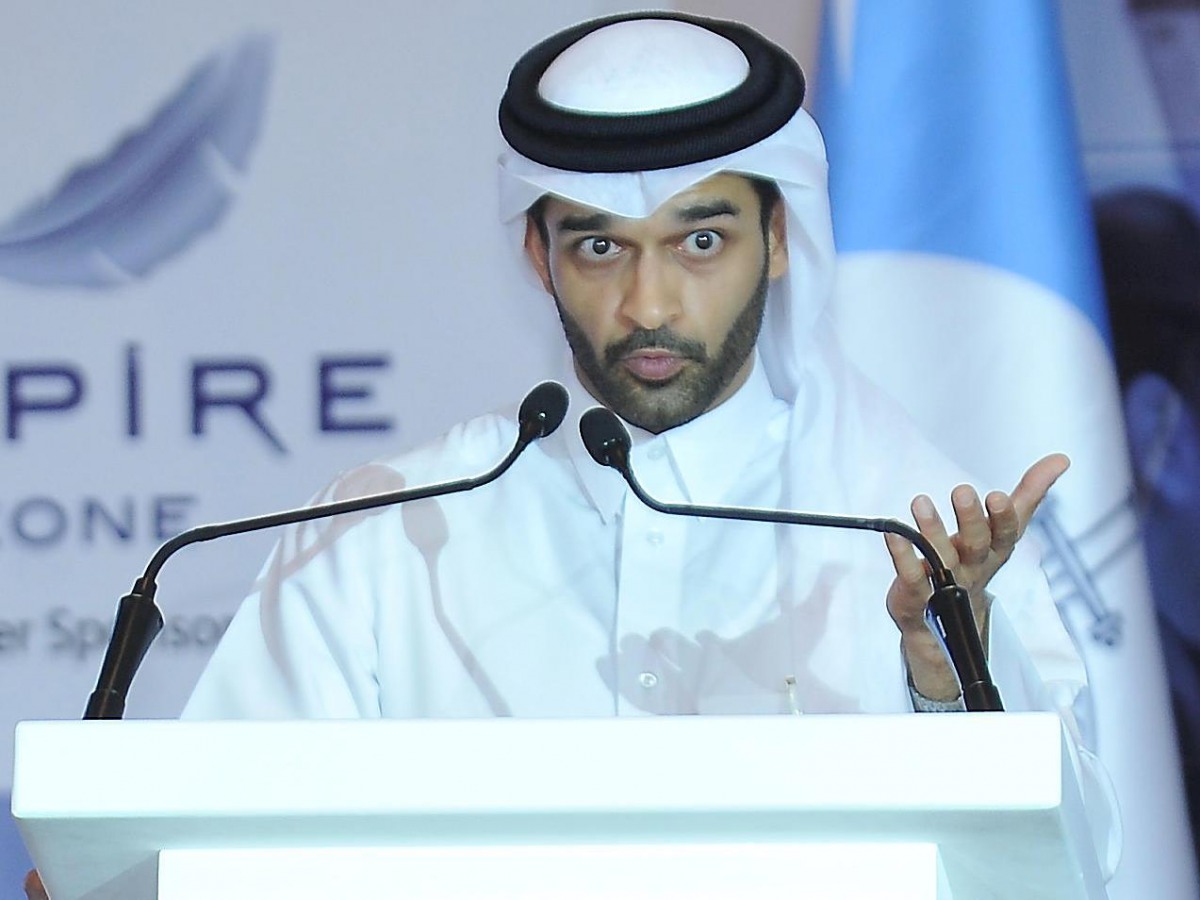
File photo of Secretary-General of Supreme Committee for Delivery and Legacy Hassan Al Thawadi at a Conference in Doha.
World’s leading human rights groups and sports organisations have recognised services and role of Qatar and the Supreme Committee for Delivery & Legacy (SC) for using the 2022 FIFA World Cup to accelerate workers’ welfare improvements.
Following a speech by the SC’s Secretary-General Hassan Al Thawadi at the Sporting Chance Forum in Geneva this week, the work done by the SC and the Qatari government was highlighted. Attended by influential human rights groups and NGOs, as well as sport’s global governing bodies FIFA, the International Olympic Committee (IOC), UEFA and the Commonwealth Games Federation, the conference was organised by the Geneva-based Institute of Human Rights and Business (IHRB).
Zeid Ra’ad Al Hussein, the UN’s High Commissioner for Human Rights; Guy Ryder, Director General of the ILO; and Thomas Bach, President of the IOC; opened the two-day event, which was used to announce plans to open an independent Centre for Sport and Human Rights in 2018. In the presence of H E Ali Khalfan Al Mansouri, Qatar’s Permanent Representative of the State of Qatar to the UN in Geneva, Al Thawadi outlined the progress made on workers’ welfare and the commitment to leave a true legacy after 2022.
He said: “Sport’s ability to unite and to inspire is not limited by language, borders, race or economic status – and at its pinnacle is the World Cup.”
“We knew the event could be an opportunity to make lasting changes in our country, and hopefully, our region. This is not a vanity project. We fought for the region and insisted that the World Cup would serve as a catalyst for accelerating positive social progress and change. One area that we knew we had to address was workers welfare.”
Organisations such as the International Labour Organisation (ILO) and the International Trade Union Confederation (ITUC) – traditionally critical of Qatar – acknowledged the progress made to tackle labour issues.
That praise was balanced by an expectation to see more done to confront human rights, however the transparency of the SC and Qatar around the steps taken to date were well-received in front of more than 200 delegates.
The constructive feedback was acknowledged by Al Thawadi, who pointed to the ILO’s recent decision to close an official complaint into the alleged abuse of migrant workers in Qatar, as proof that dialogue was the only way tackle this issue.
He added: “Nations which resist scrutiny and constructive criticism are an impediment to our region’s progress. In Qatar, we embrace scrutiny, understand the benefit of being under the international spotlight, and we are open to constructive criticism.”
“On that note, we welcome the ILO’s decision to close the complaint against Qatar earlier this month. It demonstrates their faith in our government’s resolve to drive forward the reform and progress that we know we must deliver.”
Qatar’s progress was also recognised by Giovanni Di Cola, Special Adviser, Office of the Deputy Director General of the ILO.
Speaking on a panel focusing on what lay ahead for sport and human rights, he said: “The articulation of what is happening in Qatar is important. Others may believe that when you resolve a complaint against a country, it is done. However, in reality Hassan Al Thawadi told us this tournament is helping to change the legislation of the country. For Qatar, this is about what happens for workers in the 50 years afterwards. This is the real legacy of Qatar’s World Cup. These legacies should not be underestimated and we must communicate around this.”
Tim Noonan, Director of Campaigns and Communications for ITUC, echoed the sentiment of the ILO.
He said: “There is now a legislative agenda and an ILO presence in Qatar for the first time. We need to make that work. There is a mandate for things such as a minimum wage, which has never happened before.”
Following his speech, Al Thawadi answered questions from the audience on a number of issues including freedom of the press and the possibility of the SC’s Workers’ Welfare Standards being incorporated across the entire State of Qatar.
Minky Worden, Director of Global Initiatives for Human Rights Watch, commended Al Thawadi for being open to scrutiny on the topic of workers’ welfare – before demanding more action from the SC and the State of Qatar.
In response to Worden’s challenge of ensuring the Middle East’s first World Cup was about more than just football, Al Thawadi said: “The impact will be felt long after 2022. Our work doesn’t stop when the tournament heads off to the next host of the World Cup in 2026. We won’t go back to the status quo.”
Al Thawadi’s presence at the Sporting Chance Conference came during a week of engagements that saw him speak at the Play the Game conference in Eindhoven, before participating in a public question and answer session at a special screening of the Workers’ Cup documentary in Geneva.
Mary Robinson, former President of Ireland and Former United Nations High Commissioner for Human Rights and Chair of the Mega-Sporting Events Platform for Human Rights, praised Al Thawadi for tackling a difficult subject head-on.
She said: “The conversation around this issue has been enriched because of Mr Al Thawadi’s presence. His decision to speak at this event – and attend the screening of the Workers’ Cup – was a brave thing to do.” Al Thawadi’s participation in the Sporting Chance forum came just a day after the SC extended their partnership with global trade union BWI to conduct joint inspections on official FIFA World Cup™ projects.