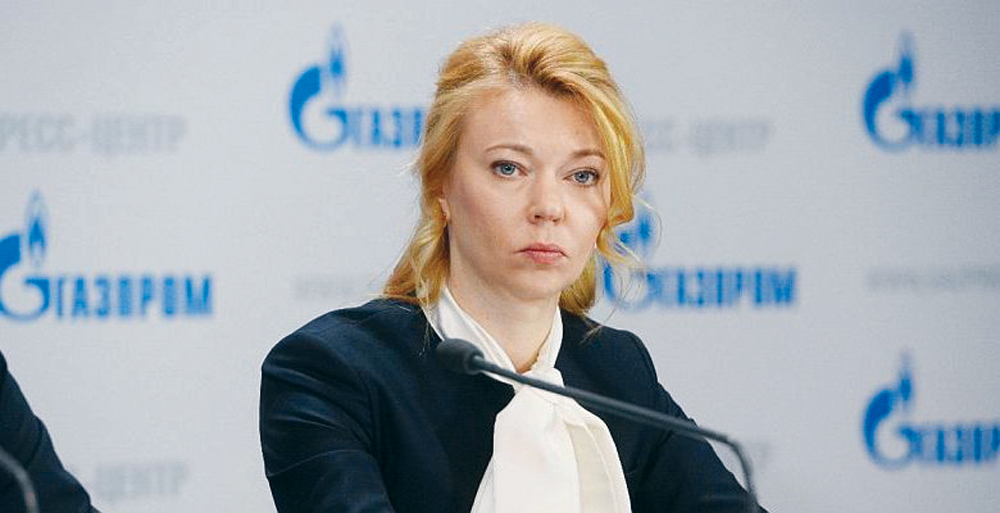
Elena Burmistrova, Gazprom’s Management Committee Deputy Chairman and Export Director General
The natural gas will be the fastest growing fuel as a primary source of energy for decades to come, and demand for gas, which is considered as the cleanest form of fossil fuel, will continue to grow beyond the year 2035, noted a senior official of Gazprom, Russia-based energy giant, at an event, yesterday.
Elena Burmistrova (pictured), Gazprom’s Management Committee Deputy Chairman and Export Director General, speaking at the Gas Exporting Countries Forum’s (GECF) Monthly Gas Lecture on changing dynamics of natural gas, provided a comprehensive outlook of the natural gas market for the short and medium term highlighting the challenges, opportunities and investment in these scenarios.
Commenting on the current demand for gas, Burmistrova, said: “A lot will depend on the persistence of restrictions in the short run. So far it is evident that the gas industry suffered from coronavirus much less than oil, and especially coal. The outlook for natural gas is underpinned by its important role in supporting decarbonization, a shift away from coal and as a source of low carbon fuel combined with carbon capture and storage (CCS).”
Citing a McKenzie analysis, she added: “Natural gas will remain the fastest growing fossil fuel, and the only fossil fuel expected to grow beyond 2035. The Opec recently said that the gas share in the global primary energy consumption will grow and exceed one-quarter (25 percent) in 2045.”
On new investment and supplies, she noted that market fundamentals make new gas projects unattractive, especially those which are financed by banks.
Notably, Gazprom , the Russian energy major, holds the world’s largest natural gas reserves and the company’s share in the global and Russian gas reserves amounts to 16 percent and 71 percent, respectively. It accounts for 12 percent of the global gas output and 68 percent of domestic gas production.
Burmistrova, with nearly two decades of experience in gas trade and commodity market, cautioned that the coronavirus is not over, and its after-effects are expected to remain for some time in the future.
On the gas industry’s capabilities for self-adjustment of supply on the unbalanced market, she said that the crisis in global gas industry had already started much before the outbreak of the COVID-19 pandemic itself, and market will rebound once the additional volumes and inventories are cleared.
On the supply glut, she said that the gas market faced unprecedented mixed of negative tendencies in 2019, and the first quarter of 2020. For instance the changing weather patterns like warmer winters in the northern hemisphere and the lockdowns due to the pandemic caused significant fall in gas consumption. And also the LNG production soared in 2019 which added around 12 percent to the world’s gas trade, this all led to fall in gas prices. However, she expressed her optimism about the rebalancing of the market rebounding of gas prices.
According to latest reports, Asian spot prices for LNG jumped nearly 9 percent last week from the previous week, as demand continued to rebound.
The GECF’s Secretary-General Dr Yury Sentyurin, in his welcome address at the Forum’s online lecture, entitled “Natural Gas: New Market Realities or Temporary Impediment?”, also provided a brief overview of the gas market highlighting the transition in energy market, and the benefits and role of natural gas in achieving the climate change goal and sustainable development.
“Whether it’s the rise of innovative online gas exchanges like the one in India, or the maiden voyage of gas-propelled vessels like Jackques Saade (the world’s first LNG-fueled Megamax-24 ship), the gas industry is undergoing profound shifts, which is why in today’s lecture we will try to examine and understand the paradigm shift, new realities and temporary impediments.”