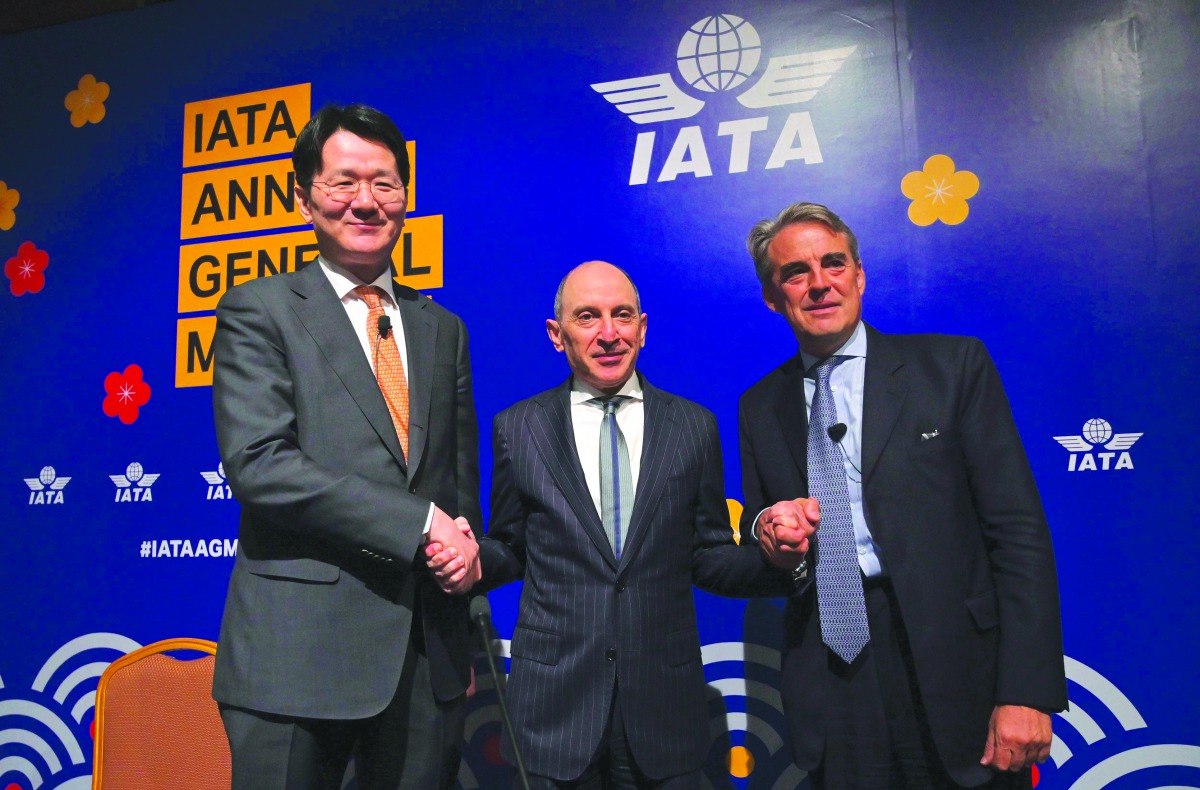
International Air Transport Association (IATA) Chief Executive Alexandre de Juniac (right) with Qatar Airways Chief Executive Akbar Al Baker (centre) and Korean Air Chief Executive Walter Cho during a press conference after the opening session of the annu
The International Air Transportation Association held its 75th annual general meeting in Seoul, yesterday as global aviation leaders gathered to discuss ways to stay sustainable and tackle challenges in the industry.
The event, attended by more than 800 guests from 290 airlines in 120 countries, was hosted by South Korea’s flag carrier South Korean Air Lines Co. It was the first time that IATA’s annual general meeting (AGM) came to South Korea, South Korea’s News Agency (Yonhap) reported.
At the AGM, IATA announced that it downgraded its 2019 outlook for the global air transport industry to a US$28bn from US$35.5bn forecast in December 2018 due to rising fuel prices and struggling demand in world trade.
Cho Won-tae, the new chairman of Korean Air, the president of this year’s AGM in Seoul said “I hope that the 75th Annual General Meeting will serve as a productive forum in which we’ll be able to bring to light where the gifts of opportunity lie in our industry and how we may approach these opportunities to benefit collectively.”
IATA Director General and CEO Alexandre de Juniac said “Creeping protectionist or isolationist political agendas are on the rise, and they threaten to compromise the value our industry creates. For aviation to be a catalyst of prosperity, borders must be open to people and to trade.”
“Our biggest and most practical opportunity is sustainable aviation fuels, Governments also need to act. They should build supportive policies to invigorate the sustainable fuels industry.” de Juniac said.
The International Air Transport Association is lowering its forecast for the airline industry this year to $28bn from $35.5bn amid rising fuel prices and weakening world trade, AFP reported.
The Montreal-based IATA said yesterday that “margins are being squeezed by rising costs right across the board, including labor, fuel, and infrastructure.”
It said competition among airlines remains stiff and “weakening of global trade is likely to continue as the US-China trade war intensifies,” primarily affecting the cargo business, although passenger traffic could also be hit if tensions rise.
IATA members meeting in Seoul also backed a plan that will cap net emissions of the greenhouse gas carbon dioxide from international aviation at 2020 levels. Airlines will have to spend money on carbon reduction measures elsewhere to offset excess emissions.