Oil prices fell from six-week highs on Friday as investors unloaded positions after weak Japanese crude import data and worries about fuel demand in India, where COVID-19 infections have soared.
On the last day of trading for the front-month June contract, Brent crude settled at $67.25 a barrel, a fall of 1.9 percent, while US West Texas Intermediate (WTI) settled at $63.58 a barrel, down 2.2 percent. For last week, both benchmark crudes - Brent and WTI, gained 1.7 percent and 2.3 percent respectively.
India, the world’s third-largest oil consumer, is in deep crisis, with hospitals and morgues overwhelmed, as the number of COVID-19 cases topped 18 million on Thursday. Japan, another major crude oil importer, recorded a fall in imports of 25 percent in March to 2.34 million barrels per day, compared to the same period last year. However, the country’s factory activity expanded at the fastest pace since early 2018.
A Reuters survey forecast that Brent would average $64.17 in 2021, up from last month’s consensus of $63.12 per barrel and the $62.3 average for the benchmark so far this year.
OPEC oil output has risen in April as higher supply from Iran countered involuntary cuts and agreed reductions by other members under a pact with allies, adding to signs of a 2021 recovery in Tehran’s exports. Oil rigs rose for the eighth straight month, to their highest since April 2020.
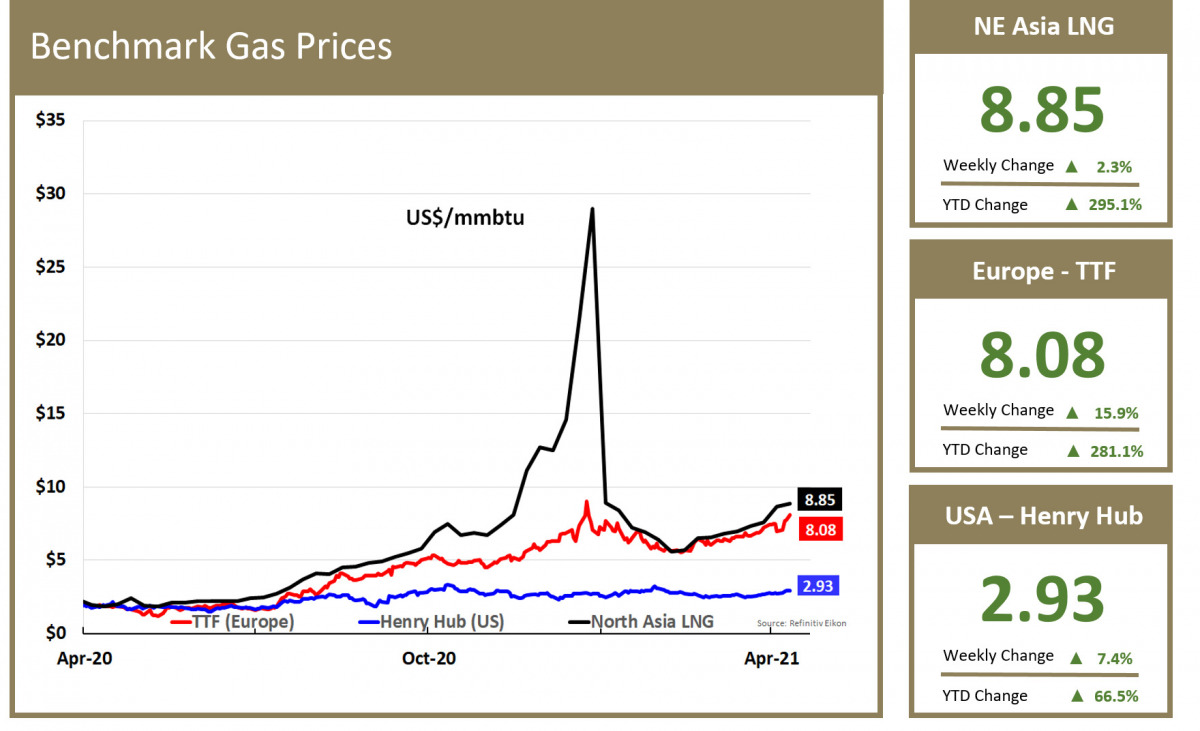
However, US oil rigs fell by one to 342 last week, according Baker Hughes Company. Asian spot prices for LNG jumped last week on the back of strong demand to restock gas inventories in Europe and Asia, industry sources said.
The average LNG price for June delivery into Northeast Asia was estimated at about $8.85 per million British thermal units (mmBtu), up $0.20 from the previous week. According to Diaz, the spread between Asian prices and the TTF reference index in Europe, which closed at $7.99 per mmBtu last week, narrowed to less than $1 - the level of difference that usually starts to make the longer trip from the Atlantic basin to Asia attractive. Demand from China and Japan has remained strong as both countries re-stock in early preparation for winter, according to research firm Rystad Energy.
In the Atlantic Basin, LNG demand was also solid as European buyers replenished stock depleted when prices reached near record levels during winter. Unipec Singapore sold a cargo for June 3-7 delivery to BP at $8.90 per mmBtu on Thursday.
The daily charter rate for shipping LNG on a vessel able to carry around 175,000 to 180,000 cubic metres has risen to as much as $70,000 to $80,000 from around $50,000 to $65,000 last week, two shipping sources said.
In the US, natural gas futures climbed to a nine-week high on Friday on record exports, slight decline in output, forecasts for cooler weather, and higher heating demand over the next two weeks than previously expected.
Front-month gas futures rose 2.0 cents, or 0.7 percent, to settle at $2.931 per million British thermal units, their highest close since February 22.
For last week, the contract was about 7 percent higher, putting it up for a third week in a row for the first time since February. As for the month, the contract was up about 13 percent after falling around 6 percent last month.
Buyers around the world continue to purchase record amounts of US gas because prices in Europe and Asia remain high enough to cover the cost of buying and transporting the US fuel across the ocean.
Traders, however, said that US LNG exports cannot rise much more until new units enter service in 2022, since the United States only has the capacity to export about 10.5 bcfd of gas as LNG.