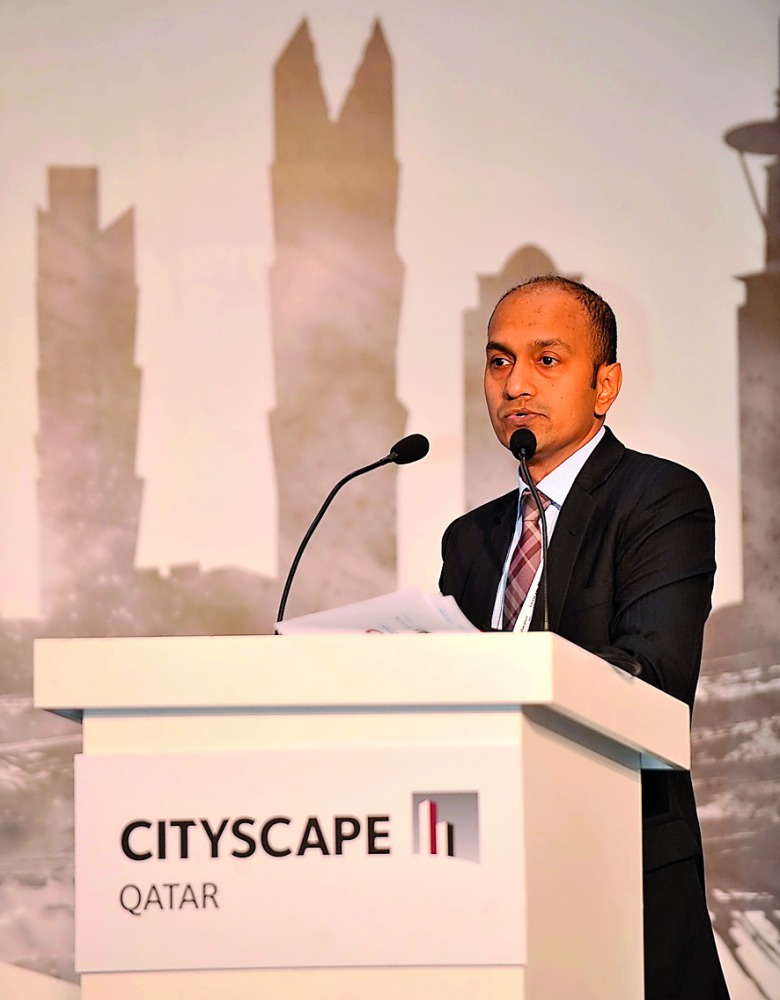
DOHA: The real estate owners and investors in Qatar should look at REITs (real estate investment trusts) as a vehicle to capture the real growth in the sector and the value more effectively. Investors, who sit on hard real estate portfolios in Qatar, have good reasons to restructure their assets into REIT, Mohsin Mujtaba (pictured), Director, Product and Market Development, Qatar Stock Exchange (QSE) has said.
The QSE official was speaking on Qatar’s ‘missing link between real estate and capital markets’ at an event. After the successful launch of two exchange traded funds (ETFs) recently, the local bourse is currently in the process of introducing the exotic REITs to the local market.
Mujtaba said the structuring of REIT will allow real estate owners to capture the value of their assets and will be able to manage them in a better way. The real estate securities have typically delivered investors attractive risk-adjusted returns when compared to other asset classes. In addition, publicly traded real estate securities generally offer investors income stability, diversification, inflation-protection potential, and liquidity.
“REITs are not something very complicated, it’s just a vehicle that will hold your real estate assets and you can structure it in any way you want. Like Mututal Funds, REITs are real estate fund that will be structured and hold properties that are available in the real estate market”, he told The Peninsula on the sidelines of the event. Currently, QSE is in talks with some Asset Managers ahead of the launch of Qatar’s first Equity REITs.
In Qatar, Mohsin said, a lot of real estate portfolios are largely packaged in a ‘hold’ structure and listed on the market. They have probably not seen the fair valuation for the investors and also they have underperformed the market.
“We would like to think that that real estate sector in Qatar have done very well over the past few years because of so much of the development, but the reality is that the listed real estate sector which covers a lot of real estate segment in Qatar have significantly underperformed in the equity market., which probably begs a question whether Qatar’s real estate assets are packaged in the most efficient manner”, he said.
Elaborating on the impressive growth of the REIT market globally over the past several years, Mujtaba said in the US alone, the REIT market is about $5trillion, which shows the efficiency of the structure. If one compare the US market in the past eight years or so, the equity REIT market have outperformed the S&P500, even if though we have seen significant rally of S&P500 over the past few years. But REITs are usually not noticed a lot.
“If you look at the performance it had done a lot better than the equity market. The equity market has done very well, but the REITS have done even better”, he said.
Explaining the opportunities in Qatar, Mohsin said since 2015, Qatar has a regime which allows for the structuring of REITS and a possibility to offer a wider public.
In the latest edition of the Cityscape Qatar, we saw large number of exhibiting their properties. However, the challenge remains that the ticket size is so big that not everybody will get an access to them. That’s where the REITs come in, that allows wider reach and smaller ticket size for smaller investors.
“In Qatar, we have tried to keep it very simple and very accessible for the real estate developers…. In terms of listing requirements, all you need to have is a single property or get two or three properties bundle together into the REITs. The minimum size required is QR40m, which is not a lot in Qatari market terms. And minimum of 30 investors should be part of the fund.
In Qatar, office buildings, residential, retail shopping malls, healthcare properties and education properties, all can be prime candidates for restructure. From an investor point of view, what people would be looking at in the current market environment is that if a REIT is able to provide 7 to 10 percent income yield and the size is roughly around QR1 to QR11bn. It would attract lot of interests from the investors.
Many large global investors like BlackRock, Vanguard Investments, and California pension fund (California Public Employees’ Retirement System-CalPERS) have huge exposure to MSCI and FTSE indices. If the size of the fund is somewhere between QR3m to QR11m, they will immediately attract investment flows from these large investors and lot of global sovereign wealth funds.