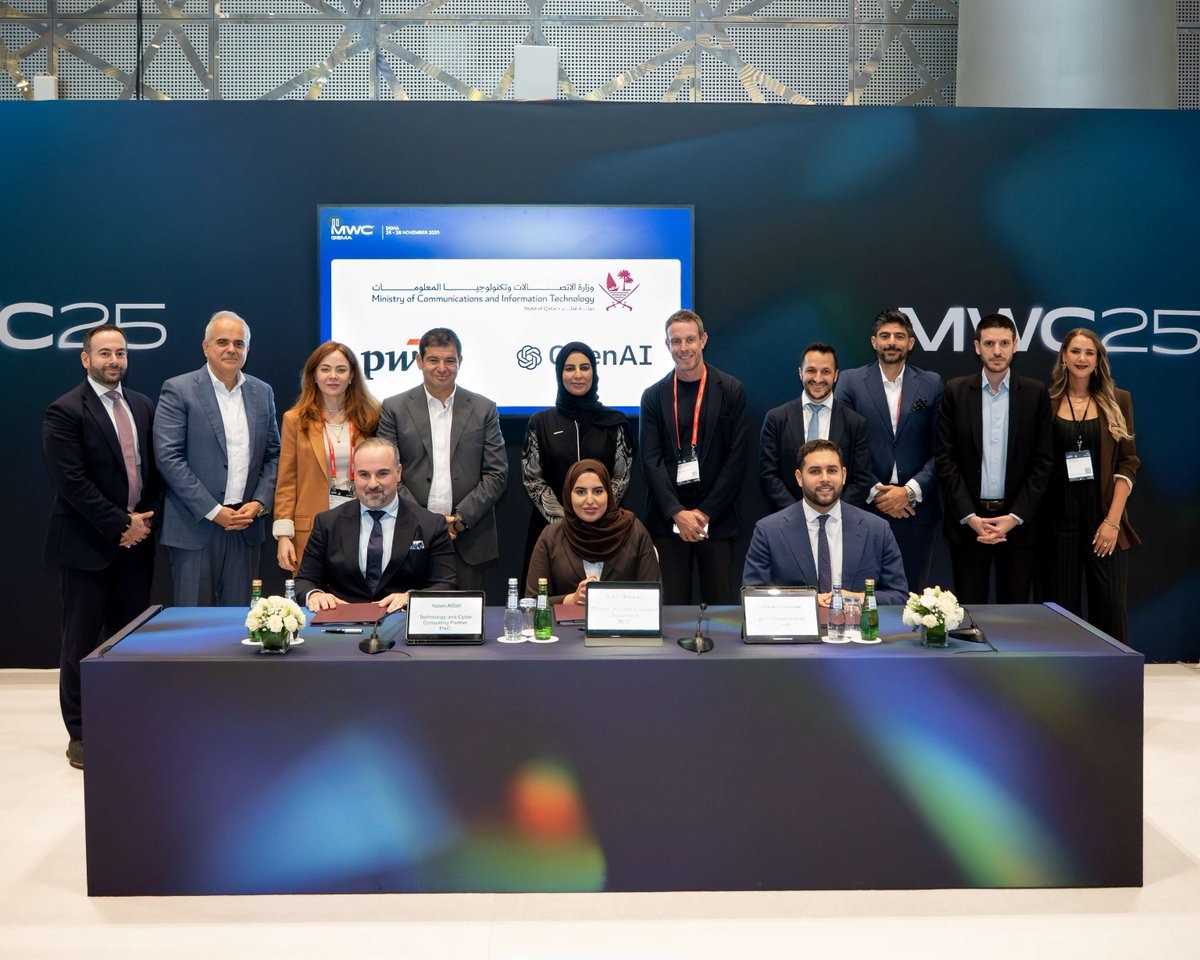
Doha, Qatar: Qatar's Ministry of Communications and Information Technology (MCIT) has signed a cooperation agreement with PwC Middle East and US-based artificial intelligence research organisation OpenAI, marking a significant step toward building an integrated national AI ecosystem.
The partnership aims to accelerate the development of advanced AI infrastructure, expand practical adoption across public and private sectors, and promote the use of innovative, reliable and safe AI solutions to improve operational efficiency and enhance the quality of services.
Under the agreement, the collaboration will focus on three main pillars: establishing a new AI testbed for government entities and startups, boosting productivity across public-sector institutions through tools such as ChatGPT, and designing innovative AI-driven projects in key national sectors.
The initiative also seeks to accelerate Qatar's digital transformation by drawing on global consulting expertise and leading AI models.
The agreement was signed by MCIT's Director of Digital Innovation, Eman Al Kuwari; Consulting Partner at PwC Middle East, Yazan Al Safi; and Head of Enterprise for MENA at OpenAI, Farouk Hamzawi.
Al Kuwari said the collaboration marks a practical step toward building a world-class national AI framework grounded in clear governance and trusted innovation. She noted that the ministry is working to empower government bodies and startups to develop AI-based projects that enhance public services, improve efficiency, and support Qatar’s transition to a sustainable, knowledge-based economy.
She added that the partnership will help accelerate MCIT's initiatives linked to government productivity, the design of pioneering digital projects in vital sectors, and the development of national talent capable of leading and safely deploying AI technologies at scale.
Al Safi of PwC Middle East described the agreement as a commitment to supporting Qatar's efforts to expand AI adoption.
By combining policy leadership, deep advisory expertise and cutting-edge technology, he said, Qatar can move from experimentation to scalable impact.
The focus, he added, is on enabling institutions to adopt AI responsibly, improve citizen experiences, and unlock knowledge-based growth across priority sectors.
Meanwhile, Hamzawi of OpenAI highlighted the cooperation as an opportunity to support Qatar's national priorities through advanced AI tools, helping boost productivity, enhance innovation and drive ambitious economic goals in a safe and responsible manner.
Under the agreement, MCIT will create an enabling environment for government agencies and startups to deploy AI solutions, while PwC Middle East will provide advisory expertise to help entities explore AI opportunities and develop productivity-enhancing initiatives. OpenAI will offer technical support, including access to advanced AI models and participation in the development of the national AI testbed, ensuring global best practices in responsible AI use.
The collaboration brings together the core elements needed to expand AI adoption in Qatar - an advanced testing environment, innovative AI-driven projects, and broadened access to cutting-edge technologies - aimed at driving productivity and supporting the country's digital ambitions.