Banks are expected to witness an overall pick-up in lending book across GCC this year, supported by Government spending. Qatar will see the economic traction related to FIFA2022, while Kuwait has ambitious project plans.
SICO Research noted in its ‘Bank sector’ report that economic growth in GCC continue to be mainly driven by Government spending and are therefore likely to witness challenging times as they gear up for an era of modest crude prices below break-even prices of most countries. Government’s current expenditures remain broadly inelastic; leaving mainly two options, i.e., to lower their capital expenditure and/or raise debt to fund the spending.
Qatar Government budgeted 1.7 percent year-on-year higher expenditure in 2019, despite FIFA 2022 related project deadlines. Of its QR207bn planned expenditure, QR48bn is related to project roll-out or 23 percent of total spending. Qatar has been spending heavily over the past few years on infrastructure and some projects are nearing completion leading to tapering of the spending plan.
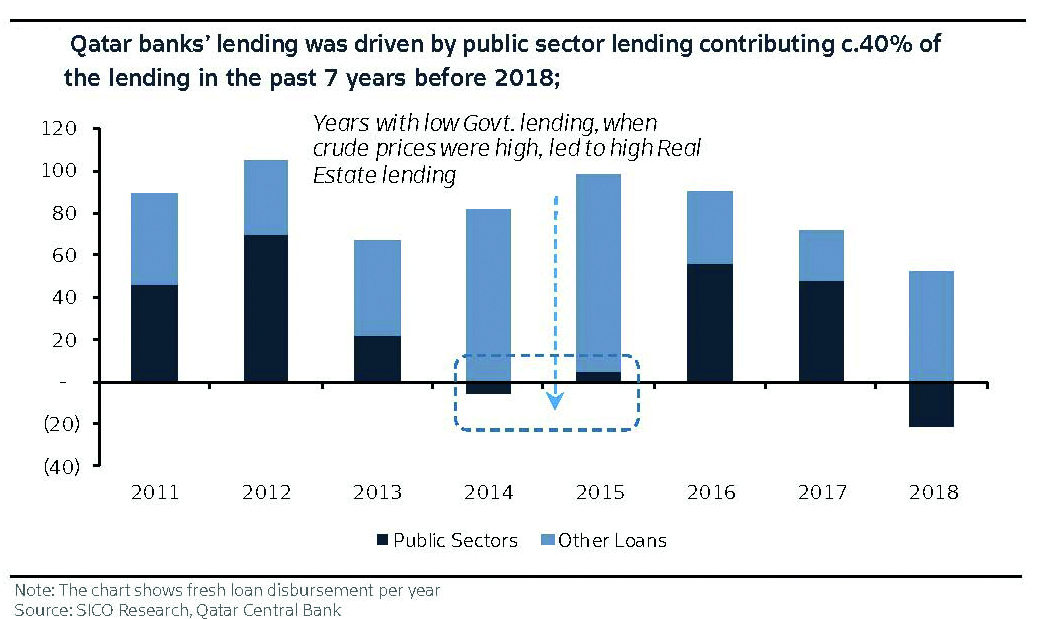
Subdued Government spending is negative for Qatari banks, which are anyway struggling to grow their lending book. The banks grew at a modest 3 percent YoY in 2018 following a robust 12 percent CAGR 2014-17, driven by public sector borrowing. Without strong Government spending SICO sees limited lending opportunities for Qatari banks.
The strong Qatari economic growth has been highly reliant on the real estate sector. Qatar’s real Gross value added (GVA) from construction sector (equivalent of a real GDP growth but at a sectoral level) averaged 18 percent in the past 8 quarters, implying that the real estate based economy is a key driving force of the economic growth.
GCC countries’ monetary policy mimics the Fed policy owning to the pegged currency. In the current rising interest rate environment, all GCC banks were able to increase their asset yields, averaging 46bps higher in 2018 compared with 2017.
SICO is conservatively estimating just 1 rate hike by Fed in the next 3 years, lower than the consensus of 2 hikes in 2019 and more in subsequent years. More than expected rate hikes would be supportive of the banks’ NIM but will be negative for an already challenging economic environment.
Qatari bank’s asset yield expanded by 47bps in 2018 supported by rate hike, however their funding cost outpaced and rose by 57bps. Excluding QNB, the systemic domestic deposits of Qatari banks declined by 10 percent YoY in FY18, which SICO believes was driven by out flux of public sector deposits, leading to liquidity pressure and thereby leading to pick-up in funding cost.