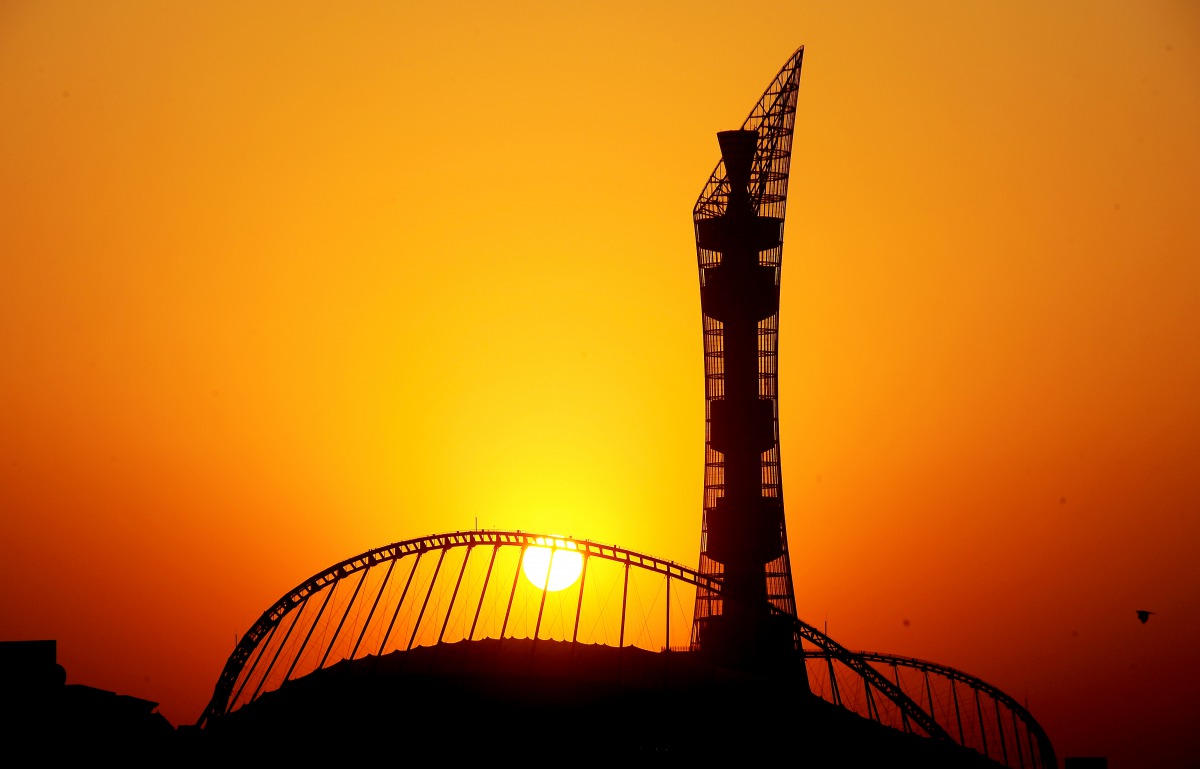
The last sunset of the year 2017 as seen over the Khalifa International Stadium, which is the first stadium ready to host the FIFA World Cup 2022. Pic: Salim Matramkot / The Peninsula
The year 2017 will be remembered as a year of resilience, steadfastness and determination for the State of Qatar as the country and its residents overcame challenges. The unjust siege imposed on Qatar and its people and residents has been at the forefront of the crises that have attracted the attention of the world. It was also a challenge and a real test for the Qatari will and determination. Thanks to God Almighty, and with the wisdom of our leadership, Qatar faced the siege and its challenges with strength, and dealt with the crisis with professionalism and credibility that won the admiration and respect of the world.
Emir’s address
On July 21, the Emir H H Sheikh Tamim bin Hamad Al Thani addressed the citizens and residents on the current situation and future directions of Qatar in light of the Gulf crisis, and affirmed Qatar’s readiness for a solution based on the principles of sovereignty. In the UN General Assembly, the Emir addressed Qatar’s blockade and called “for an unconditional dialogue based on mutual respect for sovereignty”.
2018 Infrastructure Projects
Ashghal will implement infrastructure projects worth QR21.8bn. 90% work on main roads leading to 2022 FIFA World Cup stadiums will be completed. Ashghal will carry out a total of 19 infrastructure projects in 12 areas. The authority will complete 113km of highways, including 20 new main intersections. Nine projects in the health and education field will be completed. A total of 47 factories will be refurbished to boost Qatari industrialists and producers. A total of QR11.08bn were allocated for establishing highways; QR8.88bn for infrastructure and roads and QR1.84bn for sewer pumping stations.
Ownership
The Cabinet approved the draft law on regulating non-Qatari ownership and use of real estate. Non-Qataris may own and use real estate, in the areas and in accordance with the conditions, controls and benefits specified by a decision from the Cabinet and based on the suggestion of the commission for regulating non-Qatari ownership and use of real estate.
National Database
Emir issued Law No. 24 of 2017 on the ‘National Address’. The law stipulates creating a national database of addresses of individuals and entities. The addresses of nationals and expatriates must include details of residency, mobile and land line numbers, e-mail, work address, permanent address abroad if any, and other additional information.
Qatar-US MoU
Qatar and the United States, on July 11, signed a memorandum of understanding on combating the financing of terrorism, and the US State Department confirmed that the memorandum of understanding is a good example for other countries.
Hospital Complex
New hospital complex of Hamad Medical Corporation (HMC) was officially opened in December by Emir H H Sheikh Tamim bin Hamad Al Thani, and it marked the largest healthcare expansion in the region. The hospitals will have 500 new beds as well as 3,000 highly trained clinical and support staff. The new Medical City complex will provide patients with access to an unprecedented level of care by increasing bed capacity and granting faster access to specialised treatment.
WISE Prize
H H Sheikha Moza bint Nasser, Chairperson of Qatar Foundation, presented the sixth WISE Prize for Education to Patrick Awuah, founder and president of Ashesi University College, a private, not-for-profit institution that has become one of Ghana’s premier universities in little over a decade.
Qatar National Library
Qatar National Library, a member of Qatar Foundation, opened its doors for the public in November, offering around one million books in 20 languages. It is destined to become one of the world’s preeminent centres of learning, research, and culture, and also a guardian of the region’s heritage.
Water Storage
The Water Security Mega Reservoirs, an ambitious Project of Qatar General Electricity and Water Corporation (Kahramaa) with one of the largest storage capacity in the world is being implemented smoothly at a cost of QR17bn to meet the growing demand of water in the country.
Labour Camps
The Ministry of Municipality and Environment allocated seven sites for permanent residential labour camps in different areas of the country. With a total area of 6,545,157 sqm, the sites can accommodate up to 197,000 workers.