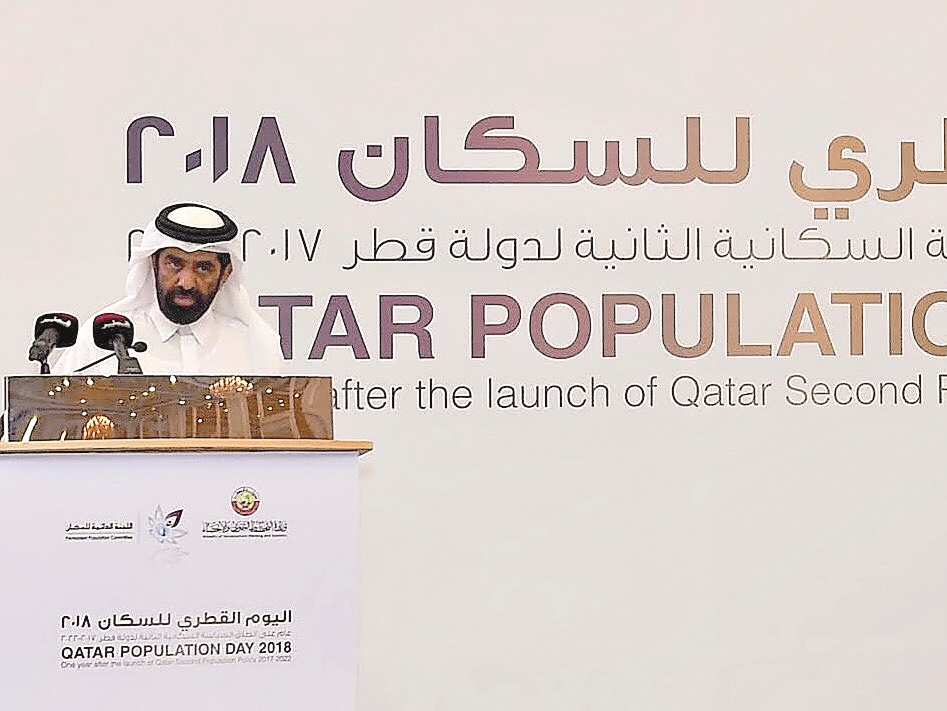
Minister of Development Planning and Statistics H E Dr Saleh bin Mohammad Al Nabit addressing Qatar Population Day, yesterday.
DOHA: Minister of Development Planning and Statistics H E Dr Saleh bin Mohammad Al Nabit, Chairman of Permanent Population Committee (PPC) said Qatar’s population growth rates lean towards gradual stability with improvement of the workforce structure in terms of skills and balance between nationalities and an increase in economic activity participation. This will lead to a more balanced demographic composition and a more sustainable growth rate.
Speaking at Qatar Population Day organised by PPC, the Minister said partnership and institutional work amongst state institutions concerned with development, population and strategic planning issues is a prerequisite for the success of implementing the Qatar Second Population Policy 2017-2022 and confirmed that the PPC provides all the support to promote this partnership. He highlighted that the event comes after a year since the launch of the Qatar Second Population Policy 2017-2022, which saw many achievements in terms of manpower and paying attention to foreign labour, QNA reported. Achievements were also witnessed in education, health and women’s participation in the economy, as well as achievements in other areas.
In the field of education, Dr Al Nabit said Qatar achieved the goals of 2030 Agenda for Sustainable Development before its date, where the efficiency of educational and training institutions has increased and adoption of information technology has been expanded at all levels of education and in various types of training.
Delivering the speech, Minister of Municipality and Environment H E Mohamed bin Abdullah Al Rumaihi said that the Ministry is keen to address the problems of rapid urban growth in accordance with the goals set in the country’s population policy aimed at improving the quality of life of all those living on this land in line with all strategies and plans being implemented.
The Minister said that rapid urban growth in Qatar in general and the city of Doha in particular is one of the requirements of comprehensive development, and at the same time it is also one of the most important aspects of economic and urban progress.
The Minister pointed out that this rapid urban growth carries problems handled by population policy. This policy called for implementing a number of measures that can contribute to overcome these problems, which were considered very seriously by the Ministry, he said, adding it has implemented some of these procedures and is working to implement others in accordance with the time period specified for their implementation.
He said the policy’s attention to the issues of urban growth and environment stems from the fact that the profound economic and social transformations witnessed by the State of Qatar played a prominent role in the concentration of economic, social and cultural services in urban centres, especially the largest ones, which led to the congestion of these centres that accommodate the vast majority of the population. It was necessary to deal with the side effects of that congestion.