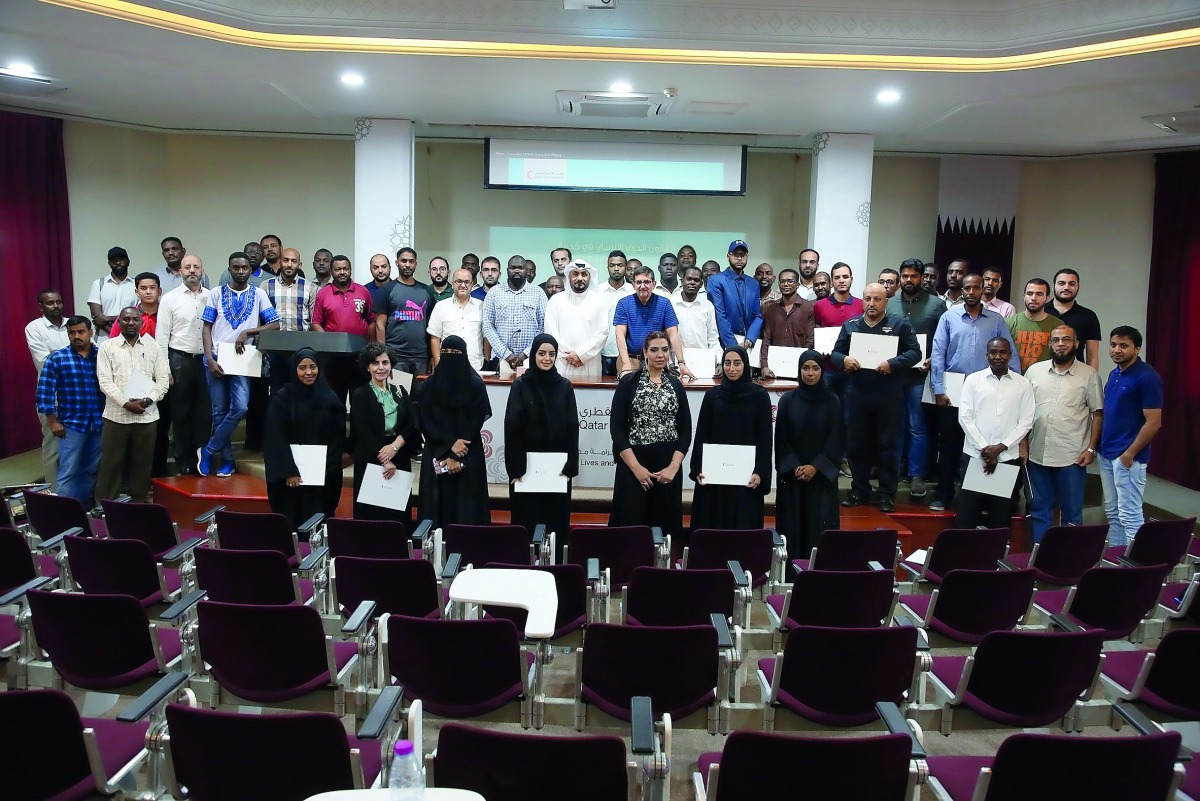
QRCS officials at a programme held to mark International Day of Peace.
DOHA: Qatar Red Crescent Society (QRCS) has celebrated the International Day of Peace, under the theme of “The Right to Peace: 70 Years Universal Declaration of Human Rights”.
Titled “International Humanitarian Law in the Service of Peace and Security”, a lecture was delivered to 50 volunteers by Dr Fawzi Oussedik, Head of International Relations and International Humanitarian Law at QRCS, said a release.
The lecture gave an overview about the definitions, historical background, and legal power of human rights. Dr Oussedik also introduced the Red Cross and Red Crescent concepts as the product of political and historical events, designed to protect civilians and paramedics at times of war.
The work of humanitarian organisations is governed by seven fundamental principles: Humanity, impartiality, neutrality, independence, voluntary service, unity, and universality.
As the world’s biggest network of humanitarian providers, the International Red Cross and Red Crescent comprises the International Federation of the Red Cross and Red Crescent Societies (IFRC), the International Committee of the Red Cross (ICRC), and 190 National Societies representing almost all countries of the world.
The mandate of the Movement is to help the vulnerable and victims of conflict, disaster, or poverty, with no discrimination on the basis of nationality, ethnicity, beliefs, or political background.
The International Humanitarian Law, Dr Oussedik explained, is part of the International Law, consisting of a set of rules and conventions that apply to international and non-international armed conflicts. Their aim is to put an end to conflict and minimise the impact on civilians at the one hand, and to protect the affected populations against legal and human rights violations on the other.
He highlighted intrinsic links between the provisions of the modern International Humanitarian Law and the noble Islamic teachings, which emphasize respect for the rights and dignity of each and every person.
In 1981, the General Assembly of the United Nations adopted the International Day of Peace, as a day devoted to strengthening the ideals of peace, both within and among all nations and peoples.