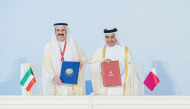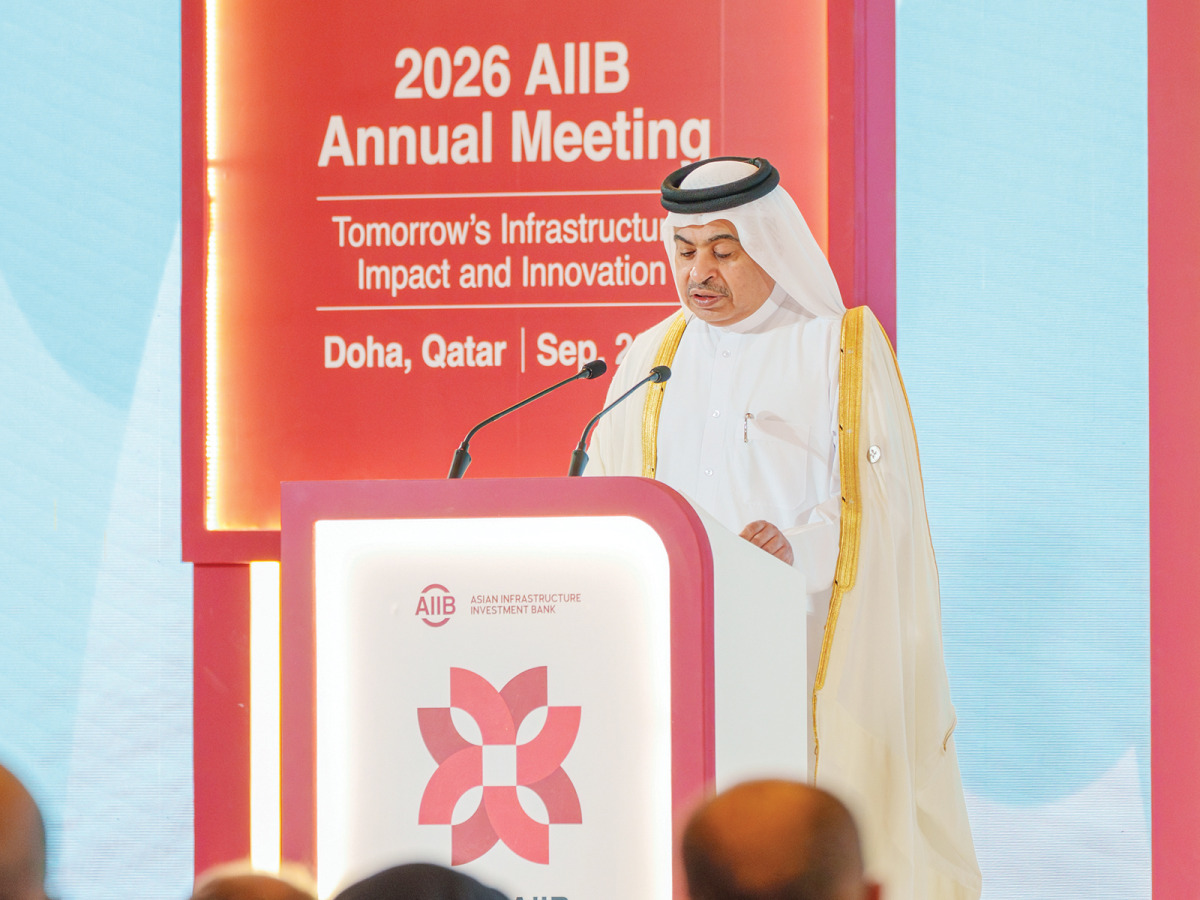
Doha, Qatar: Minister of Finance HE Ali bin Ahmed Al Kuwari underscored the importance of scaling up climate finance to support resilient and sustainable growth, highlighting the need for stronger policy frameworks, risk-sharing mechanisms and greater mobilisation of private sector investment.
Minister Al Kuwari delivered the keynote address during the flagship seminar entitled “Scaling up Climate Finance for Impact: Turning Policy Reform into Resilient Growth”, held as part of the 2026 Annual Meeting of the Asian Infrastructure Investment Bank (AIIB) in Doha, yesterday.
The seminar discussed ways to scale up climate finance and translate policy reforms into growth-enhancing and resilient investments, as well as the role of multilateral development institutions in mobilising finance and strengthening investor confidence.
Minister Al Kuwari stressed that climate finance is most effective when governments put in place the necessary policy foundations, development institutions take on risks that the private sector cannot yet bear, and banks and bond markets then connect projects with long-term sources of finance and investment.
Minister of Finance also highlighted key challenges facing climate finance, including currency risks, rising debt-service burdens and the cost of capital, stressing the importance of strengthening guarantees, risk-sharing mechanisms and local-currency financing.
He further highlighted Qatar’s efforts to support the transition towards a more sustainable economy, including investments in renewable energy, emissions reduction and sustainable finance.
Qatar comes to this discussion as an investor as well as a host, Minister Al Kuwari noted.
“Qatar Energy has moved from a first 800 megawatt solar plant at Al Kharsaah to a 2 gigawatt project at Dukhan and on the way to a 4 gigawatts by 2030 and it’s building carbon capture capacity by 11 million tonnes a year by 2035 alongside the world’s largest blue ammonia plant.
“Our LNG expansion is in large part an investment in helping Asia replacing coal, replacing its harmful impact on climate. Nebras Power operates in eight countries, including Indonesia, Bangladesh, Jordan, Oman, Brazil, and Australia, with a growing share of solar, wind and hydro, and has recently taken on new projects in Oman and Kazakhstan.
The Qatar Investment Authority has backed clean energy platforms in the Ameri-cas, renewable generation in Colombia, and a green transition fund in Spain.
Qatar Fund for Development is a partner of the Green Climate Fund, and in 2024, Qatar issued the region’s first sovereign green bond, $2.5bn, a benchmark that our banks have since followed,” he said.
These are commercial and development decisions that are also climate decisions, and that is the point. Climate finance works when government has done the policy groundwork.
When a development bank has taken the risk that others cannot yet take. And when a bank or a bond market can then connect the project to the world’s long-term savings. Each of those roles is necessary and connected to the other. None is sufficient on its own, Minister of Finance added.
Also, delivering the keynote address, President of AIIB Zou Jiayi highlighted the role of policy reform in turning climate commitments into investment at scale.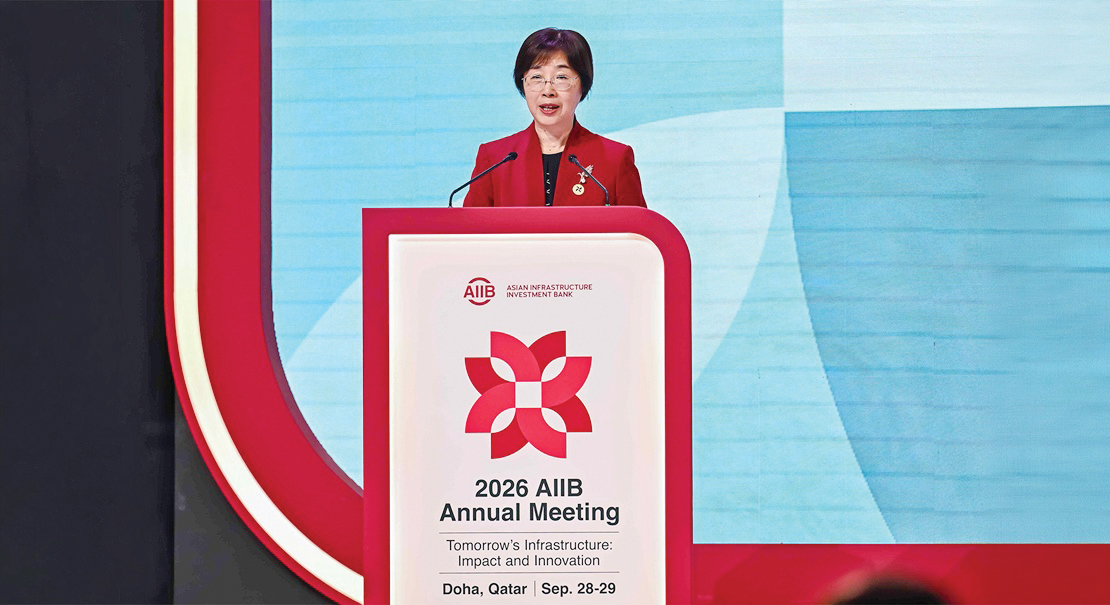 President of AIIB Zou Jiayi delivering the keynote address during the seminar yesterday.
Across AIIB’s membership, governments have established ambitious objectives for cli-mate mitigation, adaptation and low carbon transformation. These commitments are im-portant, but they do not automatically turn into investment and bankable projects.
The critical link between commitment and real investment is policy. Policy helps mobilise capital, facilitate markets, build credible institutions and create an enabling environment for investment to take place.
AIIB’s mission is financing infrastructure for tomorrow, she said.
President of AIIB further noted that supporting climate-related infrastructure is a top priority. But infrastructure does not exist in isolation, it operates within policy and institutional systems. Regulation shapes markets.
Institutions shape implementation. Public finance frameworks influence investment decisions.
These enabling conditions determine whether private capital can participate at scale. This is why AIIB has positioned Climate-Focused Policy-Based Financing (CPBF), as an important infrastructure financing instrument, she added.
AIIB introduced CPBF in 2024 to support member-led policy and institutional reform programmes that scale up climate finance and accelerate the transition towards a low-carbon and climate-resilient future.
It emphasises adaptation, private capital mobilisation, and tangible links to climate-related infrastructure investment. In simple terms, CPBF is intended to build a bridge between climate policy and infrastructure investment. It can support reforms that individual investment projects cannot deliver on their own.
Climate change is urgent, infrastructure needs are immense, fiscal space is con-strained.
President of AIIB said, “To address these challenges, we need policy reform. Policy reform will make investment happen. Our early CPBF experience demonstrates strong demand for upstream policy support and significant potential to connect that support with infrastructure investment. AIIB can make a contribution by using CPBF as an instrument to deliver impact.”