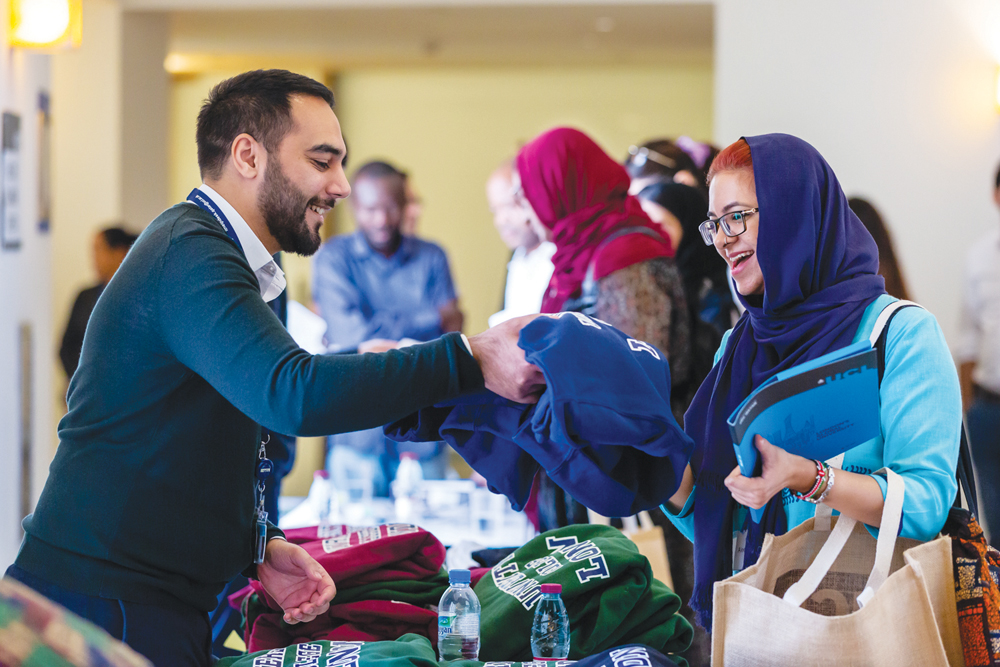
The Class of 2020 is one of the most diverse in UCL Qatar’s history.
UCL Qatar celebrated its last student induction week this week, welcoming 51 accepted students from around the world for the university’s final academic year.
UCL Qatar’s rigorous MA Programmes, first launched in Qatar in 2010, have allowed students to pursue higher levels of expertise within the field of culture and heritage, and apply skills accumulated during their studies in practical environments. Since its inauguration, UCL Qatar has been a core contributor to the country’s cultural heritage and knowledge management sector and graduated over 200 students, of which 21 percnegt are Qatari.
The class of 2020 is one of the most diverse in UCL Qatar’s history, representing 26 nationalities and comprised of 61 percent female and 39 percent male students. Many of the new arrivals have a deep passion for delivering on Qatar’s wider promise of developing its knowledge-based economy and hope to expand the cultural heritage sector in the country.
Throughout its nearly decade-long presence in Qatar, hundreds of UCL Qatar graduates have made significant contributions to the broader development of a knowledge-based economy in Qatar. Graduates are working towards the development of the country’s cultural heritage and knowledge management sector across iconic institutions like Qatar Museums, Qatar National Library and the British Library, among many others.
Somaya Ahmad Al Tamimi, Director of Strategy and Quality Assurance at Qatar Museums, mentioned that “UCL provided me with the opportunity to study a field that is significant to Qatar’s heritage and has contributed significantly in my professional career; especially that I was promoted at Qatar Museums after graduating from UCL Qatar.”
Speaking about how her MA has helped her achieve success in the workplace, Shaima Sherif, Executive Education and Public Engagement Coordinator at UCL Qatar, said, “UCL Qatar was the perfect choice for its multidisciplinary modules and its teaching staff who went above and beyond in and outside the classroom to help me achieve my academic and personal goals.”
Another graduate, Fareed Al Shishani, who is now working as a Conservation Technologist at the Distinctive Collections of the Qatar National Library, said, “UCL Qatar expanded my theoretical knowledge and practical skills, which has helped me contribute to the field of cultural heritage conservation. It also allowed me to put to test the knowledge and expertise gained at UCL Qatar into my new professional environment.”
Dr Sam Evans, Director of UCL Qatar, looked back at the institution’s time in the country and said: “In the past 10 years, our faculty, staff and alumni have been instrumental to our work here in Qatar, which has supported the development of the country’s cultural heritage institutions. We have worked diligently to achieve the ambitious goals of the Qatar National Vision 2030 and made major strides in the development of the knowledge management sector as a result. I look forward to seeing the continuous impact our students will have in Qatar and beyond and am immensely proud of the legacy UCL Qatar has built in the country.”