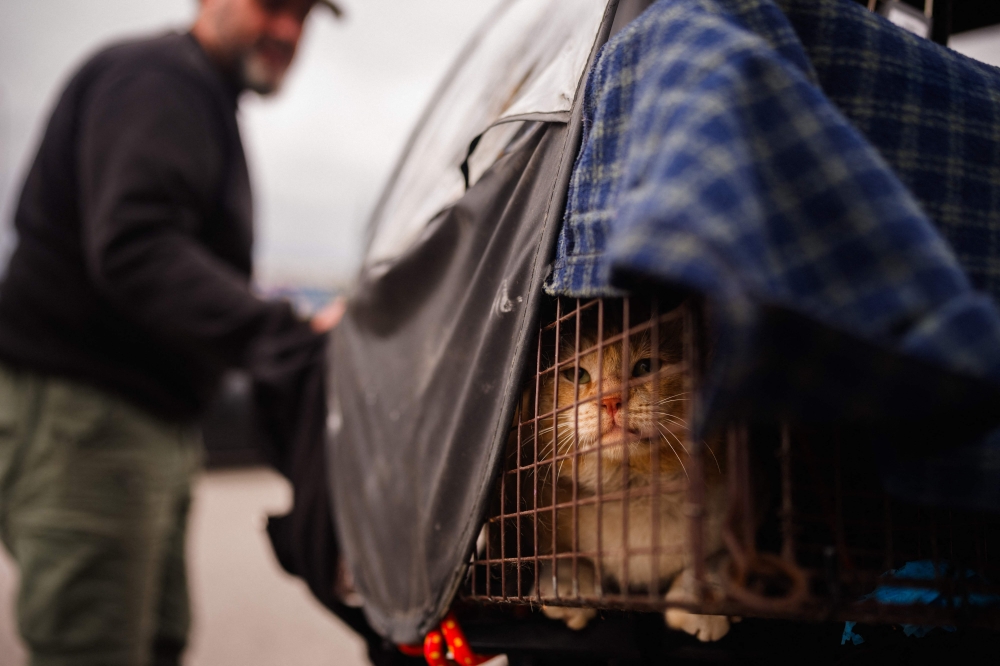
A member of a rescue team from Lebanese NGO Animals Lebanon checks a cat that was just rescued from Beirut's southern suburbs on March 26, 2026. (Photo by Dimitar Dilkoff / AFP)
Beirut, Lebanon: Armed with thick gloves and small plastic crates Kamal, Khalil and Reem jump on two mopeds and head into Beirut's southern suburbs, which see almost daily strikes by Israeli aircraft.
Hands scarred by a thousand bites and scratches, the small rescue team from Lebanese NGO Animals Lebanon uses two-wheelers to navigate streets made narrow by piles of rubble as they search for trapped animals.
In drizzling rain, the team is responding to two calls, passing from crammed central districts filled with people seeking safety into increasingly abandoned streets where Israeli airstrikes are concentrated.
The duo are seeking a pet cat they've been trying to trap for a week since it jumped through a bombed-out ground-floor window, and another showing signs of paralysis, they think from a recent Israeli bombing.
"We never lose hope that the cat we can't find is still around, because it will come back. This is its refuge," says volunteer Khalil Hamieh, 45.
Lebanon was pulled into the Middle East war on March 2 when Tehran-backed Hezbollah fired rockets towards Israel to avenge the US-Israeli killing of Iran's supreme leader Ayatollah Ali Khamenei.
Israel has responded with large-scale strikes on Lebanon and a ground offensive in the country's south.
On the edge of Haret Hreik in Beirut's southern suburbs, where Hezbollah exercises a measure of de facto authority, Hamieh's colleague Issam Attar stops the jeep that will bring the rescued cats to hospital.
The mopeds can navigate onwards on two wheels, and escape quickly if an Israeli strike is announced.
'A living being'
Between Israeli air raids and Hezbollah saying filming in the southern suburbs is "strictly prohibited", media access has become more complicated lately, and AFP journalists remained outside with Attar.
"It's a living being," Attar said of why he rescues animals. "It's not guilty of wars or anything else."
"Besides the fact that we feel for animals, there's also the owners who can't get their animals -- we can, and we want to help them."
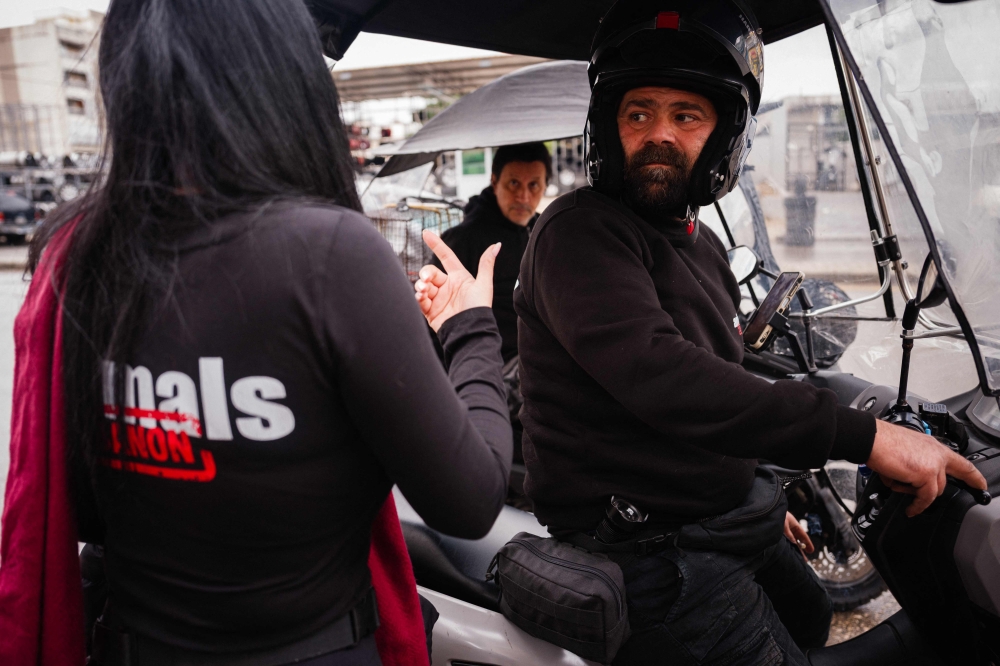 Members of a rescue team from Lebanese NGO Animals Lebanon head to Beirut's southern suburbs on March 26, 2026. (Photo by Dimitar Dilkoff / AFP)
Animals Lebanon told AFP its teams had rescued 241 animals from south Lebanon and Beirut's southern suburbs, areas under heavy bombardment since the start of the war.
In addition to killing over 1,100 people, the war has displaced over a million, according to Lebanese authorities.
In this city without air-raid sirens, gunshots into the air warn people of incoming Israeli airstrikes.
The shooting and the ensuing explosions terrify cats especially, Animals Lebanon Operation Manager Reem Sadek said, and many families can't find their pets as they rush to evacuate.
"Cats in particular, when there's a strike, they panic," she said.
"We're perhaps the only people with the experience to find... and capture them."
Some of the cats can't be immediately reunited with their owners, who have nowhere to keep them as they sleep rough on the streets or crowd into shelters, so the cats stay at the Animals Lebanon office.
'Risking our lives'
The war has made everything more complicated for the rescuers, including the evacuation from Lebanon of a five-month-old lion cub, still small but growing bigger by the day inside their office.
They confiscated her from wildlife traffickers shortly before the war broke out, as they were searching for another trafficked lion cub that they later tracked to Lebanon's rural northeast.
The airlines capable of bringing the lions from Lebanon to South Africa are not flying due to the war, so they're trying to evacuate the cubs to Cyprus by boat.
For now, the Animals Lebanon team continues its rescue missions -- as well as missions to feed stray animals and distribute food and veterinary medicine in places where displaced people are staying.
"We know we're risking our lives, and not just because of the shelling," Hamieh says, showing the scarred backs of his hands after they successfully rescued both cats and brought them out of the danger area.
"We're afraid of a fight with a cat or a dog while trying to save it," he says, "because it doesn't understand what we're doing."