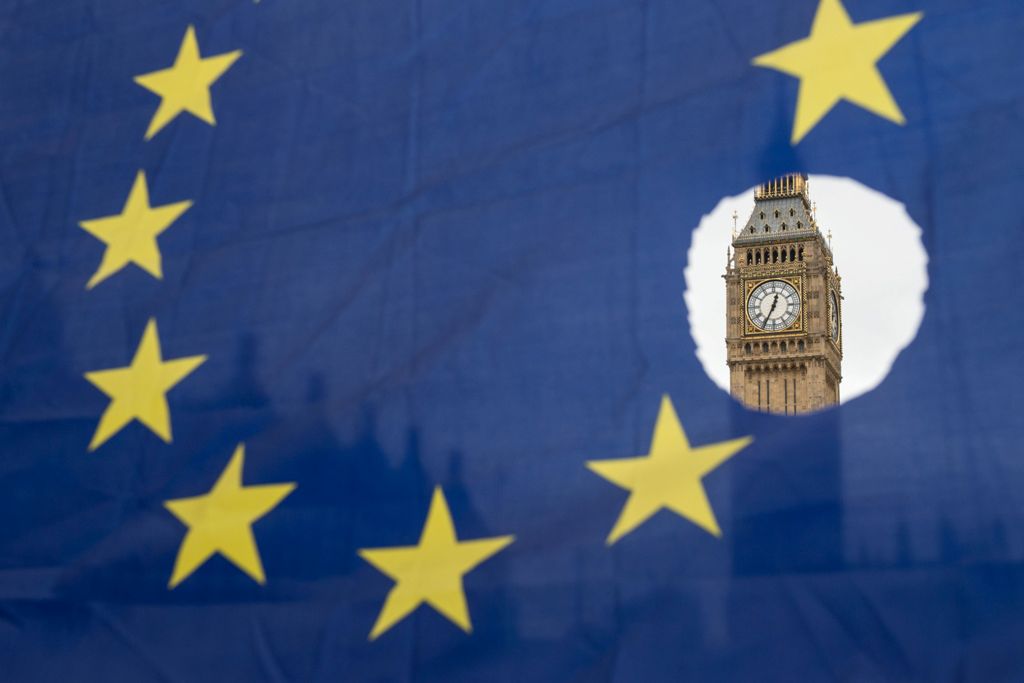
A pro-remain protester holds up an EU flag with one of the stars symbolically cut out in front of the Houses of Parliament shortly after British Prime Minister Theresa May announced to the House of Commons that Article 50 had been triggered in London on M
London: Britain and the European Union must "work hard" to avoid a failure in Brexit negotiations, Prime Minister Theresa May said in the letter formally launching the process, calling it a "momentous" challenge.
May also called for talks on Britain's exit and on future trade ties to be worked out "alongside" each other, although the EU has said the new trading relationship should only be discussed after Brexit is agreed.
In her letter, which was hand-delivered to EU president Donald Tusk in Brussels by Britain's EU ambassador Tim Barrow, May struck a conciliatory tone and called for a new "bold and ambitious" free trade deal with the bloc.
She said she wanted a "deep and special partnership" that would take in both security and economic cooperation.
"Europe's security is more fragile today than at any time since the end of the Cold War," she said.
She also said that both Britain and the EU "would of course cope" if the negotiations fall through and the two sides are forced to fall back on World Trade Organization tariffs to trade with each other.
But she added: "It is not the outcome that either side should seek. We must therefore work hard to avoid that outcome."
British business leaders have warned about the prospect of a "no deal" scenario and May had said in a speech in January that "no deal is better than a bad deal".
Below is the text of the letter British Prime Minister Theresa May sent to European Council President Donald Tusk triggering Article 50 of the EU's Lisbon Treaty, the formal start of the process by which Britain will leave the European Union.
Dear President Tusk,
On 23 June last year, the people of the United Kingdom voted to
leave the European Union. As I have said before, that decision
was no rejection of the values we share as fellow Europeans.
Nor was it an attempt to do harm to the European Union or any of
the remaining member states. On the contrary, the United
Kingdom wants the European Union to succeed and prosper.
Instead, the referendum was a vote to restore, as we see it, our
national self-determination. We are leaving the European Union,
but we are not leaving Europe – and we want to remain committed
partners and allies to our friends across the continent.
Earlier this month, the United Kingdom Parliament confirmed the
result of the referendum by voting with clear and convincing
majorities in both of its Houses for the European Union
(Notification of Withdrawal) Bill. The Bill was passed by
Parliament on 13 March and it received Royal Assent from Her
Majesty The Queen and became an Act of Parliament on 16 March.
Today, therefore, I am writing to give effect to the democratic
decision of the people of the United Kingdom. I hereby notify
the European Council in accordance with Article 50(2) of the
Treaty on European Union of the United Kingdom’s intention to
withdraw from the European Union. In addition, in accordance
with the same Article 50(2) as applied by Article 106a of the
Treaty Establishing the European Atomic Energy Community, I
hereby notify the European Council of the United Kingdom’s
intention to withdraw from the European Atomic Energy Community.
References in this letter to the European Union should therefore
be taken to include a reference to the European Atomic Energy
Community.
This letter sets out the approach of Her Majesty’s Government to
the discussions we will have about the United Kingdom’s
departure from the European Union and about the deep and special
partnership we hope to enjoy – as your closest friend and
neighbour – with the European Union once we leave. We believe
that these objectives are in the interests not only of the
United Kingdom but of the European Union and the wider world
too.
It is in the best interests of both the United Kingdom and the
European Union that we should use the forthcoming process to
deliver these objectives in a fair and orderly manner, and with
as little disruption as possible on each side. We want to make
sure that Europe remains strong and prosperous and is capable of
projecting its values, leading in the world, and defending
itself from security threats. We want the United Kingdom,
through a new deep and special partnership with a strong
European Union, to play its full part in achieving these goals.
We therefore believe it is necessary to agree the terms of our
future partnership alongside those of our withdrawal from the
European Union.
The Government wants to approach our discussions with ambition,
giving citizens and businesses in the United Kingdom and the
European Union – and indeed from third countries around the
world – as much certainty as possible, as early as possible.
I would like to propose some principles that may help to shape
our coming discussions, but before I do so, I should update you
on the process we will be undertaking at home, in the United
Kingdom.
The process in the United Kingdom
As I have announced already, the Government will bring forward
legislation that will repeal the Act of Parliament – the
European Communities Act 1972 – that gives effect to EU law in
our country. This legislation will, wherever practical and
appropriate, in effect convert the body of existing European
Union law (the “acquis”) into UK law. This means there will be
certainty for UK citizens and for anybody from the European
Union who does business in the United Kingdom. The Government
will consult on how we design and implement this legislation,
and we will publish a White Paper tomorrow. We also intend to
bring forward several other pieces of legislation that address
specific issues relating to our departure from the European
Union, also with a view to ensuring continuity and certainty, in
particular for businesses. We will of course continue to fulfil
our responsibilities as a member state while we remain a member
of the European Union, and the legislation we propose will not
come into effect until we leave.
From the start and throughout the discussions, we will negotiate
as one United Kingdom, taking due account of the specific
interests of every nation and region of the UK as we do so.
When it comes to the return of powers back to the United
Kingdom, we will consult fully on which powers should reside in
Westminster and which should be devolved to Scotland, Wales and
Northern Ireland. But it is the expectation of the Government
that the outcome of this process will be a significant increase
in the decision-making power of each devolved administration.
Negotiations between the United Kingdom and the European Union
The United Kingdom wants to agree with the European Union a deep
and special partnership that takes in both economic and security
cooperation. To achieve this, we believe it is necessary to
agree the terms of our future partnership alongside those of our
withdrawal from the EU.
If, however, we leave the European Union without an agreement
the default position is that we would have to trade on World
Trade Organisation terms. In security terms a failure to reach
agreement would mean our cooperation in the fight against crime
and terrorism would be weakened. In this kind of scenario, both
the United Kingdom and the European Union would of course cope
with the change, but it is not the outcome that either side
should seek. We must therefore work hard to avoid that outcome.
It is for these reasons that we want to be able to agree a deep
and special partnership, taking in both economic and security
cooperation, but it is also because we want to play our part in
making sure that Europe remains strong and prosperous and able
to lead in the world, projecting its values and defending itself
from security threats. And we want the United Kingdom to play
its full part in realising that vision for our continent.
Proposed principles for our discussions
Looking ahead to the discussions which we will soon begin, I
would like to suggest some principles that we might agree to
help make sure that the process is as smooth and successful as
possible.
i. We should engage with one another constructively and
respectfully, in a spirit of sincere cooperation. Since I
became Prime Minister of the United Kingdom I have listened
carefully to you, to my fellow EU Heads of Government and the
Presidents of the European Commission and Parliament. That is
why the United Kingdom does not seek membership of the single
market: we understand and respect your position that the four
freedoms of the single market are indivisible and there can be
no “cherry picking”. We also understand that there will be
consequences for the UK of leaving the EU: we know that we will
lose influence over the rules that affect the European economy.
We also know that UK companies will, as they trade within the
EU, have to align with rules agreed by institutions of which we
are no longer a part – just as UK companies do in other overseas
markets.
ii. We should always put our citizens first. There is obvious
complexity in the discussions we are about to undertake, but we
should remember that at the heart of our talks are the interests
of all our citizens. There are, for example, many citizens of
the remaining member states living in the United Kingdom, and UK
citizens living elsewhere in the European Union, and we should
aim to strike an early agreement about their rights.
iii. We should work towards securing a comprehensive agreement.
We want to agree a deep and special partnership between the UK
and the EU, taking in both economic and security cooperation. We
will need to discuss how we determine a fair settlement of the
UK’s rights and obligations as a departing member state, in
accordance with the law and in the spirit of the United
Kingdom’s continuing partnership with the EU. But we believe it
is necessary to agree the terms of our future partnership
alongside those of our withdrawal from the EU.
iv. We should work together to minimise disruption and give as
much certainty as possible. Investors, businesses and citizens
in both the UK and across the remaining 27 member states – and
those from third countries around the world – want to be able to
plan. In order to avoid any cliff-edge as we move from our
current relationship to our future partnership, people and
businesses in both the UK and the EU would benefit from
implementation periods to adjust in a smooth and orderly way to
new arrangements. It would help both sides to minimise
unnecessary disruption if we agree this principle early in the
process.
v. In particular, we must pay attention to the UK’s unique
relationship with the Republic of Ireland and the importance of
the peace process in Northern Ireland. The Republic of Ireland
is the only EU member state with a land border with the United
Kingdom. We want to avoid a return to a hard border between our
two countries, to be able to maintain the Common Travel Area
between us, and to make sure that the UK’s withdrawal from the
EU does not harm the Republic of Ireland. We also have an
important responsibility to make sure that nothing is done to
jeopardise the peace process in Northern Ireland, and to
continue to uphold the Belfast Agreement.
vi. We should begin technical talks on detailed policy areas as
soon as possible, but we should prioritise the biggest
challenges. Agreeing a high-level approach to the issues arising
from our withdrawal will of course be an early priority. But we
also propose a bold and ambitious Free Trade Agreement between
the United Kingdom and the European Union. This should be of
greater scope and ambition than any such agreement before it so
that it covers sectors crucial to our linked economies such as
financial services and network industries. This will require
detailed technical talks, but as the UK is an existing EU member
state, both sides have regulatory frameworks and standards that
already match. We should therefore prioritise how we manage the
evolution of our regulatory frameworks to maintain a fair and
open trading environment, and how we resolve disputes. On the
scope of the partnership between us – on both economic and
security matters – my officials will put forward detailed
proposals for deep, broad and dynamic cooperation.
vii. We should continue to work together to advance and protect
our shared European values. Perhaps now more than ever, the
world needs the liberal, democratic values of Europe. We want
to play our part to ensure that Europe remains strong and
prosperous and able to lead in the world, projecting its values
and defending itself from security threats.The task before us
As I have said, the Government of the United Kingdom wants to
agree a deep and special partnership between the UK and the EU,
taking in both economic and security cooperation. At a time
when the growth of global trade is slowing and there are signs
that protectionist instincts are on the rise in many parts of
the world, Europe has a responsibility to stand up for free
trade in the interest of all our citizens. Likewise, Europe’s
security is more fragile today than at any time since the end of
the Cold War. Weakening our cooperation for the prosperity and
protection of our citizens would be a costly mistake. The United
Kingdom’s objectives for our future partnership remain those set
out in my Lancaster House speech of 17 January and the
subsequent White Paper published on 2 February.
We recognise that it will be a challenge to reach such a
comprehensive agreement within the two-year period set out for
withdrawal discussions in the Treaty. But we believe it is
necessary to agree the terms of our future partnership alongside
those of our withdrawal from the EU. We start from a unique
position in these discussions – close regulatory alignment,
trust in one another’s institutions, and a spirit of cooperation
stretching back decades. It is for these reasons, and because
the future partnership between the UK and the EU is of such
importance to both sides, that I am sure it can be agreed in the
time period set out by the Treaty.
The task before us is momentous but it should not be beyond us.
After all, the institutions and the leaders of the European
Union have succeeded in bringing together a continent blighted
by war into a union of peaceful nations, and supported the
transition of dictatorships to democracy. Together, I know we
are capable of reaching an agreement about the UK’s rights and
obligations as a departing member state, while establishing a
deep and special partnership that contributes towards the
prosperity, security and global power of our continent.Yours sincerely,