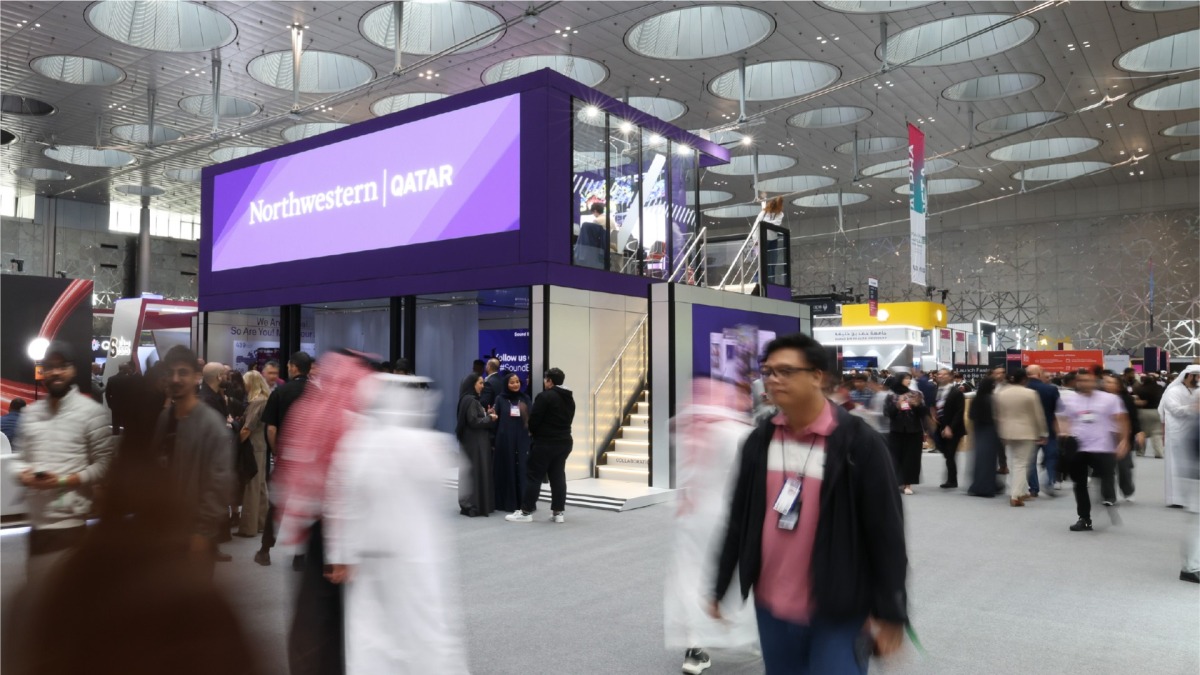
A view of Northwestern Qatar’s two-storey booth at the upcoming Web Summit Qatar 2026.
Doha, Qatar: For the third consecutive year, Northwestern University in Qatar (NUQ) will be present at the Web Summit Qatar with an expanded presence, underscoring its growing role in global conversations on technology, media, and communication.
Building on its participation over the past two years, the University will deliver an enhanced programme featuring research-driven discussions, creative showcases, and applied insights from its academic community.
“Our return to Web Summit heralds NU-Q’s broader engagement at the cutting edge of digital transformation. It reflects our commitment to deepen the impact of our expertise globally,” said dean and CEO of NUQ Marwan M. Kraidy in a statement. “It’s exciting to see research, teaching, and creative practice come together in ways that actually connect with real-world challenges. I’m proud of the talent and ideas our community is bringing to the table.”
NUQ at Web Summit Qatar 2026 will focus on key themes including technology, artificial intelligence, digital culture, and media, with contributions from the Institute for Advanced Study in the Global South, Artificial Intelligence and Media (AIM) Lab, the Media Majlis Museum, Executive Education, and faculty, students, and researchers from Northwestern’s Qatar and Evanston campuses. While Web Summit Qatar is best known as a gathering for start-ups, investors and industry leaders, the Media Majlis Museum sees its participation as essential to broadening the conversation. Speaking to The Peninsula, Director of the Media Majlis Museum Alfredo Cramerotti said the institution’s role is to translate industry-led discussions into meaningful public engagement.
“While Web Summit Qatar is primarily an industry-driven gathering focused on start-ups and business, it is important for us to be part of this conversation,” Cramerotti said. “As both a journalism and communication school and a museum, our role is to unpack industry discourse and make it accessible to a wider public without diluting its complexity.”
He likened the museum’s approach to cultural storytelling platforms, noting that presentation is often as important as originality. “Not necessarily revealing something entirely new, but presenting ideas in unexpected and engaging forms,” he said, adding that “even complex subjects can be made enjoyable, accessible and informative.”
Northwestern University in Qatar’s presence at Web Summit has grown steadily, with marking its appearance with a full architectural design booth. Northwestern Qatar will lead with a larger, two-storey booth designed as an interactive hub for learning, dialogue, and collaboration. The space includes presentation areas, engagement platforms, and a dedicated podcast studio, enabling multiple modes of interaction with visitors. “The Media Majlis Museum has always been a core part of Northwestern’s presence at Web Summit Qatar, as it sits at the intersection of media, technology and cultural expression, precisely the centre of what we do,” Cramerotti said. For 2026, the museum will present a three-strand programme titled Meme, Machine and New Realities, offering what Cramerotti described as “a triad of complementary approaches” rather than a single narrative.
The programme opens with contributions from artist Tarek Darwish and exhibition catalogue editor Birna Yed, both invited specifically for Web Summit Qatar. Darwish, whose work explores the boundary between physical and digital forms, will present his creative process, while Yed will examine contemporary publishing and the shifting relationship between print and digital media.
Two live podcast sessions will also take place, linked to the museum’s ongoing exhibition What’s between, between?. One brings together co-curator Amal Zeyad Ali and Cramerotti to discuss ideas of “futures” in the Gulf, while the second features curator Jack Thomas Taylor and Cramerotti reflecting on curatorial practice and the challenge of making complex information accessible.
Completing the programme is a VR presentation representing the “machine” strand, building on earlier digital works and introducing new narrative elements. “Commissioning new material, new narratives, stories and artistic productions is fundamental to our role as a museum and academic institution,” Cramerotti said.