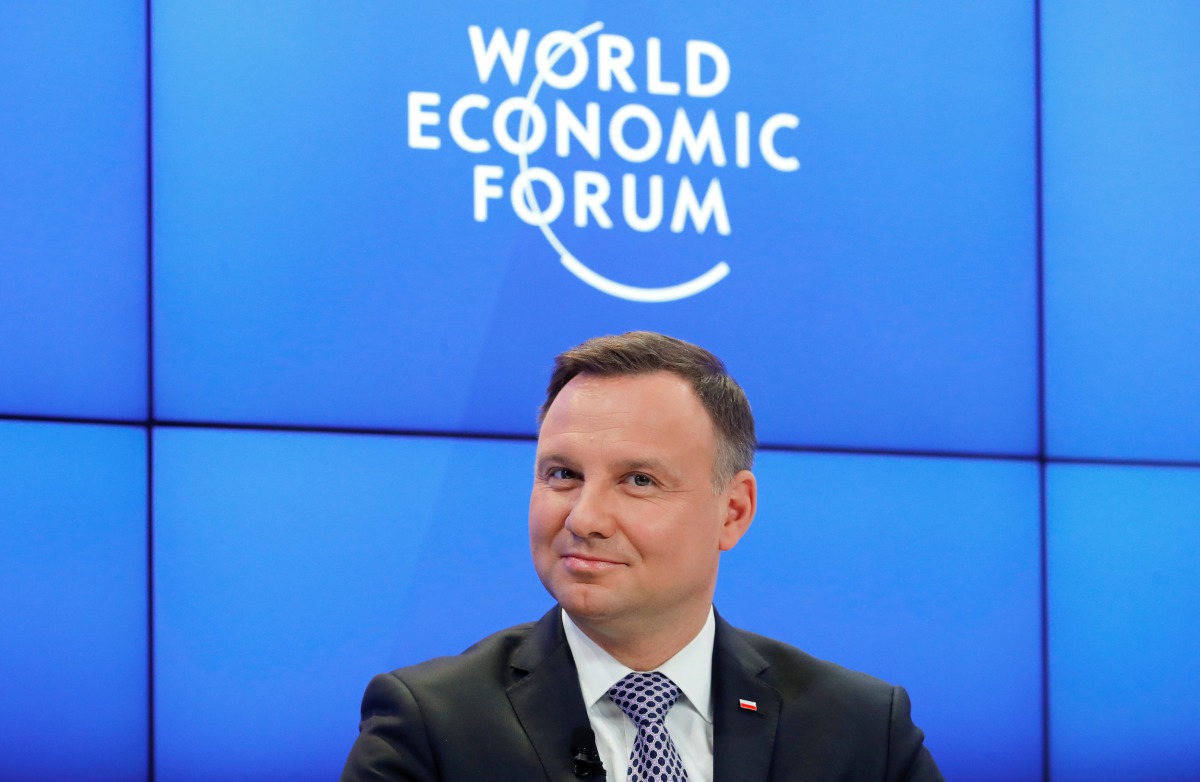
Poland's President Andrzej Duda said in a statement on Sunday that he would present his "final evaluation of procedural legal provisions after the completion of parliament's work and a careful analysis of the final shape of the act".
Warsaw: Poland's president on Sunday vowed to review a new bill regarding the Holocaust and the definition of Nazi death camps, after the measure sparked a diplomatic row with Israel.
Poland's rightwing-dominated parliament on Friday adopted legislation that sets fines or a maximum three-year jail term for anyone who refers to Nazi German death camps as being Polish.
The measure, intended to apply to both Poles and foreigners, must still pass the Senate before being signed by the president.
Poland's President Andrzej Duda said in a statement on Sunday that he would present his "final evaluation of procedural legal provisions after the completion of parliament's work and a careful analysis of the final shape of the act".
The bill includes an article that applies a fine or up to three years in jail to anyone who ascribes "responsibility or co-responsibility to the Polish nation or state for crimes committed by the German Third Reich -- or other crimes against humanity, peace and war crimes".
Israel's ambassador to Poland Anna Azari told the Polish PAP news agency that Israel believes the latter article could open the door to Holocaust survivors being prosecuted for their testimony should it concern the involvement of Poles in war crimes.
'Rewriting history'
Azari said that while Israel's government rejects the legislation, it also "understands" who built death camps like Auschwitz and that it was "not the Poles".
Duda appeared to address these concerns by saying that "everyone whose personal memory or historical research speaks the truth about the crimes and shameful behaviour that occurred in the past with the participation of Poles has full right to this truth".
A top Duda aide was set to meet with Azari on Monday in Warsaw, after Israel summoned a top Polish diplomat to express concerns over the legislation on Sunday.
Polish officials routinely request corrections when global media or politicians describe as "Polish" the former death camps such as Auschwitz set up by Nazi Germany in occupied Poland.
Prime Minister Benjamin Netanyahu has accused Poland of seeking to deny history with the bill.
"We have no tolerance for the distortion of the truth and rewriting history or denying the Holocaust," Netanyahu said on Sunday.
Jewish heartland
Yad Vashem, the Holocaust memorial in Jerusalem, said it opposed the new legislation, but also noted there was "no doubt that the term 'Polish death camps' is a historical misrepresentation".
"However, restrictions on statements by scholars and others regarding the Polish people's direct or indirect complicity with the crimes committed on their land during the Holocaust are a serious distortion," it said.
Pre-war Poland was a Jewish heartland, with a centuries-old community numbering some 3.2 million, or around 10 percent of the country's population.
When the country was occupied by Nazi Germany in World War II, it lost six million of its citizens -- including three million Jews in the Holocaust.
Poland's Prime Minister Mateusz Morawiecki reacted via Twitter on Sunday with a metaphor referring to the fate of his country's Jewish and non-Jewish citizens during the war.
"A gang of professional thugs enters a two-family house. They kill the first family almost entirely. They kill the parents of the second, torturing the kids. They loot and raze the house. Could one, in good conscience, say that the second family is guilty for the murder of the first?," he asked.
After attending Saturday ceremonies in Auschwitz marking the 73rd anniversary of its liberation, Morawiecki, a trained historian, also remarked that "Auschwitz-Birkenau is not a Polish name, and Arbeit Macht Frei is not a Polish phrase".
He was referring to the words on the Nazi camp's infamous wrought-iron gate that mean "Work makes you free" in German.