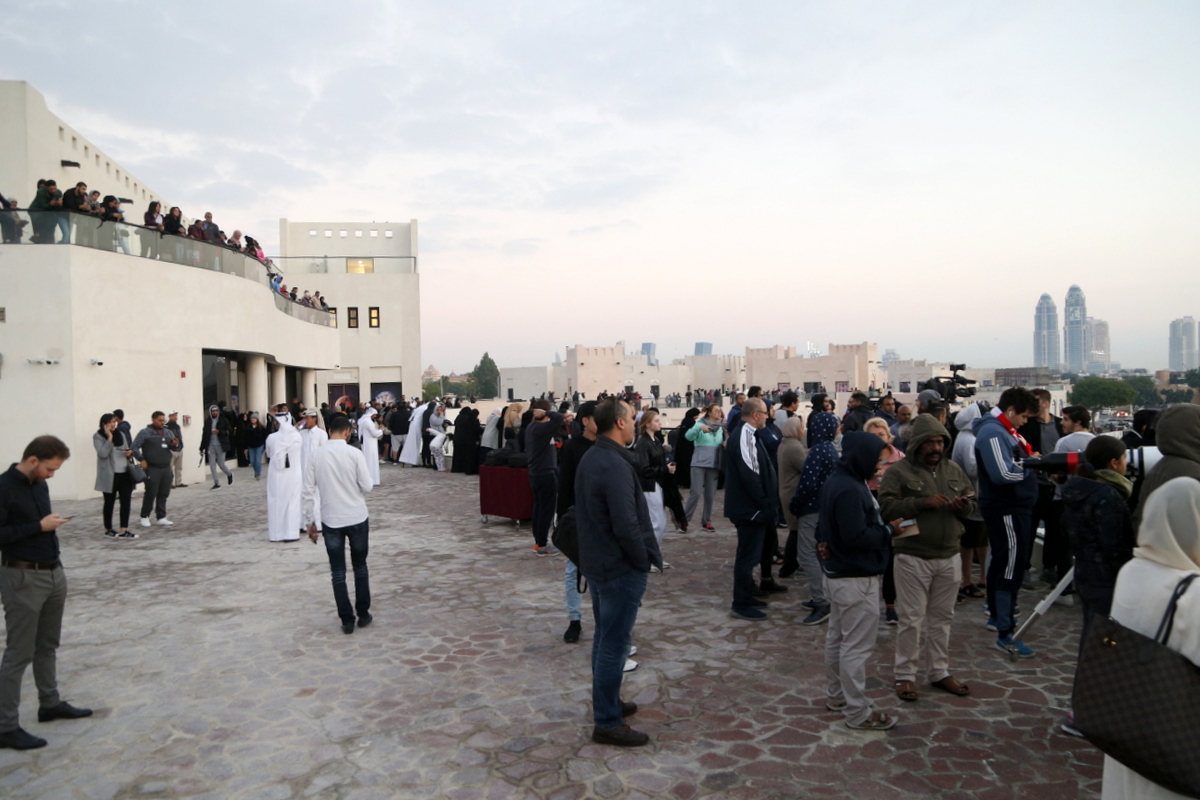
Skywatchers throng Al Thuraya Planetarium to witness the annular solar eclipse last morning. Al Thuraya Planetarium provided telescopes with high scientific specifications as well as special glasses to skywatchers for eye protection.
A large number of skywatchers thronged Katara Cultural Village early morning yesterday to witness the spectacular annular solar eclipse from the Al Thuraya Planetarium.
Seen in several countries, this solar eclipse also known as “ring of fire” was final solar eclipse of 2019 and this year’s only annular eclipse. An annular eclipse occurs when the moon is not close enough to the Earth to completely obscure the sun, leaving a thin “ring” of the solar disc visible.
Speaking about the natural phenomenon, Sulaiman Hilal Al Busaidi, astronomical consultant at Al Thuraya Planetarium, said: “The phenomenon of the annular eclipse appeared first in 1901, and after all those years, we are observing once again this phenomenon.”
Al Busaidi stressed that the event was followed by a large crowd as more than 800 visitors from different age groups and nationalities came to Al Thuraya Planetarium to catch the rare sight.
Because this is an annular eclipse and not a total solar eclipse there is no safe window for directly watching this eclipse without proper eye protection, thus devices were provided to the crowd to safely watch the the phenomenon.
Al Busaidi emphasized that appropriate devices had been provided to the crowd, observing this rare spectacle from various telescopes with high scientific specifications as well as providing special glasses for eye protection to the audience.
Al Busaidi indicated that the eclipse started at around 5.30am and continued until 7.50am, as the sunrise was at 6:17am.
This astronomical phenomenon was supposed to be visible from the Middle East, across southern India and Southeast Asia before ending over the northern Pacific, depending on weather conditions.
The next annular solar eclipse will be on June 21 next year and will be visible to a narrow band from Africa to northern Asia.
The visitors expressed their happiness following this astronomical event and their gratitude to Katara including the persons in charge of the Al-Thuraya Planetarium for the services and information they had provided that made watching this natural phenomenon a distinct educational activity.
Qatar’s first-of-its-kind high-tech planetarium, Al Thuraya Planetarium has been a major attraction in Katara since it was unveiled on Qatar National Day last year.
The country’s first astronomical dome in Qatar has among its features high-tech interactive facilities; a wealth of information on Earth Science with unique data sets in astronomy, atmosphere, geology and the oceans; and a museum displaying astronomical figures and historical information.