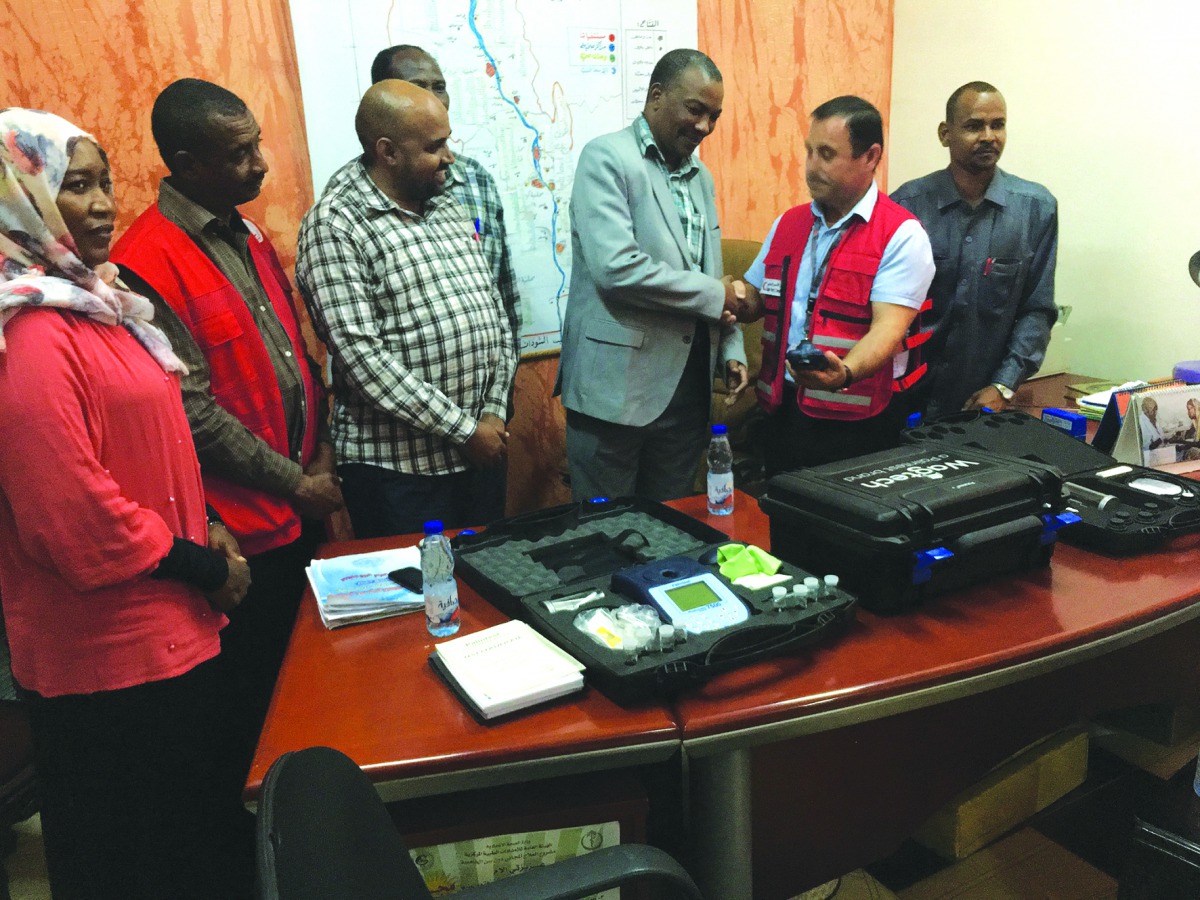
The team of QRCS with the Governor of the White Nile, Major General Haidar Al Turaifi, at his office.
As Qatar Red Crescent Society (QRCS) is proceeding with its emergency response to the recent floods in Sudan, a relief team of its representation mission visited the White Nile State.
According to reports by the Sudanese Red Crescent Society (SRCS) and the State Secretariat, the White Nile had a heavy toll of 3 deaths, 8,615 affected families, 5,000 totally destroyed homes, and 4,408 partially damaged homes.
The team delivered to the Ministry of Health (MOH) DelAgua Portable Water Testing Kits, to be used in biochemical water tests and calculation of the chlorine level of water. This will help to ensure the safety of drinking water and reduce the spread of water-borne diseases such as diarrhea.
In the presence of MOH’s heads of department, the important kits were handed over to the State’s General Director of Health. The relief team was briefed on the health and environmental situation in the White Nile. They promised to offer every possible effort to secure the current and future needs of the affected families. The government official thanked QRCS for its contributions and constant aid.
As part of the initial situation assessment, the team visited the Governor of the White Nile, Major General Haidar Al Turaifi. He gave an overview of the tragic conditions of the affected families, as well as the most urgent needs.
A special focus was put on the inundated areas, where the humanitarian aid is airdropped, including tents, mattresses, kitchenware, etc. Maj. Gen. Al-Turaifi commended Qatar’s numerous humanitarian projects in Sudan, particularly its Darfur peacemaking efforts.
“In such drastic conditions experienced by our brothers in many Sudanese states, an immediate humanitarian response is indispensable,” said Dr. Mohamed S Ibrahim, Executive Director of Relief and International Development Division at QRCS. “It is our duty to work together with SRCS, in order to make a tangible and timely difference in the lives of local communities”.
“In the short run, we will provide food and nonfood aid to have direct results. Then, we plan to start a medium — and long-term intervention, which will include rehabilitation of the damaged homes and infrastructure,” he added.