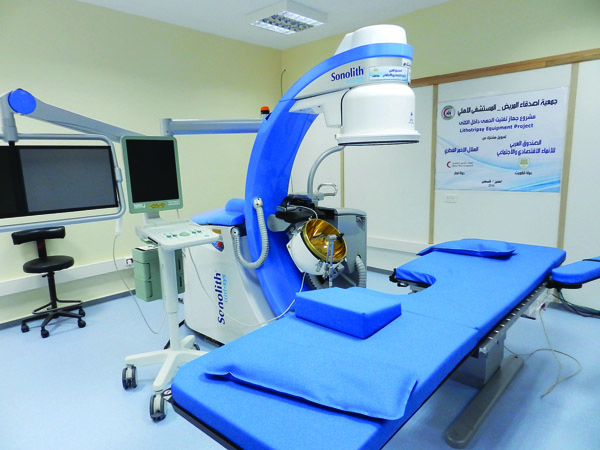
Doha: Qatar Red Crescent Society (QRCS) is conducting a medical project for poor patients in Palestine, in cooperation with the Poor Patients Fund, the Palestinian Red Crescent Society (PRCS) and Al Ahli Hospital, Hebron in the West Bank to improve healthcare services in Hebron and Palestine at large.
Last year, QRCS provided treatment for 913 poor Palestinians, at a total cost of $328,330 under the fund, which was established in 1976 as a non-profit charity seeking to serve needy families, orphans, injured people, those with disabilities and students by providing medical services lacked in Hebron and other West Bank governorates.
QRCS also procured a lithotripter for the Urological & Kidney Department of the hospital. The device cost $460,000, co-funded by QRCS, Kuwait’s Arab Fund for Economic and Social Development and the hospital.
The project helps support a vital department of the hospital by securing advanced services, saving a lot of effort and time for doctors, avoiding the need for costly and complicated traditional surgeries and reducing the rates of travelling abroad for treatment.
Various segments of society are targeted, especially those in need of such a critical treatment. Every year, the department receives 1,850 patients and performs 550 kidney stone surgeries.
QRCS office in the West Bank is coordinating with PRCS and the hospital in implementation, preparation of documents and tender procedures and awarding.
Upon the delivery of the device, all its components will be tested for functionality before actual operation.
The department is one of the busiest in the West Bank.
It has a relatively old lithotripter donated by QRCS, but it is overused due to the huge number of kidney and ureter patients in Hebron, compared to other areas.
So far, the device has treated 2,880 patients. Knowing that lithotripsy can be repeated one to three times for the same case, the actual number of lithotripsies may be triple the number of patients.
Established in 1976, the hospital is the largest medical facility in the West Bank.
It is a non-governmental non-profit organisation which aims at enhancing medical services in Hebron and beyond.
The hospital has 200 beds with expansions are in progress to attain the full capacity of 304 beds. It has 540 medical, assistant and administrative personnel and receives more than 150,000 patients a year.
The Peninsula