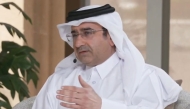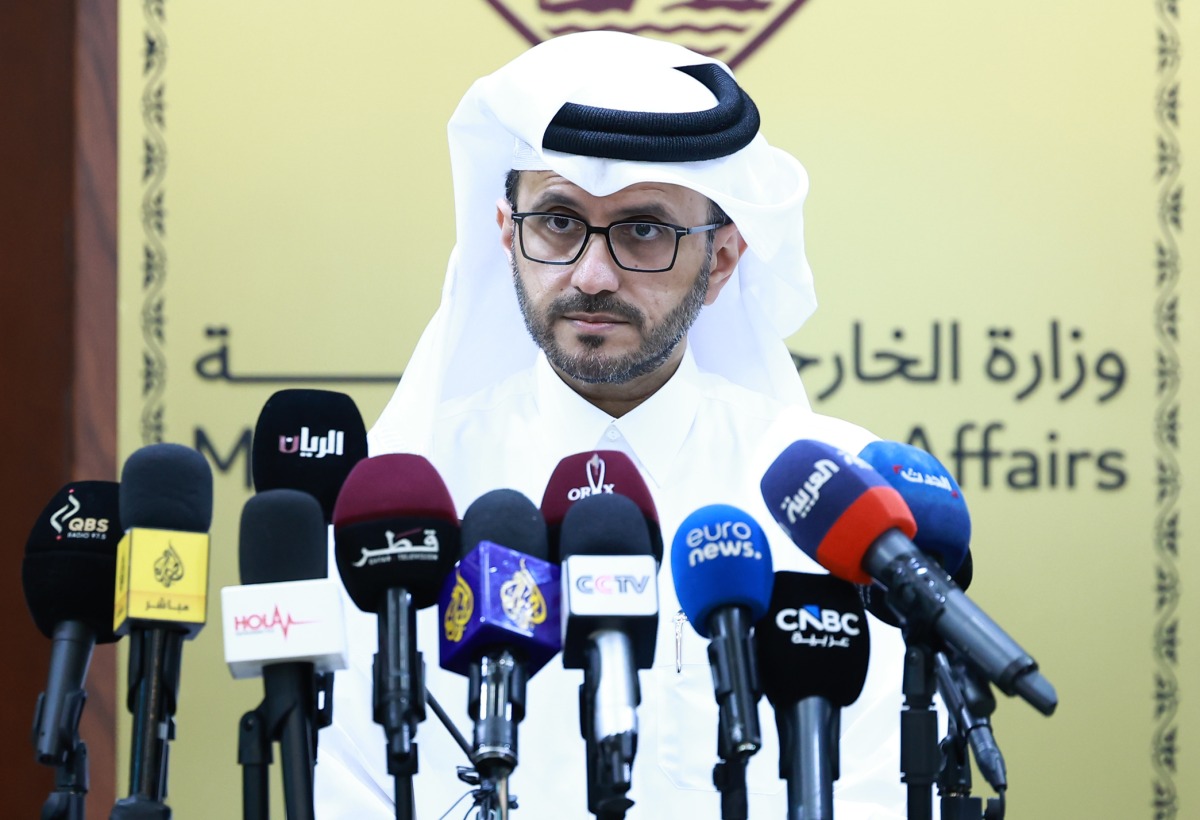
Advisor to Prime Minister and Official Spokesperson for the Ministry of Foreign Affairs Dr. Majed bin Mohammed Al Ansari
Doha, Qatar: Advisor to Prime Minister and Official Spokesperson for the Ministry of Foreign Affairs Dr. Majed bin Mohammed Al Ansari has said Qatar is not involved in mediation between the US and Iran and is keeping focus on protecting its country.
“Qatar’s position has been clear that this war must be ended through diplomatic means. This applies to all conflicts around the world—ultimately, they are resolved at the negotiating table.
The sooner parties reach that table, the fewer the casualties and the lower the losses,” Al Ansari said in weekly media briefing yesterday.
To a question about US President statement that talks with Iran were going perfectly, he said that Qatar is not involved in these talks. “Our views about any talks, if they exist, are consistent with our very principled position that all conflicts will end on the negotiation table, and we support all of these efforts. I am not privy to the details of the current negotiations, but we stand ready to help if there is any role for Qatar. But right now, our concern is in supporting these efforts and stopping the attacks on our country.”
He added that there is no justification for delaying a diplomatic solution. “We support all diplomatic efforts in this regard, whether through official or unofficial channels, and any initiative that can lead to a diplomatic end to this war.”
He added, “However, I would like to emphasize that there is currently no direct Qatari role in mediating between the two parties. Our focus at present is entirely on defending our country and addressing the various attacks that Qatar has been subjected to. At the same time, communication continues through different channels, including contacts with regional and international partners and multilateral meetings held over the past period. Work within international institutions also continues in pursuit of ending this war.”
He said that this war and the aggression against Qatar, as well as against countries in the region and neighboring states, remain ongoing concerns. “Meetings will continue, and we remain vigilant regarding military, economic, and political developments. It is also important to stress a key point as the Prime Minister stated during his press conference with the Turkish Foreign Minister, there are parties that benefit from spreading fake and misleading news.”
“Such misinformation aims, first, to create the illusion of divisions or alliances that do not exist, and second, to undermine any potential progress toward de-escalation.”
Regarding the gradual return of Qatari institutions to normal operations, he said that this step is largely linked to the improved security situation in Qatar. “As you have seen, more than 90% of the missiles targeting the country were intercepted, and most attacks were successfully thwarted. This reflects the strength and efficiency of Qatar’s security and defense systems.”
At the same time, he said, “we stress the importance of caution. Official authorities have issued clear guidelines on how to act in case of emergencies at workplaces. All citizens and residents returning to work are urged to follow these instructions carefully to ensure their safety. Life must go on, and although this situation may persist for some time, we need to gradually return to normal routines while maintaining strong security awareness and preparedness.”
He noted that the coordination with regional and international partners has been ongoing since the beginning of the crisis. “This coordination focuses on three main priorities: first, responding swiftly to attacks and strengthening joint defensive efforts; second, working through international channels to bring the crisis to an end; and third, aligning positions across various regional platforms.”
To a question on speculations about military escalation, including the deployment of land forces by the US, he said there is currently no indication of an imminent ground invasion. “That said, continued escalation in this manner is unlikely to yield positive outcomes.”
Al Ansari further said that this war has raised serious questions about the effectiveness of the regional security system in the Gulf. “Many long-standing assumptions have been challenged, highlighting the need for a comprehensive reassessment of collective regional security frameworks. The threats we face today go beyond national borders—they affect people, infrastructure, heritage, and economies across the region. Addressing them requires stronger regional cooperation and a unified approach.”
Responding to another question, he said that Qatar is working very closely with the US administration and with President Trump on finding an end to the current escalations. “We have conveyed very clearly that the attacks on Qatar have resulted in catastrophic results on the energy sector and Qatar’s economy.”
“You know as the Minister for Energy in Qatar has said that as a result of the attack on Ras Laffan, there was a reduction of 17 percent when it comes to our ability to export energy and that the cost is going to be up forward of $20bn in annual income and with a time span of about four or five years to solve everything that has happened. This was communicated very clearly to all our partners around the world, including the United States, and I think, of course, there is a great impact when such damage happens to the energy sector and the region as a whole.”
“We have said from day one that we condemn any attack on energy infrastructure in the region as a very dangerous precedent that would have very dangerous repercussions.”
“We have seen the repercussions in Qatar firsthand, and we welcome that there was a very clear stay on attacks on energy facilities, and we hope that materializes and continues. And we don’t believe that there is any justification for attacking civilian infrastructure. These civilian infrastructures, wherever they are, are the wealth of the people, regardless of the political implications of that wealth.”
To another question, Al Ansari said that Qatar was in constant communication with the US Administration, conveying to them exactly what the Iranian attacks were doing to GCC countries. “We are grateful for the partnership that is allowing us to help protect our region against these attacks. I have a very clear message communicated to the US Administration on the danger of reciprocal attacks on the energy sector. I think the US President and his team understand very clearly the impact that this has on the international energy markets.”
Regarding direct communication between Qatar and Iran, he said, “The only communication we have had with the Iranians was the call between His Excellency the Prime Minister and the Minister of Foreign Affairs of Iran (many days ago). We maintain regional communication with Iran, as we have seen with various interlocutors that we are working with. But I don’t think there is anything very important in terms of current communication.”
Responding to a question about Qatar’s relations with Iran in a postwar situation, he said, “Iran has been here for millennia. The people in this region have been here for millennia. Nobody is going anywhere. Total annihilation is not an option. No one, people or country, will disappear from existence by the wish or will of anybody. We will live next to each other. We will be neighbors for the future of humankind and we have to find ways of living next to each other.”
He added, “This is a very difficult moment. Our country has been attacked. Our sovereignty has been attacked. We have seen the effects on our economy, on the daily lives of people living here, and we don’t take it lightly, and we don’t see the attacks on our sovereignty as something that we can live with.”
“Our message to Iran was always: the brotherly relationship, the neighborly relationship between our people should take paramount over any other political consideration. The fact that they decided to attack our country like this does not show good neighborly relations or the essence of that brotherly relationship.”
Honouring the martyrs who lost their lives following the crash of a helicopter, he said that this is an occasion to reaffirm that thousands of members of the Qatari Armed Forces and security personnel, alongside their brothers from the Turkish forces and various participants engaged in safeguarding this country, head daily to the frontlines of danger, placing their lives on the line to ensure the security and safety of everyone living on the soil of Qatar.
This incident and the joint mission that brought together Qatari and Turkish blood, he continued, confirms that this partnership is not merely one between two countries, but rather a deeply rooted brotherhood and a religious and historical bond between the two peoples. He said it reflects the depth of trust and military integration, alongside the humanitarian and Islamic brotherhood between them, noting that the mingling of Qatari and Turkish blood in this incident stands as a testament to the unity of destiny between the two brotherly nations.