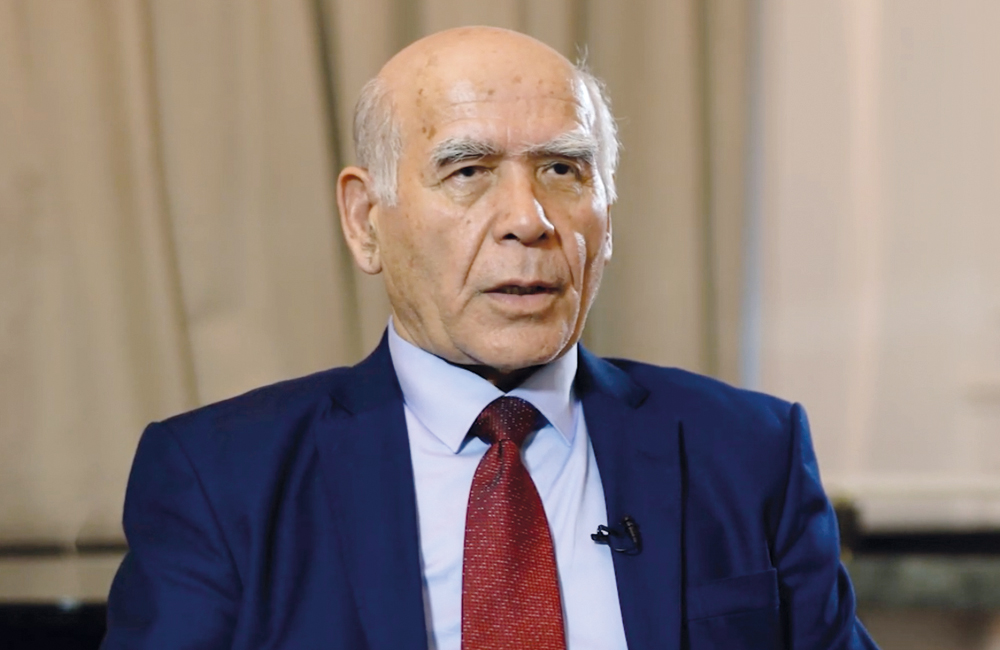
Dr Syed Rahman Sulaimanov
A number of translators and scholars from different countries of Asia, Africa, Europe and America have been honoured during the 4th edition of Sheikh Hamad Award for Translation and International Understanding (SHATIU). Among three categories of the awards also include awards for scientific works directly related to translation, such as dictionaries and translation of Islamic heritage books.
The outcome of 15-year effort of Dr Syed Rahman Sulaimanov from the National University of Tajikistan was among the scholars honoured at the SHATIU for his Tajik-Arabic dictionary. In an exclusive interview with The Peninsula, Professor Sulaimanov said: “I have won the SHATIU for the comprehensive Tajik-Arabic-Russian lexicon.”
The dictionary contains over 100,000 words or entries. “I have published many studies on translation including five volumes of translated materials from Arabic into Russian and Tajik and from Tajik and Russian into Arabic Language.”
He said that each of these volumes contain more than 700 pages, prepared with aim of transferring Islamic knowledge, thought and interpretation of Holy Quran from Arabic into these languages in order to help readers understand the content. “The effort also aims at facilitating learning of Arabic language through the provision of trilingual dictionaries.”
On reason behind his selection of this field of knowledge, he said what prompted him was his love to science following what Allah said, “Of all His servants, only those possessed of true knowledge stand in awe of God”, and secondly most of the Islamic scientific and philosophical heritages were in Arabic because Arabic was the language of science, knowledge and philosophy in the Middle Ages; even Tajik scientists like Ibn Sina, Al-Biruni and Al Khwarizmi wrote their books in Arabic. “So, the Tajik community needs the translations of these old books — in other words, it is an urgent need for our people.”
On lexicons, Prof Sulaimanov said no language could be taught or learnt without contemporary and comprehensive dictionaries. “In Tajik society, we need to establish different relations: politically, economically, culturally and scientifically with Arab countries, so we should not lose sight of the Arabic language and literature.”
“Tajikistan wants to establish relations with Arab countries on the basis of modern science and technology, and therefore, we need modern and comprehensive dictionaries as well as teaching Arabic in high and middle schools,” he stressed. He thinks that the philosophical-and scientific legacy in Arabic needs Arabic-Tajik dictionaries and the comprehensive Russian dictionaries to benefit from these rich heritage.
Prof Sulaimanov added that the old texts were the old treasure that contained the precious works of Islamic civilisation. “I think that there are only a few people who have such a precious repository full of precious jewels of science, philosophy, art and language, with this valuable legacy.”
When asked how he managed to reconcile teaching, translation and the preparation of dictionaries, he answered, “For many years, I have worked at the Institute of Philosophy and Rights at the Academy of Sciences of the Republic of Tajikistan. Throughout these years I was translating the books of Islamic authors, especially Ibn Sina.
The Institute which was named after him focuses on translation of his works on philosophy and medicine and translated 15 volumes into Tajik and Russian.” He said that seven volumes of Ibn Sina’s philosophical works and three volumes of his medical books have been printed so far. “Among these activities, I have translated the works of Ibn Sina and the works of other Islamic thinkers.”
In addition to these translations and work at the Institute of Philosophy and Rights, he relied on the materials he collected from various sources in preparing the comprehensive Arabic dictionary in three languages: Arabic, Tajik and Russian. “It is my aim to respond to the urgent needs of the public, researchers, readers and students.” He also said that after many years he returned to teach Arabic at the Faculty of Asian and European Languages at the National University of Tajikistan.
“Now I am preparing to print Arabic-Tajik-Russian dictionary on philosophy and logic using materials I have translated over years from Islamic heritages,” he said, adding that he is still looking for a financier to print it.
“Finally I can say my love to the philosophical and scientific works of Muslims philosophers in Arabic prompted me to reconcile teaching and translation and the preparation of Arabic dictionaries.”
In response to another question about whether the Arab library needed such old works, Prof Sulaimanov said: “I think the Arab library needs such content because the basic duty of translators is to translate materials related to Islamic civilisation into local languages and international languages. Translator’s role as ambassadors of enlightenment is to enhance communication between cultures,” he said.
“I did some literature translations such as The Prophet, Broken Wings of Gibran Khalil Gibran and stories from the Mikhail Naima but my prime focus is on philosophical and scientific translations,” Prof Sulaimanov added.