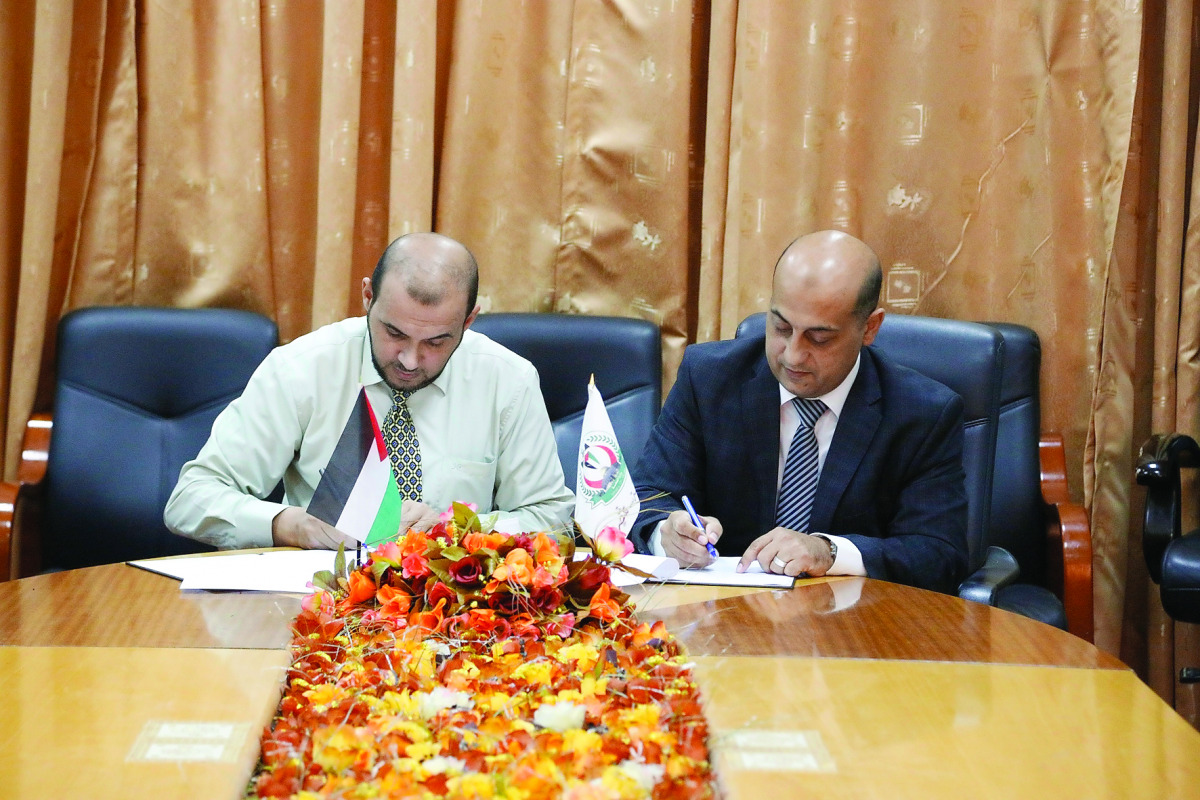
Officials signing the agreement.
In support of the health sector in Palestine, Qatar Red Crescent Society (QRCS) has signed three agreements with the Palestinian Ministry of Health (MoH) to conduct a series of projects, at a total cost of $1,493,000 (QR 5.5m).
The projects are support of the specialised medical education programme for doctors of Gaza ($476,000), renovation and equipment of the Department of Cardiology in Nasser Hospital ($517,000), and development of cystoscopy services in Gaza ($500,000).
Dr Akram Nassar, Head of QRCS Mission in Gaza, said the three projects are part of a portfolio undertaken by QRCS to develop the facilities of Palestinian hospitals and improve the quality of services offered to patients.
"The specialised medical education programme is a significant capacity-building opportunity for local medics. Under the programme, eight Palestinian doctors will receive scholarships in Jordan on medical subspecialties and attend intensive health courses," he added.
Regarding the third project, Dr Nassar said, "The purpose of the project is to develop the infrastructure of Nasser Hospital's Department of Cardiology, which is the only provider of medical care for cardiac patients".
According to him, the project will focus on building renovation, medical and stationery procurements, and in-service training for medical staff.
Dr Heba Al Mahallawy, Health Project Officer, QRCS Mission in Gaza, said the cystoscopy service development project would secure high-tech medical equipment for three private hospitals. "Special attention is paid to private hospitals in Gaza, to reduce the demand on public hospitals and lower the costs paid by patients, instead of having to travel abroad for treatment.
QRCS's contributions to the health sector in Palestine were praised by Dr Ashraf Abu Mhadi, Director of International Cooperation, MoH. "These three projects are just the newest on the list and are expected to alleviate the suffering of patients amid siege and travel restrictions," he noted.
Other projects recently launched by QRCS in Gaza include specialist lab equipment for medical education institutions, support of phenylketonuria patients, and others.