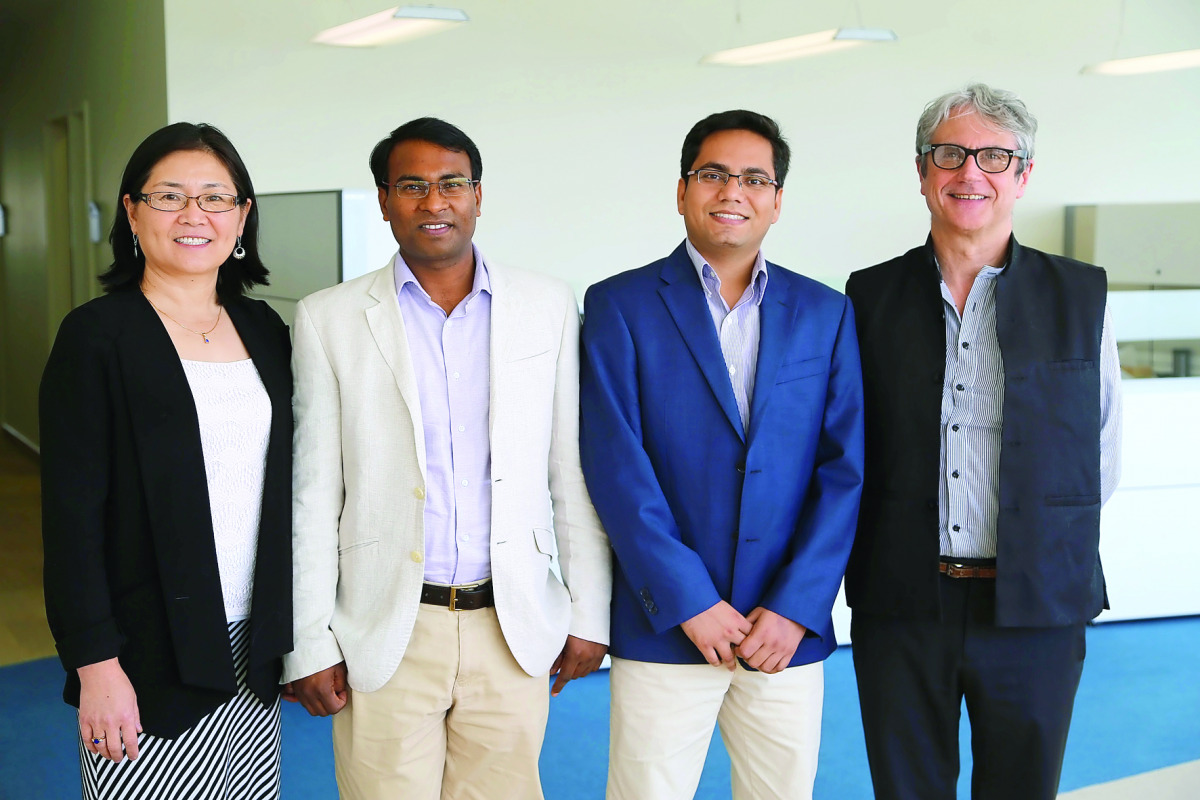
The Sidra team comprising Dr Ena Wang, Dr Santosh K Yadav, Dr Mohammad Haris, and Dr Francesco Marincola.
Sidra Medical and Research Center (Sidra) is positioned to improve the lives of children with brain disorders following its participation in a joint research project that earned an international accolade.
Sidra’s research branch collaborated with the Department of Radiology at the Fortis Memorial Research Institute in Delhi, India, and the Department of Neurology and Microbiology at the King George Medical University in Lucknow, India, to study neurocognitive impairment (the reduction or impairment of cognitive functions in the brain) in paediatric patients born with immuno-deficiencies. Sidra’s ultimate goal in undertaking the study was to contribute to better understanding of the abnormalities in brain development in children, which could then be applied to research programs relevant to the paediatric population in Qatar.
Using neurocognitive assessment and brain magnetic resonance imaging (MRI) scans, the Sidra team measured structural brain changes associated with neurocognitive functions among perinatally 1 infected children with immune-deficiencies. The team was able to locate altered cortical 2 thickness, subcortical 3 volumes and structural connectivity anomalies in the children. The findings will facilitate the early detection of structural and functional brain changes, allowing appropriate treatment and therapies to improve functional activities in children with immunity disorders.
The study advances current knowledge of neurodevelopmental issues in children, giving Sidra the opportunity to develop the methodology of neurocognitive and neurodegenerative research in Qatar. Sidra embraces a model of evidence and best practice-based health care. This involves integrating the best available research evidence worldwide into clinical expertise. The methodology will be used to evaluate the effects of different pathologies on normal brain development in children, as well as to monitor therapeutic effects.
According to Sidra’s Chief Research Officer Dr Francesco Marincola, such outcomes are possible because of Sidra’s collaborative research agenda. “Conducting targeted research that will lead to improvements in patient clinical outcomes is at the core of Sidra’s research activity. That goal is facilitated when we collaborate with others,” Dr Marincola said.
The importance of the original research study was recognised earlier this year by the International Society for Magnetic Resonance in Medicine (ISMRM) in Singapore, which gave a joint award to the researchers.
The Sidra team comprised of Dr Santosh K Yadav, Dr Mohammad Haris, Dr Ena Wang and Dr. Francesco Marincola.