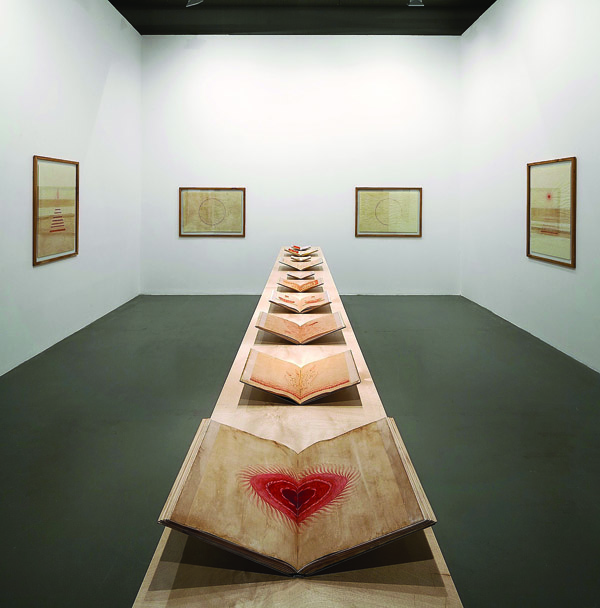
DOHA: ‘Red / Red’ installation by Turkish artist Asl? Çavu?o?lu opened yesterday at Mathaf: Arab Museum of Modern Art. It is on view until September 11 at Project Space, dedicated to emerging artists and curators’ experimentations with new ideas and forms of presentation.
Following its production for the 14th Istanbul Biennial, the installation comprises six delicate drawings on worn papers and 10 handmade notebooks made with two inks: Armenian red, extracted from the endangered Armenian cochineal insect, and Turkish red, now used in the national flag.
Armenian red is a disappearing material. Historically produced from carminic acid, the pigment is extracted from the ‘Ararat’, or Armenian cochineal, an endangered insect that lives in the roots of a plant in the Ararat Plain and Aras River valley that runs through and alongside Turkey, Armenia, Azerbaijan, and Iran. On the Turkish side of the river, knowledge of how to produce Armenian cochineal red has been lost since 1915, while on the Armenian side, the plant and insect are threatened by extinction due to 20th century industrialisation.
The installation stresses the protection of the delicate social and organic systems of the Aras valley — human, plant and animal life — to support a communally protected ecosystem and shared knowledge of production that will preserve the recording of its collective past, present and future existence. Çavu?o?lu explored the Armenian pigment’s extraction and its use in the making of manuscripts from Eastern Anatolia to Armenia.
The patterns of the drawings on display modernise from floral to geometric shapes, and show the resilience of each pigment as it transforms over time. The Turkish red holds its colour while the Armenian fades, narrating the changing physical and symbolic links to national culture, identity and memory.The Peninsula