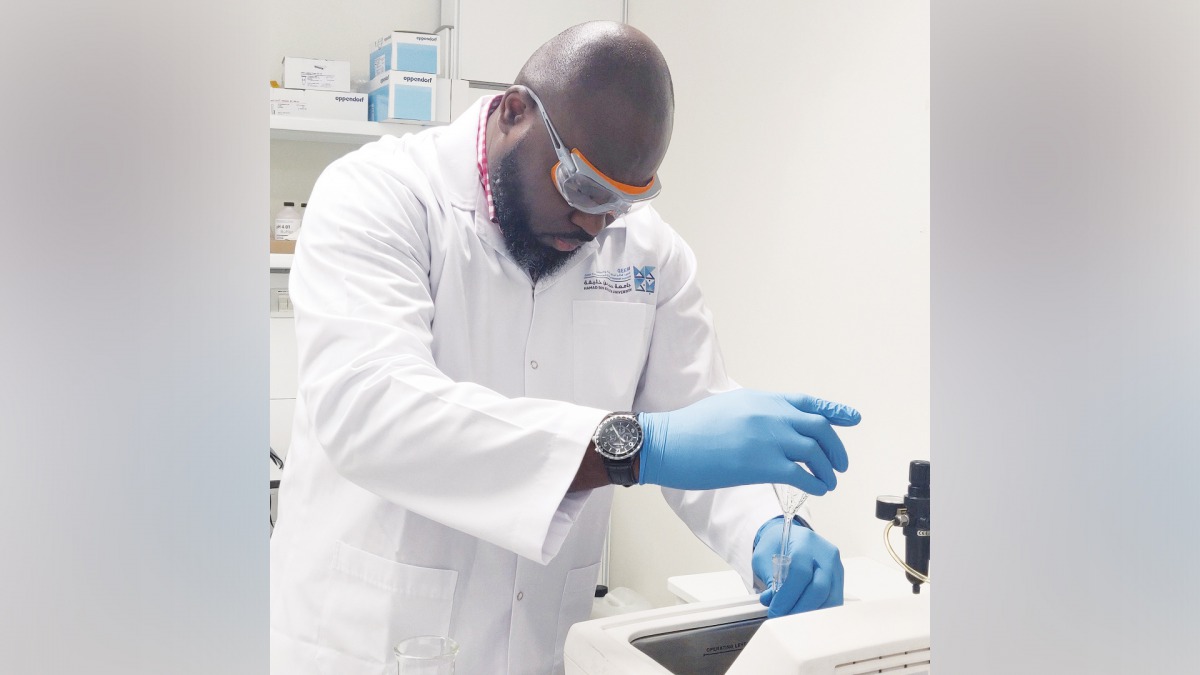
Dr. Oluwaseun Ogunbiyi during a research.
Doha: Experts from Qatar Environment and Energy Research Institute, a national research institute under Hamad Bin Khalifa University, say that washing hands with soap and water is more effective than using hand sanitiser in fight against COVID-19.
They say that the virus can also be passed on by touching contaminated surfaces and then touching your face, even when outside. “Ordinary soap diluted in water is sufficient to rupture and kill many different types of bacteria and viruses, including COVID-19. It is generally accepted to be more effective than using hand sanitizer; however, high alcohol content sanitiser should be considered where soap and water is not available,” said Dr. Oluwaseun Ogunbiyi from Qatar Environment and Energy Research Institute
According to Dr. Oluwaseun, hand-washing with soap, when done correctly, is critical in the fight against the coronavirus; however, according to Unicef, there are millions of people worldwide who do not have ready access. In total, only three out of five people worldwide have basic handwashing facilities, which increases the risk of contracting the virus.
Dr. Deema Al Masri, from Qatar Environment and Energy Research Institute, said that international studies show that COVID'19 cannot contaminate drinking or tap water.
“To date, COVID-19 has not been detected in drinking water supplies globally. Municipal drinking water systems utilise filtration and chlorination steps that are generally thought to be effective in activating COVID-19,” said Dr. Deema “COVID-19 is also unlikely to be found in bottled water itself. However, given the suspected life-span of COVID-19 on plastic, when buying bottled water from a supermarket or water delivery, care should be taken with handling of the packaging.”
Dr. Deema added that the COVID-19 virus is an enveloped virus, with a fragile outer membrane. Generally, enveloped viruses are less stable in the environment and are more susceptible to oxidants, such as chlorine. While there is no evidence to date about survival of the COVID-19 virus in water or sewage, the virus is likely to become inactivated faster than non-enveloped human enteric viruses with known waterborne transmission.
According to the World Health Organization (WHO), there is no evidence that COVID-19 is transmitted in wastewater treatment systems or in treated wastewater. Wastewater treatment plants treat viruses and other bacteria. WHO recommends the use of standard, well-maintained plumbing, such as sealed bathroom drains, and backflow valves on sprayers and faucets to prevent aerosolized fecal matter from entering the plumbing or ventilation system, together with standard wastewater treatment.
Dr. Jenny Lawler, Qatar Environment and Energy Research Institute, said, “The virus is contracted when someone comes in direct contact with respiratory droplets of an infected person, usually through coughing and sneezing. The virus can also be passed on by touching contaminated surfaces and then touching your face, even when outside,” said Dr. Jenny.
“The coronavirus may survive on surfaces anywhere from several hours up to two to three days, with the most recent study indicating that the virus can be found after up to four hours on copper, up to 24 hours on cardboard and up to two to three days on plastic and stainless steel,” said Dr. Jenny.
The measures against COVID-19 include washing hands thoroughly, ensuring that surfaces are properly cleaned and ensuring that a person covers his mouth and nose with flexed elbow or tissue when coughing or sneezing.
Other measures include disposing of any used tissues immediately and effectively, staying at home and practicing social distancing, self-isolating if unwell and monitoring that ablution areas make soap and hand sanitizers readily available to ensure visitors comply with hygiene practices.