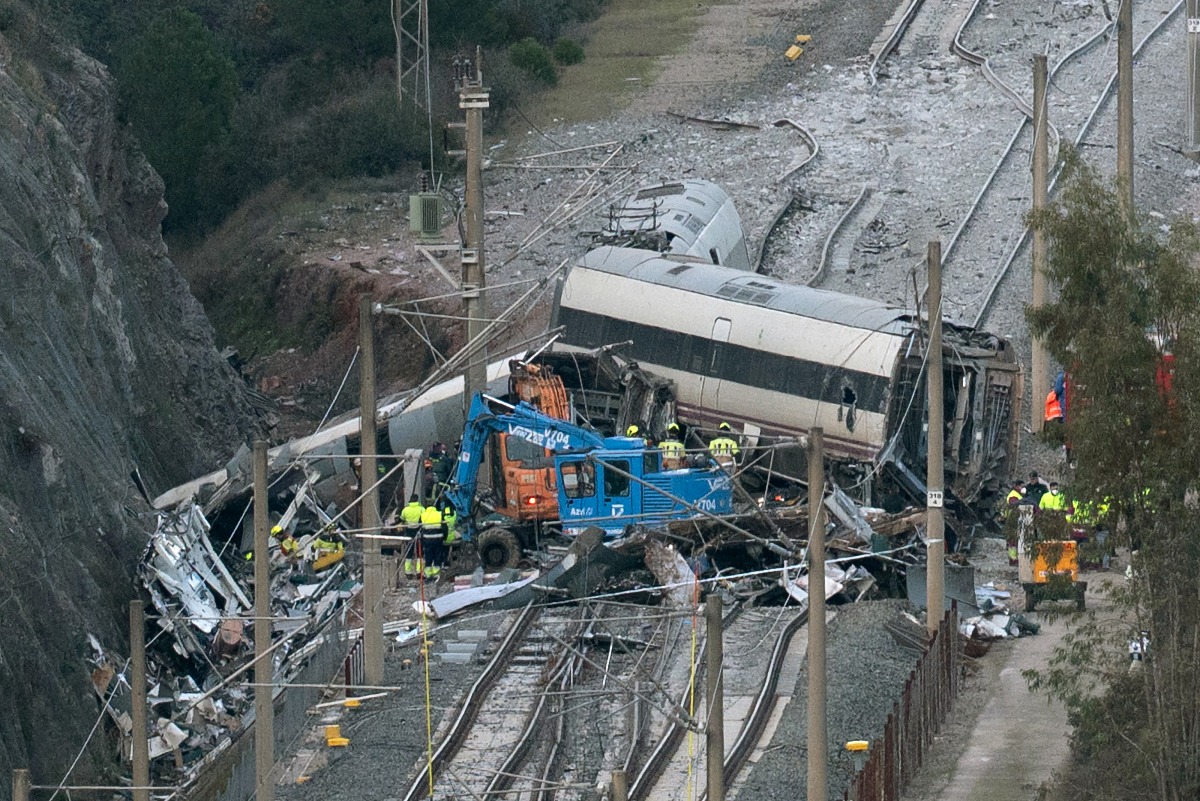
Emergency services and investigators work on the site of a high-speed trains collision that killed at least 42 people, in Adamuz, southern Spain, on January 20, 2026. Photo by JORGE GUERRERO / AFP
Madrid: An investigation into last weekend's high-speed train collision in Spain that killed 45 people suggests the track was cracked before the catastrophe, according to a preliminary report published on Friday.
The shellshocked country is searching for answers to one of Europe's deadliest such accidents this century, which has raised doubts about the safety of the world's second-largest high-speed rail network.
The disaster struck in the southern region of Andalusia on Sunday evening when a train run by private firm Iryo derailed and crossed onto the adjacent track, smashing into an oncoming service operated by state company Renfe.
An inspection of the Iryo train "detected notches in the tread of the right-sided wheels" of four carriages, said the preliminary report by the CIAF rail accident investigation committee.
"These notches in the wheels and the deformation observed in the track are compatible with the fact that the track was cracked," it wrote in what it called a "working hypothesis".
Notches "with a compatible geometric pattern" were also found on the right-sided wheels of three other trains that had travelled on the same track in the hours before the accident, the CIAF added.
Based on the available information, "we can put forward the hypothesis that the cracking of the track took place before the passage of the Iryo train that suffered the accident, and therefore before the derailment", it wrote.
The CIAF cautioned that "this hypothesis... must be corroborated by later detailed calculations and analysis".
Transport Minister Oscar Puente has said the flat, straight stretch of track in question had been recently renovated, while the Iryo train was "practically new".
Human error has also been ruled out as the trains were travelling within the speed limit.
Investigators continue to examine the scene for evidence.