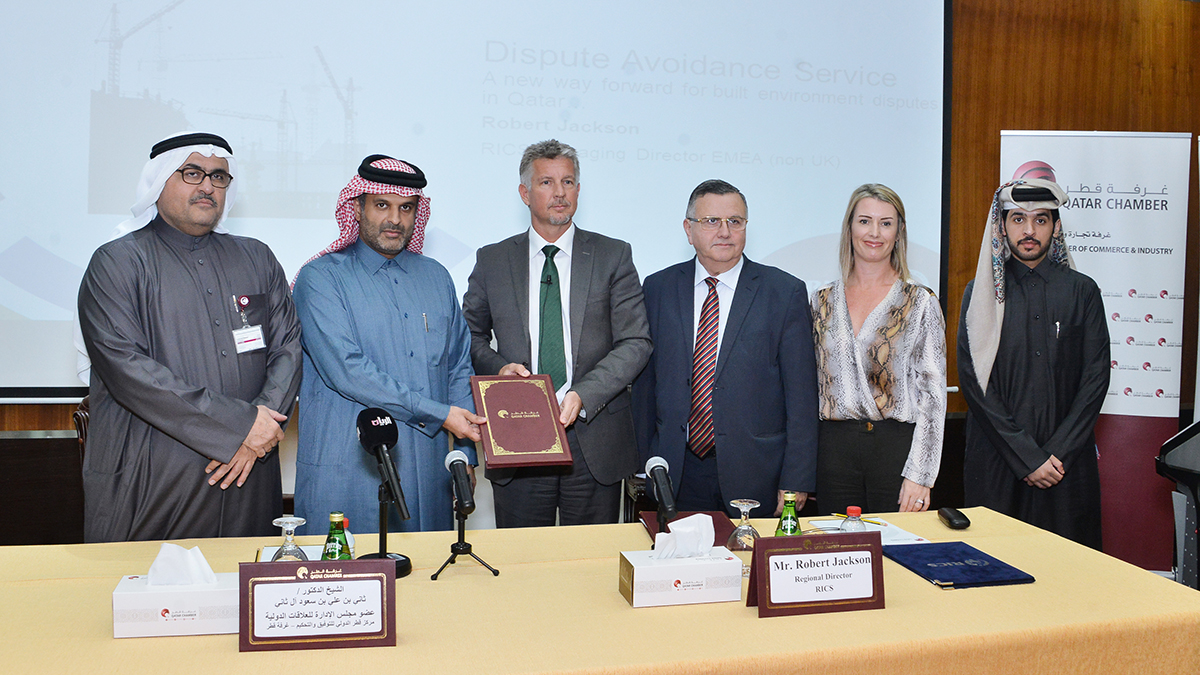
The officials during the event.
DOHA: The Qatar International Centre for Conciliation and Arbitration (QICCA) at Qatar Chamber and the UK-based Royal Institution of Chartered Surveyors (RICS) joined hands to host an seminar at Qatar Chamber headquarter to highlight the ways of avoiding disputes in construction.
The seminar titled ‘Dispute Avoidance in Construction Sector in Qatar’ was attended by a number of lawyers, arbitrators, businessmen and representatives of construction companies in Qatar.
On the sidelines of the seminar, QICCA and RICS signed MOU to enhance co-operation in setting up disputes avoidance service (DAS) in the Center as well as working together to promote and enforce local and international standards, delivering industry events and seminars to the public, joining hands in organising training programs and exchanging knowledge and expertise.
The MOU was signed by QICCA Board Member for International Relations Sheikh Thani bin al Thani and RICS Regional Director Robert Jackson. The seminar discussed the multiple benefits that dispute avoidance services (DAS) will bring to the Qatar market, and how the process will be administered.
QICCA’s Assistant Secretary General Ibrahim Shahbik, who inaugurated the seminar, said that the seminar addresses mechanisms of disputes settlement in construction projects which require all parties to exert combined efforts to implement these projects without any delay.
He noted that the lack of coordination among these parties could result in disputes and impact on the project schedule as well as hinder its progress.
Addressing the seminar, RICS Regional Director Robert Jackson explained ways and mechanisms of avoidance disputes in construction projects as the fundamental standards that impact on construction and real estate sectors.
Jackson said that there were $56m worth of construction disputes in the Middle East last year with the length of dispute averaging 13.7 months.
He noted that the main reason of disputes in this sector posed by inefficacy and lack of productivity. He added that there are seven issues have to be taken into account regulation and transparency, rewiring the contractual framework, rethinking the design and engineering process, improving procurement and supply chain management, improving on-site execution, infusion digital technology, new materials and advanced automation and reskill the workforce.
RICS believes that the industry as a whole needs to move towards a more collaborative delivery model and believes that the usage of Dispute Avoidance Services (DAS) will help the market tackle the various issues outlined previously. Such DAS where implemented elsewhere in the world have delivered massive benefits and had a significant positive impact on investor confidence in the sector.