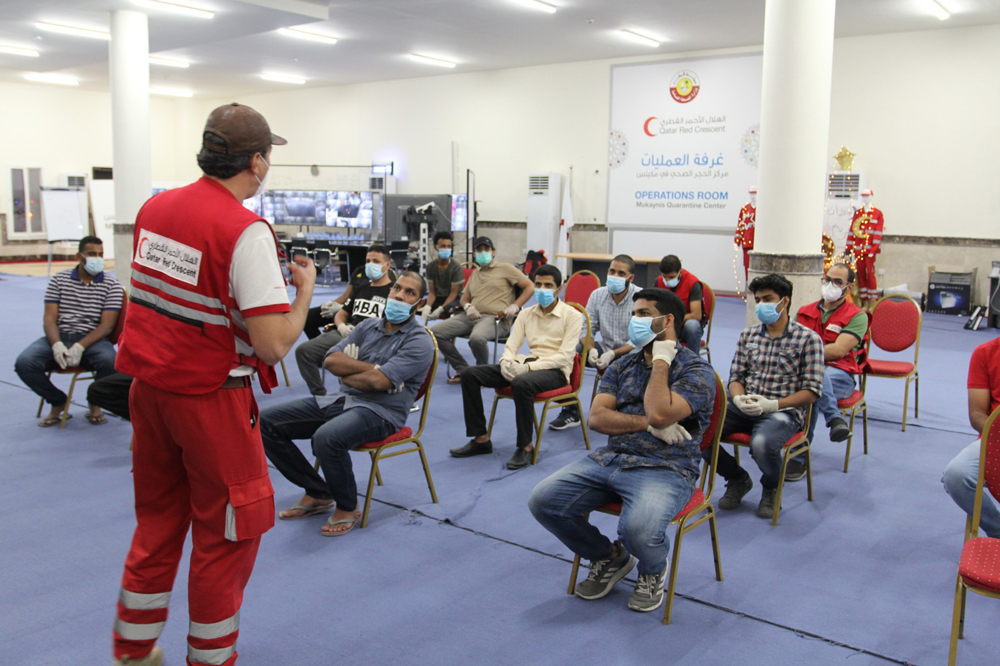
Qatar Red Crescent Society (QRCS) has made better-than-expected results in managing the workers’ quarantine facility in Mekaines. As the COVID-19 crisis began, the Ministry of Public Health (MoPH) assigned the operation of the facility to QRCS, as a reliable strategic partner with considerable experience in disaster response, medical services, and emergency shelter.
For years now, QRCS has been managing four health centers across the country, where medical services are provided for expatriate workers 24/7.
The Mekaines quarantine facility receives the cases referred from Hamad Medical Corporation (HMC), secures all requirements for comfortable and safe accommodation, and keeps the inmates under constant observation, particularly those with chronic diseases.
The medical personnel carry out clinical examinations and provide health care and medications up to the highest medical standards. QRCS ambulance vehicles are also deployed to transport the infected cases, in cooperation with HMC.
Inside the facility, everyone is working hard to do their job: the triage nurses separate the confirmed from suspected cases, the catering team distribute food meals to the inmates, the security watch entry and exit, and cleaning trucks collect garbage from the bins put everywhere.
Dr. Abdul Salam Al Qahtani, board member of QRCS and Director-General of the Medical Affairs Division, said the organization gives top priority to fighting the coronavirus (COVID-19). All the medical and nonmedical resources are mobilized to control the pandemic and to support the government authorities in this respect.
Early in the crisis, QRCS created the COVID-19 Crisis Management Committee, chaired by Dr. Al Qahtani and comprising 10 officials and representatives of various QRCS departments.
Under the committee there have been formed three sub-committees: the COVID-19 Quick Medical Response, QRCS Volunteers, and Mekaines Quarantine Management.
“Late in March, QRCS was entrusted with the operation of the Mekaines quarantine facility, in light of its accumulated medical experience in managing the Workers’ Health Centers for over 10 years,” stated Dr. Al Qahtani. “Originally, the facility had been limited to receiving suspected COVID-19 cases and those who had contact with them. Later, it was shifted to receiving positive cases. As a result, the capacity was increased from 3,000 inmates to as many as 14,000 inmates at some point”.
According to Abdullah Al Qatan, Executive Director of QRCS’s Medical Affairs Division, the Mekaines quarantine facility is divided into blocks and villas. “Currently, there are 10 blocks in operation, with a total of 1,348 villas,” he said. “With this capacity, it can accommodate more than 28,000 persons”.
“We receive the positive cases among expatriate workers, whether referred from HMC or discovered by our COVID-19 testing units at the Workers’ Health Centers. Since its inauguration, the Mekaines quarantine facility have received 27,649 inmates. Everyone here is given high-level medical services and accommodation, until they are recovered and can be discharged.
“A large number of QRCS staff and volunteers are engaged in the different aspects of the facility. Some companies were contracted to provide specialized services as required. The workforce is divided into teams for the main domains: cleaning, security, food, logistics, and maintenance. Currently, there are 1,052 persons working in the facility, including 147 medical professionals, 195 volunteers, 371 cleaning workers, and 266 security guards.
Dr. Al Qahtani emphasized the importance of contributions from the partners. “There are more than 32 contributing organizations from the public and private sectors, as well as four nonprofit organizations,” he pointed out. Among these partners are the Ministry of Municipality and Environment (MME), Ministry of Interior (MoI), Qatar Charity, Afif Charity, Ooredoo, Vodafone, just to name a few.