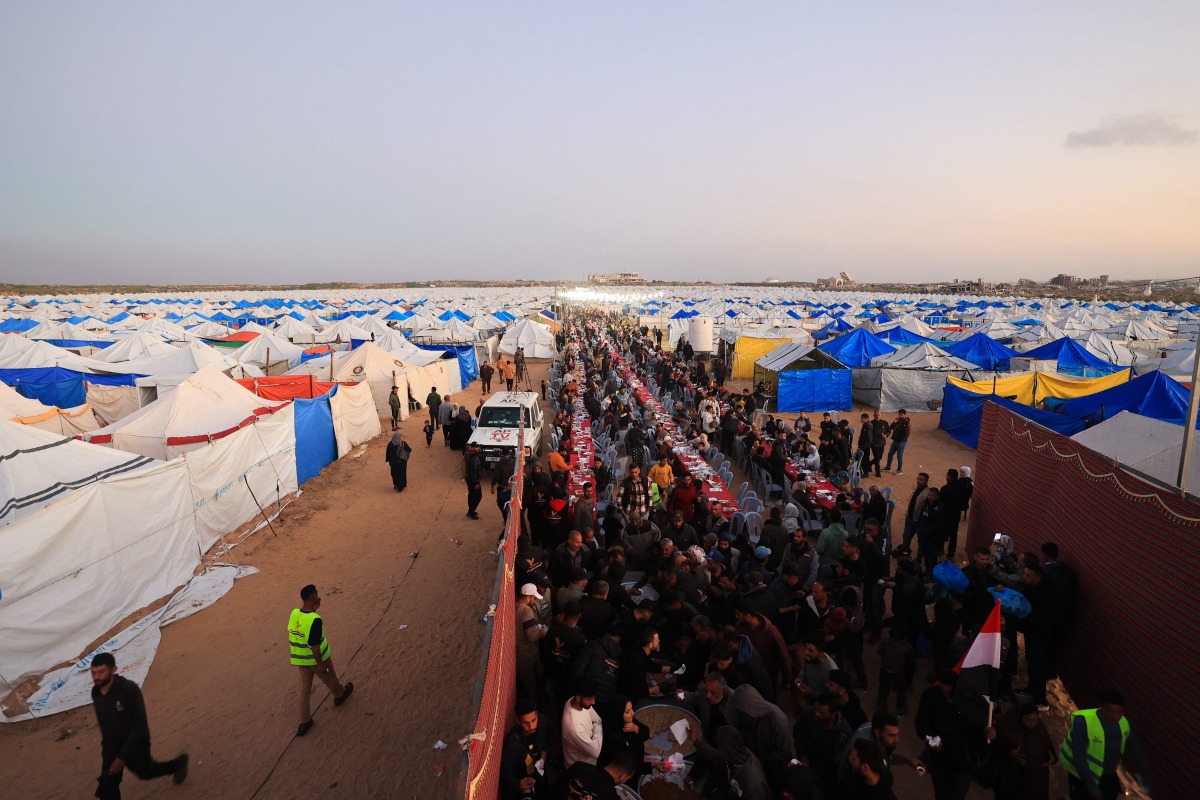
Displaced Palestinian families sit at communal long tables as they gather to break the dawn-to-dusk Ramadan fast during Iftar, in the al-Zahara neighborhood, north of the Nuseirat refugee camp in the central of Gaza Strip on February 21, 2026. (Photo by Eyad Baba / AFP)
Gaza: The people of Gaza receive the holy month of Ramadan for the third consecutive year in the wake of the ramifications of the Israeli occupation's onslaught, as well as the siege that overshadowed all aspects of life amid a humanitarian reality described by UN officials as one of the largest humanitarian catastrophes in this era.
These unforeseen travails were conspicuously reflected in Gaza's markets, purchasing capabilities, and Ramadan rituals, which have always been the hallmark of Gaza, forming a cultural and national legacy as well as a social and spiritual outlet for its people.
At an old stone corner in Gaza's historic Al-Zawiya market, merchant Jamal Yassin stands among the modest contents of his grocery, displaying whatever food and provisions are available and traditionally known in Gaza. Demand from locals is increasing, yet he describes commercial activity as virtually non-existent.
The market is trying to regain its vitality after the massive devastation it suffered over more than two years of war, which obliterated the foundations of the economy and the purchasing power of the people, Yassin told Qatari News Agency.
He added that residents have no cash; market activity is extremely light, and purchases are minimal, because the vast majority of Palestinians are without income or work, effectively forming an army of unemployed.
He noted that some merchandise is available in limited quantities, while essential items remain missing due to ongoing Israeli restrictions on the entry of food and basic supplies.
This has caused prices of the available items to skyrocket to levels unaffordable for the overwhelming majority of Gaza residents, who have been exhausted and burdened by the war's repercussions.
People come to the Ramadan markets, joyful to welcome the holy month and its blessings, but they ask about prices and leave without buying, or purchase only a tiny fraction of what they need.
Overall, the enclave is reeling from a rising unemployment rate, as well as shuttered income sources due to the Israeli carnage that decimated facilities, workshops, commercial centers, and factories, eliminating the very semblance of GDP.
This renders Palestinian families who bore the brunt of the destruction of their homes to live in calamitous conditions inside tents, as well as among debris and bombed-out buildings, incapable of providing all kinds of food necessities for this Ramadan.
Um Mohammed Wadi said that this year's atmosphere-where the Israeli war has halted in its blatant form- may feel better than the past two years in terms of sensing Ramadan's arrival, especially since the Gaza population were tormented by a two-year war, including killing and forced displacement from one place to another.
Yet, she told QNA that inflation and the dearth of essential food supplies continue to torment Palestinian families, who strive to meet their children's nutritional needs in line with the rituals and dietary requirements of the holy month.
While strolling through the Al-Shati Camp market in western Gaza City, Wadi explained that Gazans want prices lowered so they can afford to buy, especially as the past two years brought no Ramadan atmosphere due to fear, hunger, and displacement.
Today, the people of Gaza try to celebrate and feel joy, but skyrocketing prices weigh heavily on them, as the Israeli occupation denies them goods and blocks their entry to the enclave, driving up the cost of the few available items, Wadi said.
However, notwithstanding the economic hardship, some Ramadan symbols- modest and symbolic as they are- try to make a timid comeback.
Lantern seller Mohammed Al-Siqali showcased Ramadan lanterns in multiple shapes and colors on a street-side stall, priced as reasonably as possible.
Seeing children's joy as they hold these lanterns while accompanying their relatives triggers hope that they would offset some of the rituals they had missed throughout the past period, Al-Siqali said, indicating that numerous merchants strive to reduce prices as appropriately as possible to mitigate this tough situation for those hardest-hit Gazans due to war, even if with a tiny profit margin, since most families still cannot afford to purchase a lantern even at a symbolic price.
The lantern, a simple symbol of joy, reflects children's need for a natural space of happiness after enduring fear, displacement, and a war that killed thousands.
Um Ibrahim Barakat, mother of a martyr from Sheikh Zaytoun, greeted Ramadan with pain and determination to preserve its rituals, uphold traditions, and bring joy to her martyr son's children, even to slightly alter their psyche.
Despite losing her home and her son's martyrdom, she insisted on creating a Ramadan atmosphere, refusing to let the children lose the joy of Ramadan.
This Ramadan, Gaza faces a devastated economic reality: destroyed infrastructure, crippled markets and economic establishments, a sharp decline in purchasing power, rising prices, and loss of loved ones. Yet, Gazans cling to hope and strive to revive the month's rituals and customs, no matter the hardship.