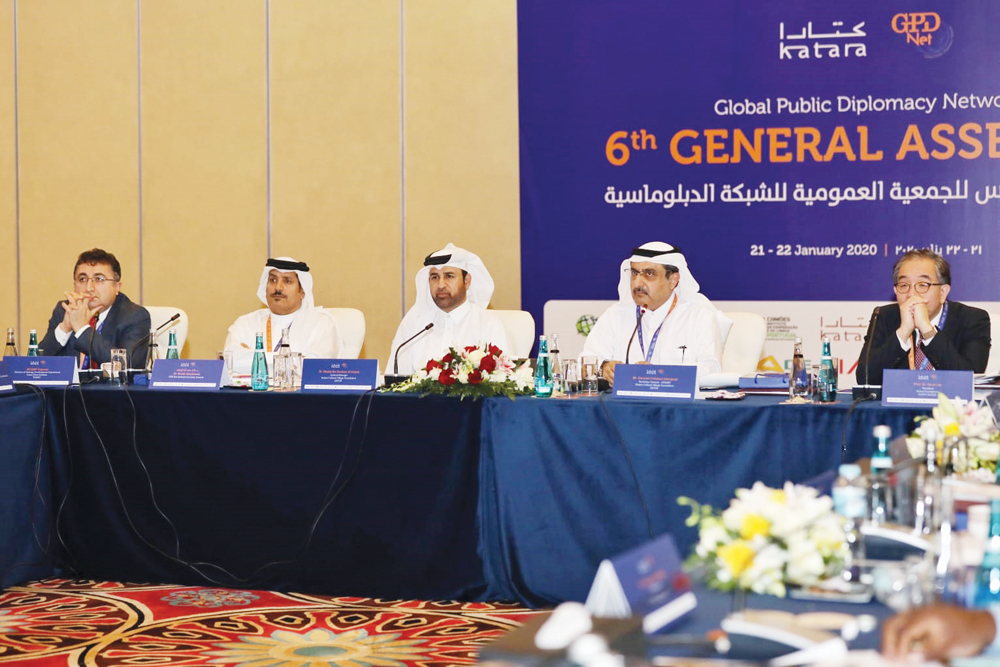
Officials during the meetings of the General Assembly of Global Public Diplomacy Network.
The meetings of the General Assembly of Global Public Diplomacy Network yesterday witnessed the joining of eight new countries to the network’s membership, a development considered a major achievement for the Network and the Presidency of the Network.
Eight new countries submitted their credentials to the General Assembly, namely Bosnia, Cuba, Georgia, Malaysia, Serbia, South Africa, Ukraine and after voting the applications of five countries were accepted as permanent members which are (Cuba, Malaysia, South Africa, Georgia, Ukraine) while the other three countries (Bosnia, Serbia, Kenya) were given status of participating members.
Thus, the number of member states in the Network doubled from nine to eighteen, under the Presidency of the State of Qatar for the International Public Diplomacy Network. Therefore, the activities of the second day witnessed the signing ceremony of the accession of new countries whose membership has been permanently accepted into the Public Diplomacy Network and those countries which have been accepted as participating members.
The meetings of the sixth General Assembly of the International Public Diplomatic Network (GPDnetwork) continued at Katara, headed by Dr. Khaled bin Ibrahim Al-Sulaiti, General Manager of Katara and President of the Global Public Diplomatic Network, in the presence of Darwish Ahmed Al-Shebani, Secretary-General of (GPDNetwork), and Dr. Khaled Aba Al-Zemat, Assistant Secretary General of the Network.
The heads of the official delegations of the participating countries took part in a discussion session that dealt with a series of topics, projects and programs presented by the State of Qatar and the member states. Discussions focused on experiences, exchange of ideas and activating joint work in the field of public international diplomacy. In the first and second sessions of the yesterday’s meeting, members discussed also issues of the agenda including listening to the deliberations of delegations of new countries who applied to join the membership of the network.
The member countries represent specialized cultural institutions related to public international diplomacy programs at the meeting, and specialized teams under the supervision of eminent personalities have achieved wide fame in the cultural sector of their countries.
The general assembly meetings in the third and fourth sessions turned into closed meetings to discuss some important issues, such as the expansion of membership, voting system, proposed programs, and the diplomatic network roadmap after expanding its membership and terms of reference and attracting new members.
While the fifth session talked about the new electronic portal for the general international diplomatic network that was launched yesterday in the presence of the delegations of member states, which is a pioneering initiative for Katara aimed at enabling effective means of communication between the member countries, as the portal provides a flexible and dynamic mechanism for exchanging information, building capabilities and providing all forms of support for cultural events organised by the member states.
In this context, Eng. Darwish Ahmed Al-Shaibani, Secretary General Public Diplomacy Network, said: “After receiving the leadership of the Network, Katara pursues a distinguished strategy in the electronic aspect establishing a portal linking the members and providing many common services to them, in more secure and advanced way.”
He further said that it is based on international standard, specifications, where social media is an essential part of this development.
The Secretary-General of the Public Diplomatic Network added that Katara made great efforts to establish the website of the Network, which is a dynamic mechanism in line with the requirements of the next stage, and keeps pace with the principles of dealing with developments and seeks to implement the goals of social media “ enhancing the cultural role of virtual reality and contributing to the development of societies.”