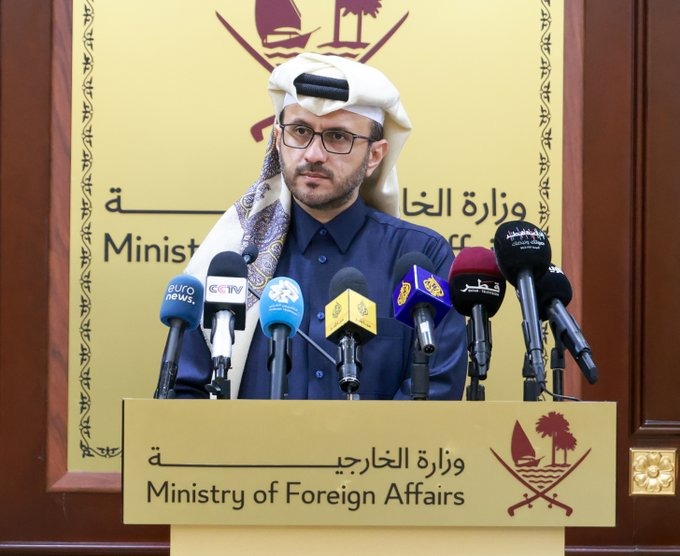
Doha, Qatar: Advisor to the Prime Minister and Official Spokesperson for the Ministry of Foreign Affairs Dr. Majid bin Mohammed Al Ansari emphasised that the State of Qatar's commitment to the Palestinian people will not be affected by any media statements, polarisation, or political stances from any Israeli party.
During the Ministry of Foreign Affairs' weekly media briefing on Tuesday, the Official Spokesperson for the Ministry of Foreign Affairs said that the Israeli stance will not deter the State of Qatar from supporting the brethren in the Gaza Strip, in light of what is being circulated regarding Israel's rejection of the State of Qatar's presence through its representative in the Gaza Executive Council. He stressed that Qatar's presence in this matter is not incidental or temporary, but rather reflects the State's involvement in mediation in this matter from day one.
He highlighted Qatar's disregard for these political or media stances from the Israeli side, adding that Doha is communicating with the American side clearly in this regard and Qatar's role in this file is internationally welcomed. He pointed out that Israel's refusal to allow the technocratic committee (the administrative committee) that was announced, along with the Peace Council and the Gaza Executive Council, to enter the Gaza Strip should be met with pressure from the international community on the Israeli government to implement the terms of what was previously agreed upon at the international level within the terms of the ceasefire and the plan of US President Donald Trump.
He stressed that the State of Qatar has been committed from the beginning to supporting the Palestinian people and the residents of Gaza and has been involved in all aspects of resolving this conflict, whether through mediation to release hostages and exchange Palestinian prisoners, or through the humanitarian aspect related to aid, or through the twenty-point plan and the efforts led by the United States to end this war. He pointed out that the appointment of Advisor to the Prime Minister for Strategic Affairs HE Ali Al Thawadi as the representative of the State of Qatar in the Gaza Executive Council, along with representatives from several countries, came based on the roles that Qatar played in the previous stage of the ceasefire efforts, as well as to play an active role during the subsequent stage of the agreement that was reached in Sharm El Sheikh according to the Trump plan.
He said that the appointment of a representative of the State of Qatar to the Gaza Executive Council confirms Qatar's commitment and its internationally recognised role in supporting the brothers in the Gaza Strip. He stressed that Qatar is not an independent actor and bears responsibility within an international effort to end the war in Gaza and support the Palestinian people, and that talk about the possibility of its joining the Gaza Peace Council announced by the White House will be decided collectively with partners around the world and not individually.
He added that Qatar has been involved in the Gaza file since day one and is also involved within the framework of the twenty points of US President Donald Trump's plan. It was one of the parties that signed the agreement in Sharm El Sheikh and contributed to the full implementation of the first phase of the agreement. The announcement of the second phase through the formation of councils and committees for Gaza comes within this phase. Therefore, the formation of the Gaza Peace Council and membership in it is still subject to consultations among several countries led by the United States of America.
He pointed out that the structure that was implemented through the formation of the Peace Council, the Gaza Executive Council and the Technocrat Committee is not a Qatari invention, but rather an agreement reached between a large number of countries led by Washington to reach this structure within the framework of implementing the ceasefire agreement and President Trump's plan.
Dr. Al Ansari noted that the formation of the Peace Council, the Gaza Executive Council, and the Administrative Committee is one of the requirements of the second phase, and the issue now lies in the commitments of the Israeli side, which must be pressured, along with all parties, to adhere to the terms of the agreement and implement the second phase directly.
He indicated that the obstacles that are being recorded in the implementation of the second phase, such as ceasefire violations and preventing the administrative committee from entering Gaza, are being addressed with the mediation partners in accordance with the terms of the agreement and President Trump's plan.
Regarding the work of the United Nations Relief and Works Agency for Palestine Refugees (UNRWA) in the Gaza Strip, the Advisor to the Prime Minister and Official Spokesperson for the Ministry of Foreign Affairs pointed out that the obstruction of the agency's work by the Israeli side makes life more difficult for the Palestinian people and threatens the international system and multilateral action. He stressed that the State of Qatar continues to support the agency on the material, moral and political levels, and calls on international partners and the international community to support the United Nations agencies in carrying out their tasks and not to allow any party to endanger or attack these tasks.
Regarding the tensions in the region, particularly between the United States and Iran, Dr. Al Ansari stressed that any escalation in the region would have dire consequences for the region in general, the effect that was seen last year. He said that the State of Qatar, along with its partners, strongly supports any diplomatic avenue to resolve the crisis and spare the region any escalation, especially since it is in constant contact with the United States on various issues and its position is clear regarding the escalation in the region.
He underscored that communication is taking place at the international level for this purpose. Therefore, the responsible American position has spared the region this escalation during the past days, and Qatar is still working with the parties, and communication channels are open to try to ensure that any escalation is avoided, especially in light of the continuous escalation during the past two years in the region, which has witnessed since 2023 a cycle of tensions that have cost many lives and created unbearable humanitarian conditions. Therefore, Qatar stands firm in its approach toward diplomatic solutions for all conflicts and all disputes in the region and beyond, and on the same permanent approach.
Advisor to the Prime Minister and Official Spokesperson for the Ministry of Foreign Affairs Dr. Majed bin Mohammed Al Ansari noted that Qatar is following the developments of the renewed escalation and is fully engaged with all parties.
He said Qatar has played a role in the past when it came to communications with Iran and the United States and reached interim agreements on a number of issues, expressing his hope that it will be possible to play that role now as well and that channels of communication remain open.
He said in this context that Qatar is in contact with both sides at this moment regarding that, pointing to the communications undertaken by Prime Minister and Minister of Foreign Affairs HE Sheikh Mohammed bin Abdulrahman bin Jassim Al-Thani, with Iran's Minister of Foreign Affairs HE Dr. Abbas Araghchi, in addition to communications with the United States of America and regional leaders, which focused on how to stop this escalation and work together to resolve many issues in the region through dialogue.
He highlighted that it is not important to focus on (who convinced whom) regarding a possible US strike on Iran last week; rather, the focus should be on the fact that the voice of reason ultimately prevailed, and Qatar is in a position where it continues to follow up and engage with all regional and international parties within the framework of de-escalation and working on a positive roadmap to emerge from any escalation.
Regarding developments in the Syrian file and the recent agreement that provides for the integration of the Syrian Democratic Forces into the Syrian National Army, Al Ansari explained that the Syrian people are currently in a new phase and everyone must exercise sufficient responsibility to ensure that weapons are in the hands of the state, and that there are understandings on the table of dialogue that guarantee the rights of all in Syria equally.
He expressed Qatar's welcome for this agreement and considered it a positive step toward achieving stability, calling for the inclusion of all components of the Syrian people in the state, stressing that Qatar will always remain supportive of the brothers in Syria on both economic and political levels.
Al Ansari began the media briefing by reviewing the political activities of the Ministry of Foreign Affairs during this week, including the Prime Minister and Minister of Foreign Affairs' visits to Jordan and Libya and his meetings there and, most recently, his current participation in the Davos Forum, as well as the contacts and meetings he held in Doha, including the phone call he made with Foreign Minister of the sisterly Kingdom of Saudi Arabia HH Prince Faisal bin Farhan bin Abdullah Al Saud, and the phone call he received from Minister of Foreign Affairs of the Islamic Republic of Iran HE Dr. Abbas Araghchi, and also the call he received from High Representative of the Union for Foreign Affairs and Security Policy and Vice President of the European Commission HE Kaja Kallas, and Minister of Foreign Affairs of the Republic of Cyprus HE Dr. Konstantinos Kombos, which currently chairs the Council of the European Union, all in the context of the tensions the region is witnessing, alongside developments in the occupied Palestinian territories.
He also discussed the activities of Minister of State at the Ministry of Foreign Affairs HE Dr. Mohamed bin Abdulaziz bin Saleh Al Khulaifi, including his meeting in Doha with Special Assistant to the Japanese Minister of Foreign Affairs and Ambassador in charge of the reconstruction of the Gaza Strip, HE Okubo Takeshi, where they discussed developments in the situation in the Strip, especially on the humanitarian side and the implementation of the second phase of the ceasefire launch agreement, in addition to his meeting with Director-General of the National Security Council of Malaysia HE Nushirwan bin Zainal Abidin, where they discussed cooperative relations between the two countries and ways to support and enhance them and discussed the latest developments in the Asian continent, along with a number of topics of mutual interest.