

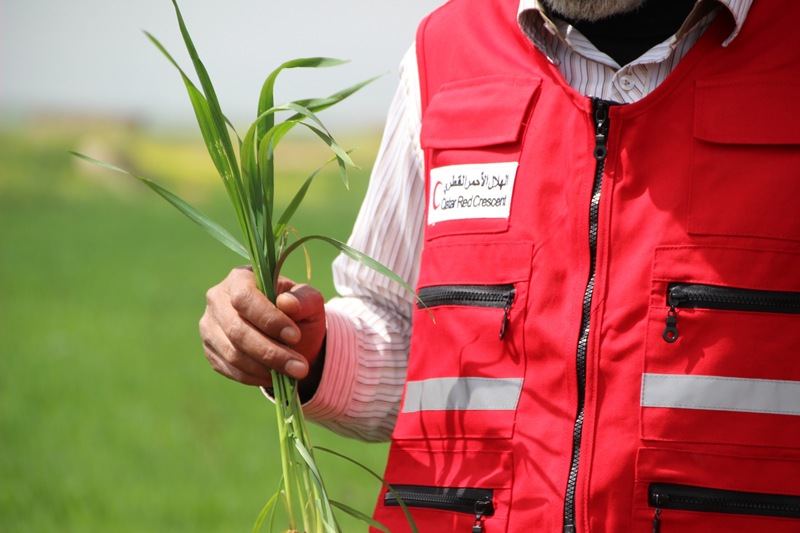
Doha: Building on the exceptional success last year, Qatar Red Crescent Society (QRCS) has completed this year's project of supporting wheat crop growing in Syria, covering 2,340 hectares of agricultural land in six governorates.
The project aims at solving the problems facing farmers in relation to securing agricultural input and marketing their production.
In total, 1,560 farmers benefited from this project, each cultivating 1.5 hectares. The distribution of cultivated lands was as follows: Aleppo 30%, Idlib 20%, Homs 15%, Hama 15%, Daraa 15% and Rif Dimashq 5%.
The work was done in partnership with the General Organization for Seed Multiplication (GOSM) and Al-Sham Amana, a Syrian NGO. Five offices were established and 20 agronomists were hired to supervise the implementation of the project in the six governorates.
At an overall cost of $1,550,000 (QR5,641,690), the crops were harvested as of June 2016, with an estimated production of 9,360 tons of wheat. QRCS will purchase 60% of the crops, while the beneficiaries will retain 40%. Some portion of the wheat will be used in producing bread, another portion will be purified and resold to the farmers at minimal prices for the coming season, and a third portion will be utilized in expanding the targeted agricultural lands, in an attempt to preserve and restore the wheat species of Syria.
In his remarks, QRCS Executive Director, Fahad bin Mohammed Al Naimi, said: “This development project was launched in the 2014-2015 wheat crop season. It is designed to support the growing of wheat as an important crop, trying to increase its production to acceptable levels that can alleviate the everyday suffering of the Syrian people, who can no longer rely on the already insufficient assistance from the international community, which leaves Syrians idle and dependent on foreign aid".
The purpose of the project, Al Naimi explained, is to encourage the farmers to cultivate their abandoned lands, increase wheat production in target regions as a strategic food item, create many work opportunities for jobless agricultural laborers, end wheat monopoly in farming areas, and lighten the burden on humanitarian organizations by shifting from relief to resource development.
"To ensure success, we coordinated closely with the other organizations supporting wheat crop farming to avoid duplication, we also provided the farmers with 585 tonnes of seeds and 585 tonnes of fertilizers. The results were marvelous, and we are determined to go on with this noble humanitarian endeavor for the benefit of our Syrian brothers," he added.
Al Naimi revealed plans to establish a specialist center for restoration of wheat species of Syria.
The Peninsula









