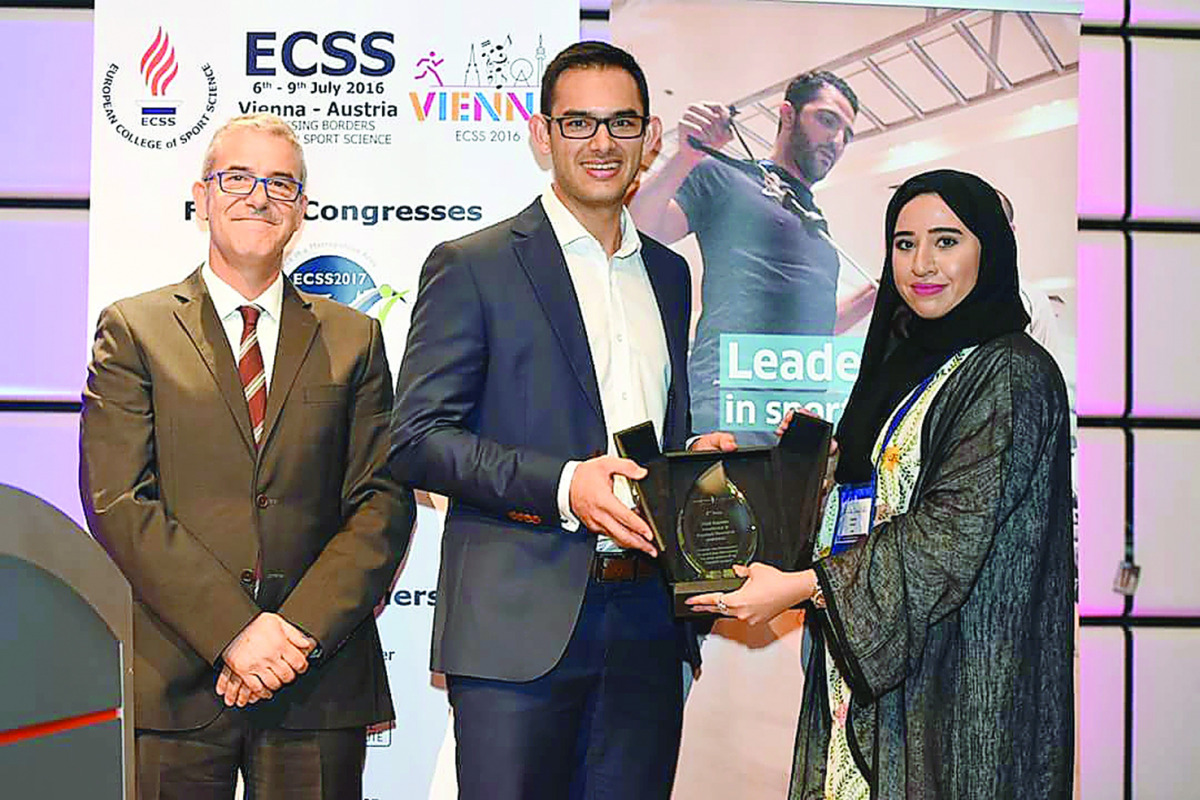
Doha: Aspetar, the orthopaedic sports medicine hospital in Qatar, has concluded participation in the 21st edition of the European College of Sport Science (ECSS) Congress held in Vienna, Austria.
Aspetar has a three-year partnership with the ECSS congress that aims to enrich the industries of sports science and medicine by providing a platform for researchers from around the globe to exchange knowledge, insights and expertise around a number of topics related to sports science and medicine.
Dr. Muhammad Ghaith Al Kuwari, Acting Director General, Aspetar, said: “The aim of the award is to attract and support novel, applied research projects with relevance to football, thereby stimulating more research on applied science with potential applications to the football pitch. It also help us identify talented experts and researchers in line with our vision to be a global leader in sports medicine and exercise.”
A select group of Aspetar’s specialised experts including Shaima Al Khaldi, Assistant Director of Exercise & Sports Science; Abdulla Al Mohannadi, Health Researcher; Dr. Julien Periard, Research Scientist; Dr. Richard Allison, Senior Sports Dietitian; amongst others, represented the hospital at the Congress.
Aspetar announced the winners of Excellence in Football Research Award. The first place went to Mitchell Smith from Australia for his research project Mental Fatigue Impairs Soccer-specific Performance.
The winner of the second place award was Francesca Champ from UK for her research paper Reflections from a Female Sport Psychologist Working in Elite Level Professional Football.
Roland Rossler from Switzerland received the third awards for his research on FIFA +11 KIDS: A Warm-up Programme to Prevent Injuries in Children’s Football.
Aspetar’s experts took part in several sessions that covered topics including the influence of hyperthermia and hypoxia on performance and pacing; the limits presented by extreme hot climatic on physical activity; factors influencing Qatari women to adopt physically active lifestyles; the relationship between Vitamin D and bone health; in addition to sharing Aspetar’s latest research on hypoxia. Aspetar also sponsored a session on ‘Heat and Altitude Training for Elite Athletes’.
The four-day Congress combined various sessions including workshops, discussion panels and lectures on sports science and medicine with the aim to explore areas of collaboration in future research projects, and give early stage researchers an opportunity to network with more established counterparts.
The Peninsula