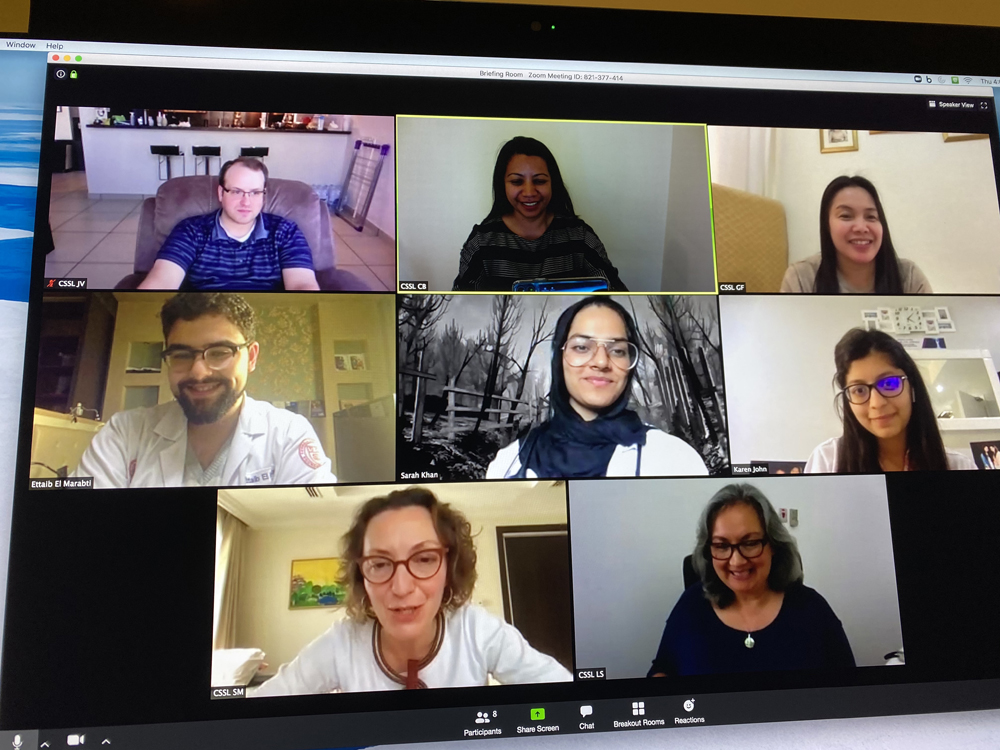
Weill Cornell Medicine–Qatar students during a session held via video conferencing.
Weill Cornell Medicine – Qatar (WCM-Q) may have closed the doors of its building to faculty and students due to the coronavirus pandemic but teaching the next generation of doctors must continue — and has never been more important.
Online education presents new challenges, though, particularly when teaching clinical skills, an area of the curriculum that often demands practical experience as well as theoretical knowledge.
WCM-Q faculty, staff and students have risen to the occasion, however, allowing lessons to continue as planned, albeit digitally.
Dr. Moune Jabre, senior attending physician in obstetrics at Sidra Medicine and the director of WCM-Q’s obstetrics and gynaecology clerkship, said she and her colleagues have been able to deliver the entirety of the planned curriculum so far, and there have even been some unintended positive consequences, such as an introduction to the role of telemedicine.
Dr. Jabre said that using online video conferencing apps has allowed students to deliver oral presentations and that practical work can still be taught and learned by assigning clinical cases and diagnostic imaging cases for online self-review. The trainee doctors continue to have full access to their professors for feedback and support through virtual meetings.
Dr. Stella Major, associate professor of family medicine in clinical medicine and director of WCM-Q’s Clinical Skills and Simulation Lab, said she and her team have also used online resources to continue the clinical skills curriculum.
Dr. Major said: “Using video conferencing, simulated patients and a variety of simulation-based educational models, we have started supporting clinical skills teaching and assessment remotely. Students feedback has been very positive, as this has offered them a chance to be exposed to telehealth.”
She said that students have used telemedicine skills to conduct thorough case histories with standardized patients, as well as learning how to counsel patients on smoking cessation and delivering bad news.
But once the pandemic is over, everyone agrees that students will have follow-up sessions and real-patient clinical skills instruction to ensure they have the correct practical examination skills.
For the obstetrics/gynaecology clerkship, Dr. Jabre explained how she plans to have students attend a practical exam skills session in the Clinical Skills and Simulation Center for physical examination competence in gynaecology. The students will watch instructional videos first then have a practice session followed by a competency check station for each skill.
This determination to overcome the challenges presented by COVID-19 has been praised by Dr. Thurayya Arayssi, professor of clinical medicine at WCM-Q and senior associate dean for medical education and continuing professional development.