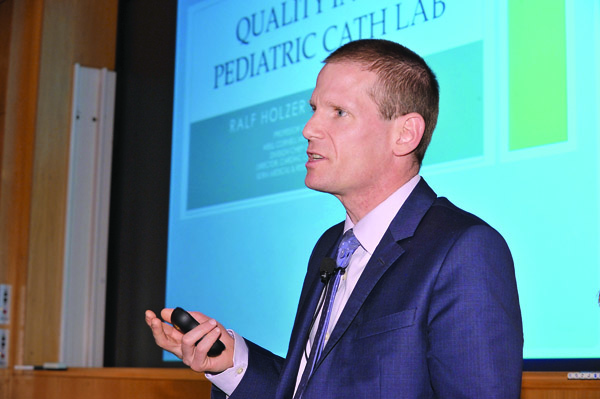
Doha: The question of how to ensure quality assurance in catheter procedures in children was the topic of this month’s Grand Rounds lecture at Weill Cornell Medicine – Qatar (WCM-Q).
Cardiac catheterisation in infants and children is a medical procedure to diagnose and treat certain heart conditions. It involves an interventional cardiologist placing a long thin tube into a blood vessel that leads to the heart.
Dr Ralf Holzer (pictured), Director, Cardiac Catheterisation & Interventional Therapy, and Acting Division Chief Cardiology, Sidra Medical and Research Centre, told healthcare professionals at WCM-Q that prior to 2003 there were no standardised processes for reporting outcomes and risk adjustment in cardiac catheterisation.
This began to change when Boston Children’s Hospital started to record detailed data from its procedures and used it to compare outcomes between operators.
Other institutions joined the initiative and formed the ‘Congenital cardiac catheterisation Project on Outcomes’ (C3PO), a prospective registry on catheterisation procedures, he said.
“Until the first research paper was released, I was unable to tell patients the exact chance of an adverse effect happening, but following that I was able to give patients and families very specific numbers. This meant that families and patients were able to get informed consent.”
Dr Holzer said every hospital could begin quality assurance and improvement programme by collating information on a local level and ensuring it is monitored and shared with physicians and the management.
He said data capture should be consistent but quality assurance and continuous quality improvement should not be seen as punitive. Instead it should be seen as a method of allowing individuals and programmes to identify potential areas for improvement.
Dr Thurayya Arayssi, Associate Dean, Continuing Professional Development, said: “Quality assurance and improvement is at the heart of continuing professional development. The Grand Rounds series is a great vehicle through which we can share knowledge and ensure that we are continually learning and improving to provide the patient with the very best of healthcare.”
The Peninsula