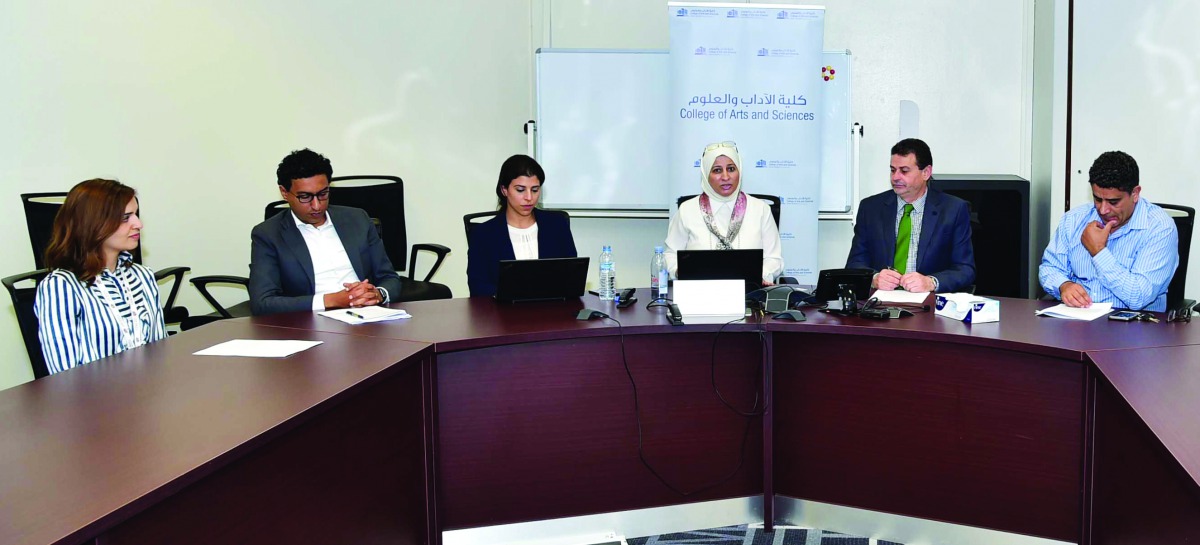
The faculty of QU-CAS outlining the details of the upcoming ‘Sustainable Development Conference’ at a press conference.
DOHA: The College of Arts and Sciences at Qatar University (QU-CAS) announced its first “Sustainable Development Conference” at a press conference recently.
Details of the 2-day conference (March 26-27) were outlined by Assistant Professor of Urban Planning and Development at CAS Department of International Affairs and the conference’s Organising Committee Chairperson, Dr Esmat Zeidan; Assistant Professor of International Relations at CAS Department of International Affairs and member of the conference’s organising committee, Dr Mazhar Zoubi; Assistant Professor of Research at CAS Center for Sustainable Development and member of the conference’s organising committee, Dr Mohamed Saidi; CAS Assistant Professor of Mathematical Sciences and member of the conference’s organizing committee, Dr Lina Al Majed; and Associate Professor of Sociology at CAS Department of Social Sciences, Dr Maher Khalifa, in the presence of CAS faculty and staff and representatives of the local media.
Dr Esmat Zeidan noted that the conference will focus on the steps undertaken by Qatar in 2008 for the transition to sustainability in line with the goals of Qatar National Vision 2030.
She said: “If sustainable development is to be achieved in Qatar, it will require significant changes in key sectors like energy, water and agriculture. This aligns with the global sustainability agenda which focuses on green economic growth, decarbonisation and decoupling growth from the use of vital natural resources like water, energy and land.”
“Qatar has shown a strong commitment towards the implementation of global sustainability agreements such as the Sustainable Development Goals (SDGs) or the Paris Agreement,” she added.
Dr Mazhar Zoubi said: “The comprehensive and multi-layered concept of sustainable development has been recognized globally and is incorporated in the national development visions across the Gulf region. Ambitious national visions in the Gulf regions address economic transformation challenges towards knowledge-based economies, infrastructure modernization, investments in education and health, the use of renewable energies, and decreasing the large ecological footprints of consumption and production.”
Dr Mohamed Saidi said: “Qatar’s aquatic and terrestrial ecosystems represent a vital resource for development and national identity. For example, throughout history, coastal ecosystems have had vital importance for food security, recreation, tourism, and as habitats for wildlife.
At the same time, the human or built infrastructure relies on resources exploited offshore such as desalinated water and fossil energy. In order to protect and preserve the environment, Qatar has put forward one of most advanced visions in the region with regard to the environment.
“The Qatar National Vision 2030 has been driving the debate on sustainability for a decade now, leading to tangible success in protecting air, land, water, and biological diversity.”