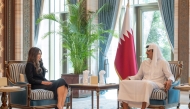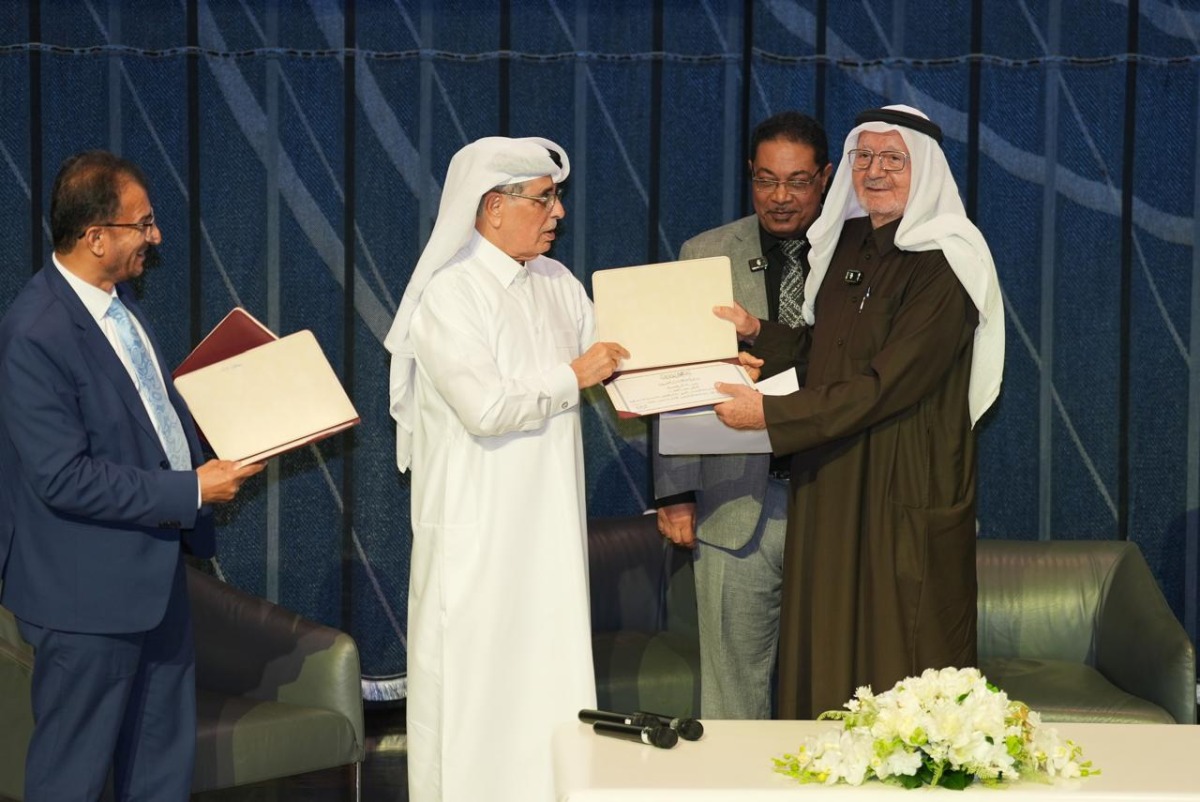
Minister of State and President of Qatar National Library H E Dr. Hamad bin Abdulaziz Al Kawari with other officials and guests during the event.
Doha, Qatar: Qatar National Library hosted a cultural seminar titled “The Arab Book in General and the Qatari Book in Particular: A Foresight Reading,” organised in cooperation with the Arab Book Award. The seminar brought together a distinguished group of intellectuals and cultural figures.
The event was held to mark World Arabic Language Day, observed annually on December 18, and as part of the Arab Book Award’s efforts to stimulate cultural activity, support the book industry, and open professional discussions on the future of publishing in the region.
The seminar opened with an eloquent literary address inspired by the classical maqamat tradition, delivered by Minister of State and President of Qatar National Library H E Dr. Hamad bin Abdulaziz Al Kawari. In his remarks, he recalled the deep-rooted foundations of the Arab book and skillfully linked the authenticity of Arab heritage with future aspirations for Arabic publishing.
The seminar featured contributions from academic and historian Dr. Mustafa Aqeel Al-Khatib; Dr. Al-Siddiq Omar, a member of the Steering Committee of the Arab Book Award; and Dr. Aisha Jassim Al-Kuwari, Chief Executive Officer of Rosa Publishing House. The session was moderated by Dr. Mohammed Khaled Al-Rahawi, Associate Professor of Arabic Language at Qatar University.
The discussion began with the first thematic axis focusing on quality standards, presented by Dr. Al-Siddiq Omar Al-Siddiq, a member of the Arab Book Award committee. He emphasised that the challenges facing the Arab book are closely linked to the broader state of weakness afflicting the Arab world, noting that genuine advancement can only be achieved through serious knowledge and scholarship.
He explained that much contemporary Arab authorship tends toward narrative and fiction, with a limited number of high-quality works, alongside a noticeable decline in rigorous academic studies in the humanities, social sciences, philosophy, Islamic studies, history, as well as in critical text editing, dictionaries, and encyclopedias.
He added that the Arab Book Award was established to strengthen the status of the Arab book and encourage authors and researchers to produce robust scholarly works through its two categories, “Single Book” and “Lifetime Achievement”, thereby contributing to both the quantitative and qualitative advancement of Arabic publishing.
Dr. Mustafa Aqeel Al-Khatib, winner of the Arab Book Award in its first edition, affirmed that literary and academic awards serve as an important incentive for writers and authors and do not restrict creativity.
He noted that the Arab book continues to suffer marginalisation in many regions, and that a large segment of those under the age of twenty are unfamiliar with prominent figures of modern Arab thought and culture. He stressed that the Arabic language is distinguished by its stability and enduring nature, making it a language of civilization, culture, and thought, rather than merely a tool for communication. Dr. Aisha Al-Kuwari stated that the Arab book industry faces challenges that go beyond production volume to include distribution, impact, and sustainability.
She explained that the industry constitutes an integrated ecosystem encompassing the writer, publisher, reader, and supportive cultural policies. She identified limited distribution, high production costs, and declining reading rates, particularly among young people, as key challenges, calling for a restructuring of the publishing system without compromising the quality of Arab creativity.