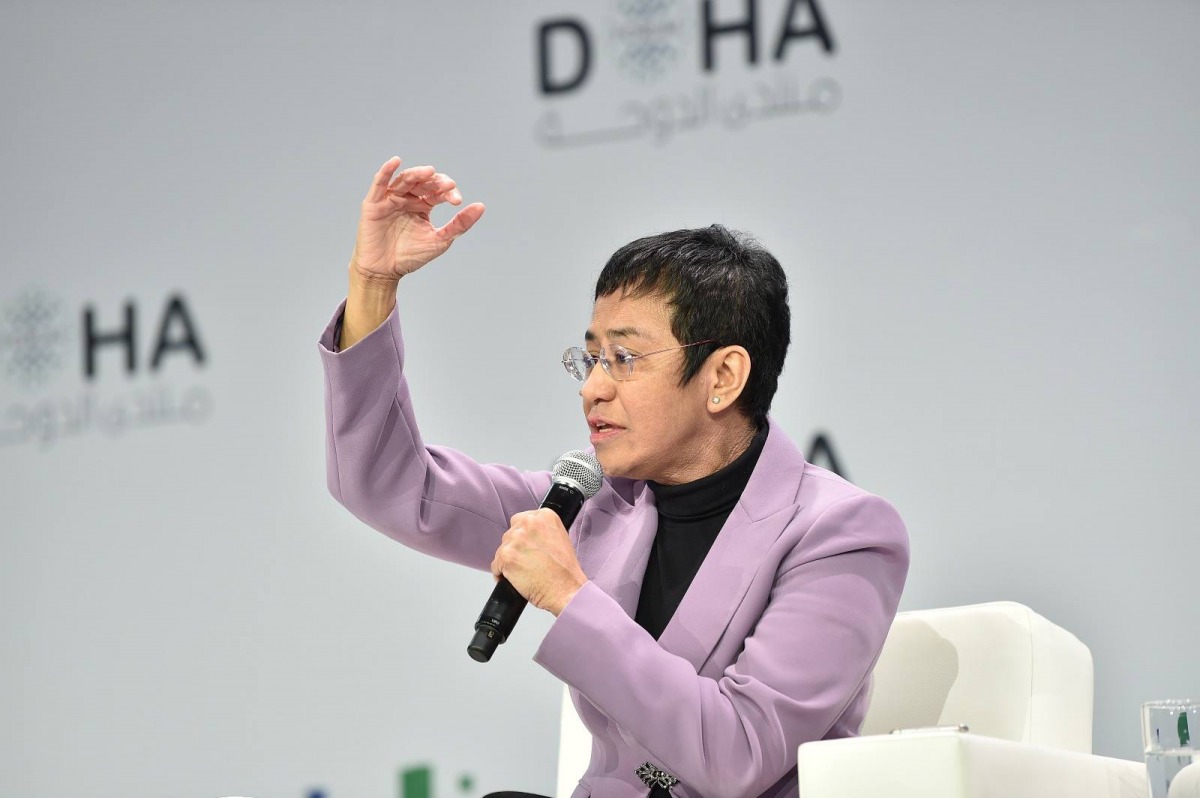
Veteran Filipina journalist and Time 2018 Person of the Year Maria Ressa speaks at a plenary session at the 18th Doha Forum.
Doha: Veteran Filipina journalist Maria Ressa, one of the journalists recently named Time Magazine’s 2018 Person of the Year, has underlined that journalists and democracies are increasingly coming under attack as social media platforms are weaponised using fake news.
“We all believe information is power but information ecosystem is broken. Journalists are under attack because we are the frontline to protect democracies and democracies are under attack,” Ressa, who is Executive Editor of Rappler, said during a plenary session at the 18th edition of Doha Forum.
Moderated by Al Jazeera English anchor Peter Dobbie, the session titled “The Targeting and Demonization of Journalists and News Outlets: What Should Be Done?” also featured Committee to Protect Journalists board member David Schlesinger, and former White House spokesman Sean Spicer.
“Being a journalist has always been a dangerous profession. Journalists have been killed in pursuit of the truth. What is particularly worrying now is that journalists are being targeted for their stories as a way of silencing them,” said Schlesinger.
There are 251 journalists in prison around the world for their reporting and 52 journalists were killed last year, added Schlesinger, while talking about how fake news had been used to attack journalists.
Ressa defined fake news as “something that has been embedded on social media when social media is weaponised.”
“I think our world is so infested with information warfare that people have no idea they are being manipulated through social media. Violence online moves into the real world. Repeated incitement to hate on social media tends to erupt in the real world,” said Ressa.
She underlined how that the problem lies in the fact that social media allows fact and fiction to exist simultaneously and allows fiction - the lies - to spread faster.
“In the US, over 69 percent get their news from Facebook, in the Philippines it’s 97 percent. I think the biggest problem we have now is that Facebook unites 2.3 billion people around the world.
You no longer have boundaries of nation states. A lie seeded in one country reaches all of us,” she explained. Schlesinger reminded people to be discerning about where they get their news even if platforms give a fire hose of information.
“They have to be able to separate those who do the work of professionalism from those who don’t, those who deal in facts to those who deal in fiction. We in the journalism side have responsibility as well, but bottom line is journalism is not a crime, journalism is not worthy of a death sentence for anybody,” said Schlesinger.
Speaking to local media after the session, Ressa, said: “It’s great, fun and very interesting. I’ve known David for a while and I’d only seen Sean onstage at the White House. I think what’s interesting here is it’s a whole different part of the world that I know, and understanding and seeing how all the power structures have been affected has been amazing.”
On her message to Filipino journalists in the Middle East, she said: “Keep track of what’s going on in the Philippines. Lines are moving all the time and I think that we need to make sure that we do our jobs to tell people when we cross the line.”