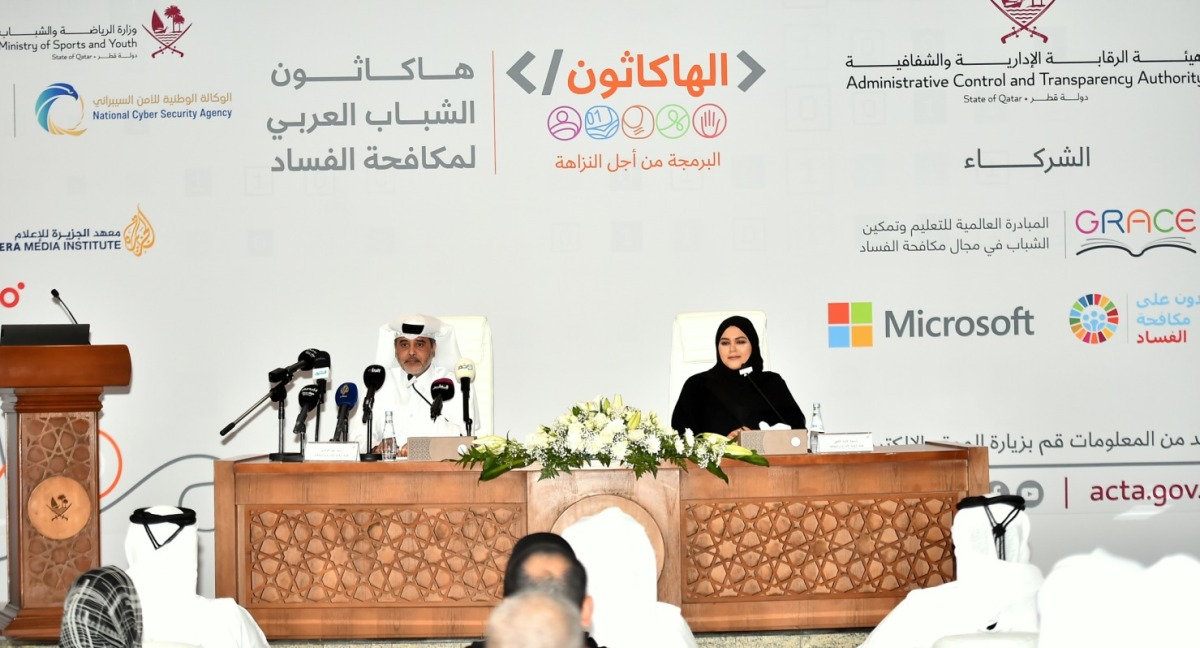
Doha, Qatar: The Administrative Control and Transparency Authority (ACTA) held a press conference to announce the details of the launch of the "Arab Youth Anti-Corruption Hackathon" which will be organized from Sep. 10 to 14 in partnership with the United Nations Office on Drugs and Crime (UNODC) and Microsoft Qatar.
Arab Youth Anti-Corruption Hackathon initiative aims to seize the energy and potential of youth to innovate and develop technological solutions for corruption-related problems that affect their communities, as it combines digital innovation and social entrepreneurship.
The "Coding4Integrity'' initiative "Arab Youth Anti-Corruption Hackathon" provides an opportunity for Arab youth from 18 to 30 year-old to expand their knowledge of corruption-related topics and enhance their social, leadership and technical skills.
On this occasion, Director of Public Relations and Communication Department at ACTA Eid Saeed Al Hajri said that ''the Hackathon highlights the efforts of the State of Qatar and the UNODC in combating corruption and promoting transparency, in addition to enhancing the spirit of innovation and creativity in areas related to the effective fight against corruption, and the effective role of Microsoft in supporting such efforts globally.''
He considered this conference as an essential platform for providing updates on the developments of the Hackathon, the efforts made by the participating teams, and the upcoming stages that the Authority is currently preparing for, as the launch of the Hackathon comes in response to the growing interest in the field of digital innovation as an incentive for youth action against corruption.
He emphasized ''the involvement of the relevant national authorities in this event, which will contribute to achieving the desired goals of the initiative, noting that the Arab Youth Anti-Corruption Hackathon was launched in 2021 to invest the energies and capabilities of young people to innovate and develop technological solutions for corruption-related problems, which negatively affect their local communities."
Al Hajri pointed out that "Hackathon represents a valuable opportunity to promote a culture of integrity and combating corruption in the Arab region, expressing their enthusiasm to cooperate with their partners in success, to achieve common goals by hosting the Hackathon."
For her part, ACTA's Media Spokesperson for Hackathon event Fayza Sinan Al Kaabi said, ''the registration process witnessed a great turnout, with a total of 1299 participants, representing 17 Arab countries."
She explained, ''119 participants were selected at the end of the final confirmation stage and the formation of the team, including 60 young women, pointing out that the participants were distributed in 26 Hackathon teams."
Al Kaabi indicated that "there are 15 participants from the State of Qatar, a number that clearly shows the interest of Qatari youth in learning about the anti-corruption mechanism and using their skills in computer programming to proactively support the implementation of the United Nations Convention against Corruption (UNCAC), as the Hackathon participants will be asked to develop an idea or solution based on information and communication technology that addresses one of the challenges related to combating corruption and promoting integrity in the Arab region."
ACTA's Media Spokesperson for Hackathon also discussed the challenges of transparency in public procurement processes, encouraged whistleblowing and established mechanisms to protect whistleblowers, protect sports from corruption, report corruption related to water management, enhance the ability of the private sector to confront corruption, and innovation in education. She noted that the first-place winning team will have the opportunity to present its work on …